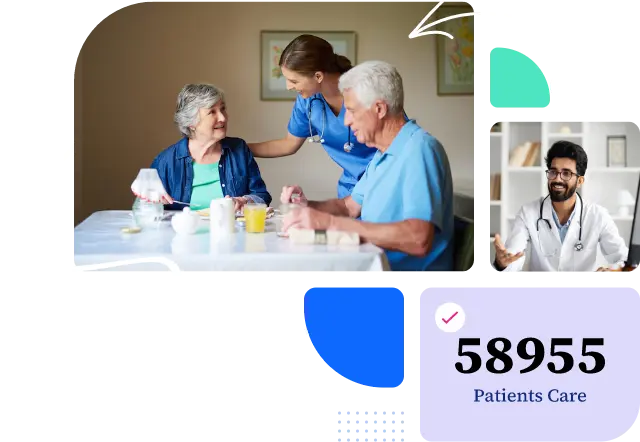

One care coordination platform for every CMS program your practice bills. Physical health, behavioral health, medication review and post-discharge follow-up run in the same chart, so your clinicians stop rebuilding the patient story in four places.

Enable virtual care for clinicians

Enable virtual care for clinicians

Your care team sees device readings, care-plan status, time logged and open alerts on one screen. There’s no tab-switching between an RPM tool, a CCM tool and a spreadsheet. When a patient moves from a hospital stay into TCM and then into monthly CCM, the record follows them.


1

Request a software demo.

2

Go live in about 30 days, not two quarters.

3

Bill the program. Show the outcome. Keep the contract.

Care coordination that reaches the patient at home

Connected devices send readings without the patient opening an app. When a blood pressure or glucose value crosses the threshold you set, the care team gets the alert the same day. That’s what turns a monthly check-in into an actual intervention.

Care coordination that reaches the patient at home
Bringing it all together

Bringing it all together

Coordination doesn’t usually fail at the visit. It fails in the gaps: the discharge nobody followed up, the medication change nobody logged, the missed reading nobody chased. Keeping every program in one record with one audit trail is how those gaps close. There’s a billing reason to want that too: CMS does not let the same minutes count toward two care management codes in the same month, and a practice running CCM in one system and RPM in another has no reliable way to prove it never double-counted. One time log across all programs is the cleanest answer to that question when an auditor asks it.

HealthArc’s Approach to Care Coordination

Step 1 - Advocate

Step 1 - Advocate

We work as an extension of your practice, under your supervising provider’s name and NPI. Your clinicians keep every clinical decision. We handle the follow-up work that eats their week.

Step 2 – Access

Step 2 – Access

We track whether a patient is actually getting better or quietly getting worse, month over month. Trend lines beat a single office reading every time. That matters most in the first 60 days after enrollment, when a patient is still deciding whether the program is worth the effort.

Step 3 – Monitor

Step 3 – Monitor

Readings come in daily. Care plans get written, updated and time-stamped against the CPT code they support, so the billing record is built as the work happens.

Step 4 – Connect

Step 4 – Connect

Someone calls the patient. That’s the part most platforms skip. We ask what changed, update the plan around what the patient will realistically do, and push the note straight into your EHR encounter record.

Frequently Asked Questions

What is HealthArc’s approach to care coordination?

Four stages, and they run continuously rather than once at enrollment:

  • Advocate: Advocate. We’re an extension of your team, working under your provider’s NPI.
  • Access: Access. We track each patient’s condition over months, not visit to visit.
  • Monitor: Monitor. Daily readings, threshold alerts, time-stamped care plans.
  • Connect: Connect. Real phone calls with patients, and the notes push back into your EHR.
How does HealthArc's care coordination improve patients' outcomes?

Care teams see readings between visits instead of waiting 90 days for the next appointment. If a hypertensive patient’s pressure climbs for four days straight, someone calls that week. Most of the outcome gain in care coordination comes from that shortened reaction time, not from the dashboard itself.

Can HealthArc's care coordination services be personalized to the needs of patient?

Yes. You set the alert thresholds, care-plan templates and escalation rules per condition and per provider, and they can differ patient to patient. Plans get revisited on every monthly call rather than written once and left alone.

How does HealthArc support clinicians in the care coordination process?

You choose how much of the work we take. Software-only means your staff runs the program on our platform. Managed services means a HealthArc clinical pod of RNs, LPNs and medical assistants does the monitoring, outreach and documentation under your supervising provider’s name. Plenty of practices run a co-managed mix of the two. Most start there.

What types of health care services are integrated into HealthArc's care coordination platform?

HealthArc's care coordination platform is fully integrated with services that include:

  • Remote Patient Monitoring (RPM)
  • Chronic Care Management (CCM)
  • Principal Care Management (PCM)
  • Transitional Care Management (TCM)
  • Remote Therapeutic Monitoring (RTM)
  • Behavioral Health Integration (BHI)
  • Advanced Primary Care Management (APCM)
  • Medication Therapy Management (MTM)

Test out HealthArc solution for Free

Tell us which programs you bill today and which ones you’ve been putting off. We’ll show you what the workflow looks like when it all lives in one platform.

How can HealthArc help you?

Interested in a demo or just general questions? Fill out the form below and a representative will respond shortly!

Contact Vector
X
X

    FULL NAME*

    WORK EMAIL*

    WORK PHONE NUMBER*

    MESSAGE*