
Digital Health Platform
One Digital Health Platform for Remote Monitoring, Care Management and Patient Engagement
HealthArc puts device readings, care plans, patient outreach and billing on one screen. Nine CMS programs run on it. Patients get cellular devices that work out of the box, and your team works from a single dashboard instead of five logins.
HIPAA compliant
SOC 2 Type II
FDA-cleared devices
No upfront fees
Readings arrive on their ownCellular, no app, no Wi-Fi
On one screenSynced with your EHR
Device readings & trendsBP, glucose, weight, SpO2, spirometry
Alerts that need a humanPer-patient thresholds, not one-size limits
Care plans & logged timeEvery call and minute captured as it happens
Patient messages & video visitsAudio, video and two-way messaging built in
Billing-ready reportsCodes, thresholds and consent checked monthly
9CMS programs, one platform
2,000+Providers served
100,000+Patients monitored
~30 daysTypical time to go live
Why Practices Switch
Most Remote Care Runs on Five Tools That Don’t Talk to Each Other
A device vendor’s portal for readings. A spreadsheet for minutes. The EHR for notes. A phone for outreach. A billing export at month end. Each one works. Together they eat the time your staff was supposed to spend with patients.
Data sits in separate places
When readings, notes and logged time live in different systems, someone has to stitch them together before a claim can go out. That someone is usually a nurse.
Patients drop off after week three
Apps, Bluetooth pairing and Wi-Fi passwords lose the older, sicker patients first. They’re the ones whose readings matter most and whose months bill most reliably.
Billing is rebuilt at month end
If documentation is a separate chore, it gets done late or not at all. Months that met the CMS requirements go unbilled because nobody could prove it in time. We see this one constantly.
What’s in the Platform
Everything a Digital Health Program Needs, in One Login
HealthArc is a digital health SaaS platform built for providers who bill Medicare for between-visit care. It configures to the workflow your office already runs, so adoption doesn’t depend on retraining everyone.
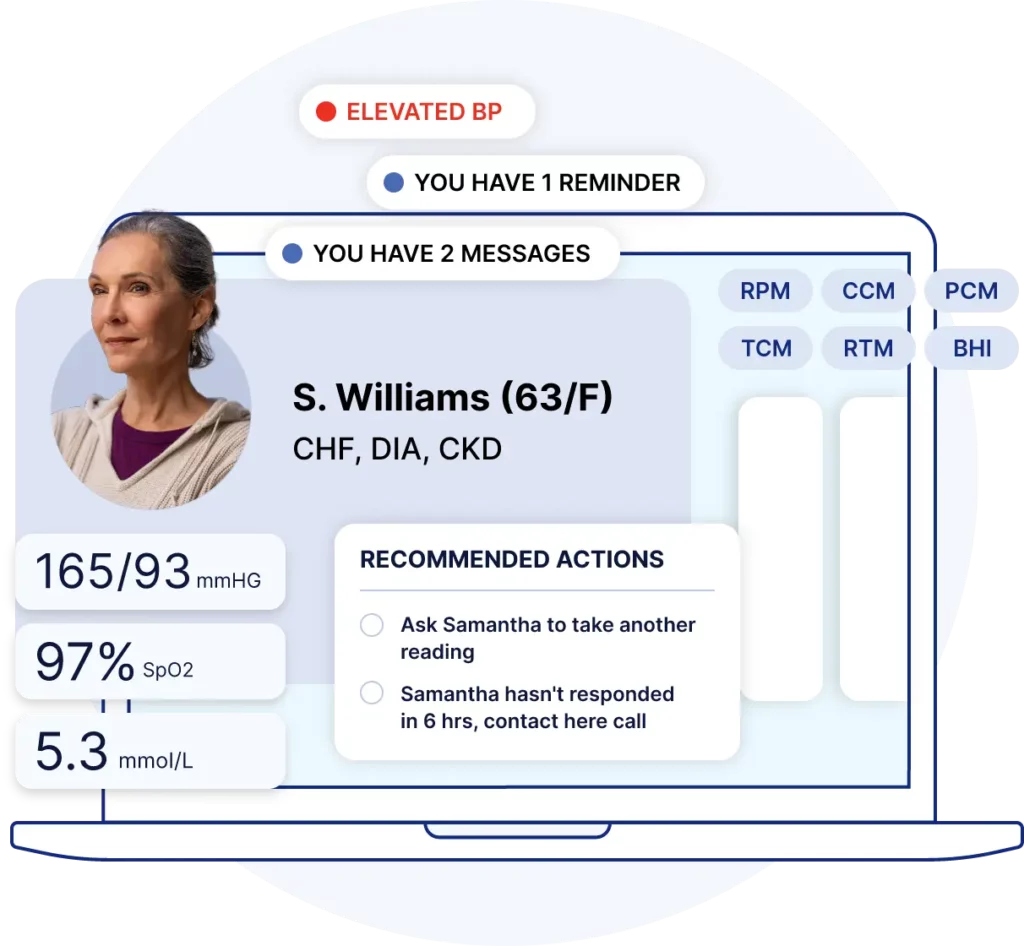
Each patient’s readings, conditions, enrolled programs and next recommended action sit on one card, so your nurse knows who to call first.
Digital health management
A care-team dashboard with readings, trends, care-plan status, logged time and open alerts for every enrolled patient. Sort it by who needs attention this week, which is the list your nurses actually work from on a Monday morning, instead of alphabetically by last name.
Patient engagement
Audio and video visits, two-way messaging, and an AI-assisted bot that nudges patients to take readings and coaches them between calls. Devices need no app, so engagement starts on day one.
Analytics & population health
Predictive risk flags show which patients are drifting before it turns into an admission. Panel-level reports track enrollment, adherence, alert response and billable months.
Two-way EHR integration
Readings, notes and time logs post back to the chart over HL7 FHIR. Works with athenahealth, Epic, eClinicalWorks, NextGen and other major EHRs. See EHR integrations
Billing & compliance
Medicare eligibility checks at enrollment. Time, readings, consent and thresholds time-stamped as they happen. A monthly report lists which patients met which code.
Care as a Service
Our care coordinators can watch the vitals for you. When a reading moves the wrong way they act: book a visit, route to a specialist, or coach the patient at home. How care coordination works
Nine CMS Programs
Which Programs Can You Run on It?
All nine run on one patient record. A patient enrolled in RPM and CCM at the same time exists once in the system, and the platform keeps the time for each program separate so nothing is double-counted. No duplicate charts.
Remote Patient Monitoring
Daily vitals from cellular devices, reviewed by a care team.
~$105 per patient / month99453 · 99454 · 99457 · 99458Chronic Care Management
Monthly care coordination for patients with two or more chronic conditions.
~$60 per patient / month99490 · 99439 · 99487Advanced Primary Care Management
A bundled monthly primary-care code with no time threshold.
$15 to $90 per patient / monthG0556 · G0557 · G0558Principal Care Management
Focused management of one high-risk condition.
~$60 per patient / month99424 · 99425 · 99426Remote Therapeutic Monitoring
Respiratory, musculoskeletal and therapy adherence data.
~$105 per patient / month98975 · 98976 · 98980Transitional Care Management
The 30 days after a hospital discharge.
$220 to $298 per discharge99495 · 99496Behavioral Health Integration
Depression and anxiety care inside the primary-care practice.
~$50 per patient / month99484 · 99492 · 99493Medication Therapy Management
Medication reviews for adherence and polypharmacy.
~$50 per review99605 · 99606 · 99607Principal Illness Navigation
Navigation support for patients with a serious illness.
Billed monthly by timeG0023 · G0024Amounts are rounded Medicare national averages for a typical month and vary by location and by which codes a patient qualifies for. The full figures for each code are in the CPT code library.
New for 2026: CMS added short-window remote monitoring codes, so a patient with 2 to 15 days of readings in a month can now be billed with 99445, and 10 minutes of management with 99470. The platform tracks both thresholds automatically. Read our 2026 guide to 99445 and 99470, or put your own numbers into the revenue calculator.
EHR & system integration
EHR Integrations Across Every Program
HealthArc connects with 55+ EHRs, including Epic, Oracle Health (Cerner), athenahealth, NextGen Healthcare and eClinicalWorks. One connection serves all nine programs, so adding APCM or BHI later doesn’t start a new IT project.









From your EHR into HealthArc
- Demographics and insurance
- Diagnoses and problem list
- Medications and allergies
- Appointments and ADT discharge events
From HealthArc back to the chart
- Device-reading summaries and flagged readings
- Signed notes for all nine programs
- Time logs by CPT and HCPCS code
How the connection is made
- HL7 FHIR R4 APIs for two-way, real-time exchange
- HL7 v2 messaging (ADT, ORU, CCD) for older systems
- Direct vendor integrations, such as the athenahealth Marketplace
- File-based exchange or REST API where there’s no live interface
Beyond the EHR
Devices
40+ cellular devices plus third-party device APIs, all landing in one reading stream.
Billing and RCM
A billing-ready export for your RCM system or clearinghouse, every required field filled.
Data warehouse
A REST API for your analytics team and population-health reporting.
Security
A BAA is signed before any data moves. Data is encrypted in transit and at rest.
- 4–8 hours of your team’s time
- No IT team needed
- Live in about 30 days
Product names and logos are trademarks of their respective owners. Listing an EHR reflects HealthArc’s integration support and doesn’t imply endorsement by that company. The exact fields exchanged depend on your EHR’s configuration and API, and are confirmed in writing during scoping.
What’s Included
What You Get, and What Most Vendors Charge Extra For
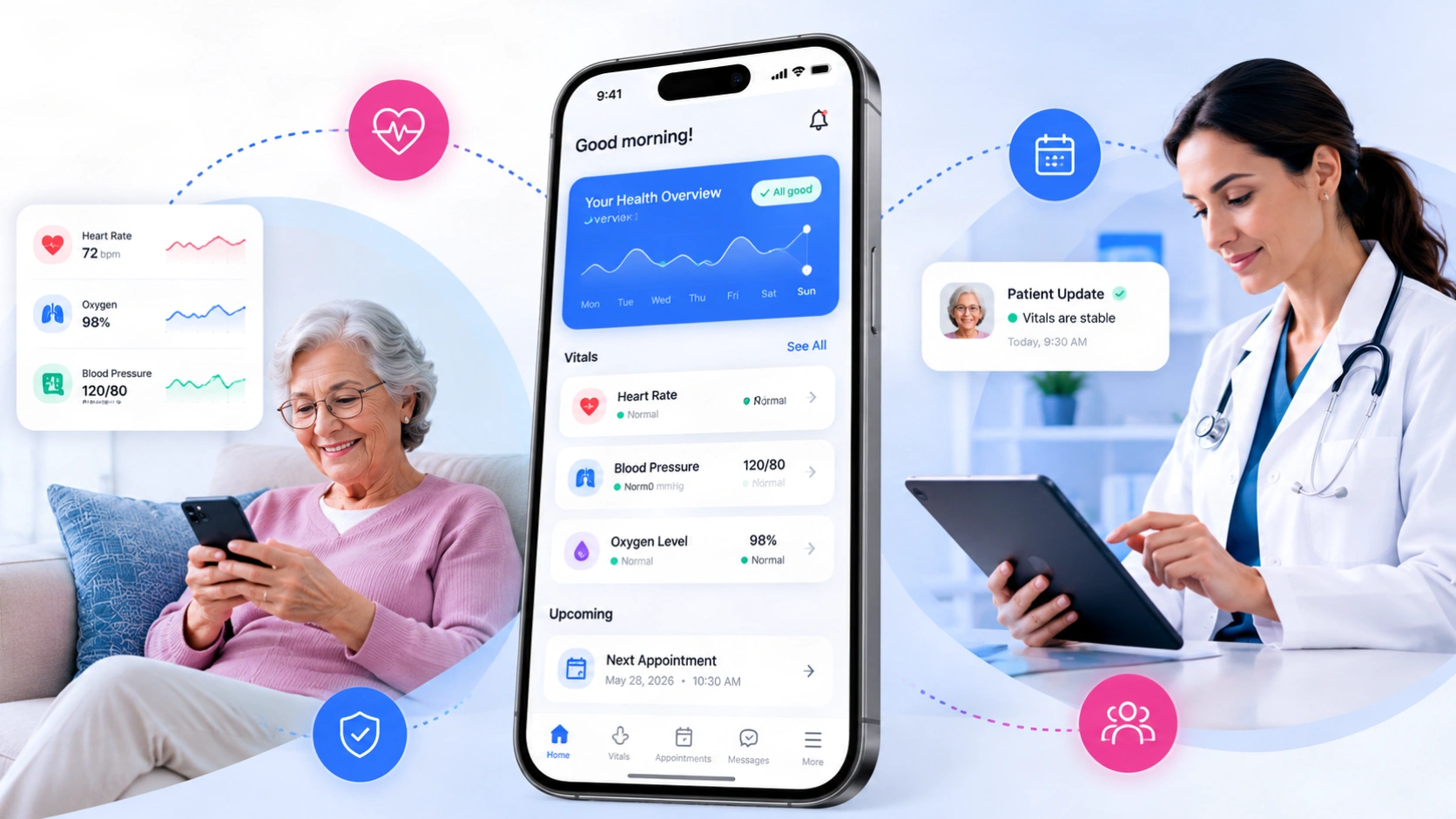
There’s no upfront fee and no hardware to buy. Patients see their own readings and reminders, and your clinicians see the same data on the care-team side. Here’s what comes with the platform for each side of the program.
For patients
- Devices, consumables and shipping at no cost
- Ready to use out of the box, with warranty and free replacement
- Cellular connection with no monthly plan or bill
- Readings send themselves. No app, no Wi-Fi, no pairing
- Training and reminders that keep people taking readings
For your practice
- No upfront fees for providers
- Patient outreach, education and enrollment handled for you
- Medicare eligibility checked before enrollment
- AI-assisted bot for adherence and coaching
- Predictive population health reports
Support
- 24-hour support by phone, chat and email
- New features shipped regularly, without downtime
- Hardware replaced at zero cost
Cellular Devices
Devices Your Oldest Patients Can Use Without Help
Cellular medical devices ship straight to the patient as a service. Each one arrives activated, with its own SIM. The patient takes a reading and it’s on your dashboard a few seconds later.
That matters more than it sounds. The patients least likely to own a smartphone are usually the ones with the most chronic conditions, and they’re the reason most remote programs exist.
- Blood pressure monitors and weight scales for hypertension and heart failure
- Glucose meters, plus Dexcom and Libre CGM integration
- Pulse oximeters and spirometers for COPD and asthma

| HealthArc cellular | Typical Bluetooth device | |
|---|---|---|
| Smartphone needed | No | Yes |
| Wi-Fi or home internet | No | Usually |
| App to install and pair | No | Yes |
| Data plan for the patient | Included | Patient’s own |
| Setup by the patient | Turn it on | Several steps |
More detail in cellular vs Bluetooth blood pressure monitors for RPM.
How You Run It
Use Your Staff, Ours, or a Mix
Software is rarely the real constraint. Staffing the calls, the follow-ups and the documentation is. Pick how much of that work you want to hand over, and change it later if your team grows.
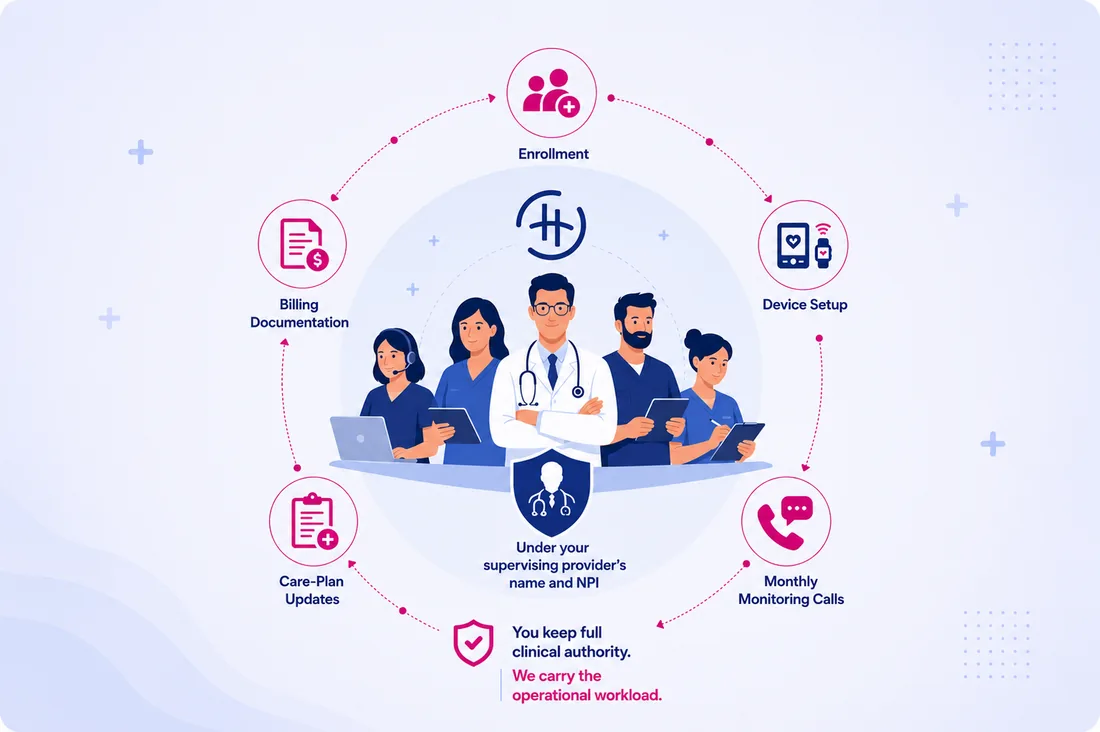
When our team runs it, the work happens under your supervising provider’s name and NPI. You keep full clinical authority. We carry enrollment, device setup, monthly calls, care-plan updates and billing documentation.
Option 1
Software only
Your clinical staff runs the program on the HealthArc platform.
- Full platform, devices and EHR integration
- Training for your care team
- Best if you already have nurses or MAs with spare hours
Option 2
Co-managed
We handle enrollment and routine monthly calls. Your team keeps escalations and clinical decisions.
- HealthArc does outreach, education and enrollment
- Your providers review alerts and sign off
- Best if you want control without adding headcount
Option 3
Fully managed
A HealthArc clinical team of RNs, LPNs and MAs runs the program under your providers’ NPI and protocols.
- Monthly patient contact, escalation and follow-up
- Documentation captured as the work happens
- Best for practices with no spare clinical time
Results
What Changed at a Cardiology Practice in New Jersey
Dr. Lawrence Antonucci, a founding member of New Jersey Cardiovascular Group, ran RPM and CCM on HealthArc with cellular blood pressure cuffs and weight scales, plus HealthArc care staff. These are the practice’s reported results.
9 mmHgAverage drop in blood pressure
24%Fewer hospitalizations
43%Less physician workload
200+Patients enrolled with no new hires
Case study · Cardiology
Enhancing cardiac care outcomes through digital health
How one cardiology practice moved from scattered systems and delayed follow-ups to daily readings and a program that runs without extra staff.
Read the case study Case study · Multi-specialtyTransforming chronic care at Monarch Medical
A practice treating chronic pain, obesity, diabetes and psychiatric illness used RPM and care coordination to catch problems earlier and cut manual documentation.
Read the case study
Buyer’s Checklist
How to Choose a Digital Health Platform
These are the questions practices ask us before they sign, with straight answers. Ask every vendor on your shortlist the same ones.
| Question to ask | Why it matters | HealthArc’s answer |
|---|---|---|
| How many CMS programs run on one patient record? | Separate tools per program means duplicate patients and double-counted time. | Nine, on one record. |
| Do patients need a smartphone or Wi-Fi? | Every setup step loses patients, usually the sickest ones. | No. Devices are cellular and ready out of the box. |
| Does data write back to our EHR? | One-way feeds leave staff copying notes by hand. | Yes, two-way over HL7 FHIR. |
| Who makes the monthly patient calls? | Most programs stall on staffing, not software. | Your team, ours, or both. Your choice. |
| How is billing documentation produced? | Rebuilt documentation is where audits find gaps. | Captured automatically as the work happens. |
| What do we pay up front? | Hardware purchases tie up cash before the first claim. | Nothing. No upfront fees, no device purchase. |
| Is it HIPAA compliant and audited? | You’ll need a BAA and proof of controls. | HIPAA compliant, SOC 2 Type II, BAA signed. |
| How long until the first enrolled patient? | Every month of delay is a month of unbilled care. | About 30 days. |
Still comparing? Our guide explains what a digital health platform does and why practices adopt one, and our alternatives hub compares HealthArc with other remote care vendors side by side.
Getting Started
From Signed Agreement to Enrolled Patients in About 30 Days
Most of the setup happens on our side, from pulling the eligible patient list out of your EHR to shipping and activating every device. Your team’s time goes into one kickoff call, a protocol review and signing off on the patient list.
Not sure yet? We’ll ship a device and set you up on the portal so you can try it on a real patient before you commit to anything.
Start a Pilot1
Panel analysis
We find the patients who qualify for each program and estimate what the program is worth.
2
EHR connection and protocols
We connect to your EHR and set alert thresholds and escalation rules with your providers.
3
Enrollment and devices
Patients are called, consented and sent devices. Readings start the day a device is switched on.
4
Monthly review
You get a report on enrollment, adherence, alerts handled and billable months, so problems show up early.

Who It’s For
Built for Practices, Specialists and Health Systems
From a two-provider primary care office to multi-site specialty groups. Pick your organization type, specialty or condition to see how the platform fits.
FAQ
Digital Health Platform Questions, Answered
What is a digital health platform?
A digital health platform is software that lets a care team monitor, contact and manage patients outside the office. HealthArc’s version combines connected devices, a care-team dashboard, patient messaging and video, EHR integration and the documentation Medicare needs, so remote care programs like RPM and CCM run from one place.
What digital health services does HealthArc offer?
Nine CMS programs: Remote Patient Monitoring (RPM), Chronic Care Management (CCM), Principal Care Management (PCM), Remote Therapeutic Monitoring (RTM), Transitional Care Management (TCM), Behavioral Health Integration (BHI), Advanced Primary Care Management (APCM), Medication Therapy Management (MTM) and Principal Illness Navigation (PIN). They share one patient record, so a patient in two programs doesn’t exist twice in your system.
How does the platform improve patient management?
It puts device readings, care-plan status, logged time and open alerts on one screen. Patients whose readings are drifting are flagged before it turns into an admission, and the connected devices send data without the patient doing anything.
What medical devices does HealthArc support?
Cellular blood pressure monitors, weight scales, glucose meters, pulse oximeters and spirometers, plus Dexcom and Libre continuous glucose monitors. Devices are plug-and-play, come with warranty and free replacement, and need no Wi-Fi, smartphone or monthly data plan. See the full list on our devices page.
Does HealthArc integrate with our EHR?
Yes. HealthArc connects with 55+ EHRs, including Epic, Oracle Health (Cerner), athenahealth, NextGen Healthcare, eClinicalWorks, Veradigm (Allscripts), AdvancedMD, DrChrono, Elation Health, Greenway Health, Tebra, PointClickCare and PrognoCIS. Integration is two-way over HL7 FHIR R4, HL7 v2 or a direct vendor integration, and readings, notes and time logs post back to the patient chart. What can be written back depends on your EHR’s API. Setup guides are on the EHR integrations page.
How much does a digital health platform cost?
HealthArc has no upfront fees and no device purchase. The programs it runs are paid by Medicare per patient per month, roughly $60 for CCM and about $105 for RPM at national average rates, so the program usually pays for itself. Use the revenue calculator to estimate it for your patient panel.
Do we need to hire staff to run it?
No. You can run the platform with your own team, share the work with ours, or have a HealthArc clinical team run the program under your providers’ NPI.
Is HealthArc HIPAA compliant?
Yes. HealthArc is HIPAA compliant and SOC 2 Type II certified, signs a Business Associate Agreement with every customer, and uses FDA-cleared devices. More on our security page.
How long does it take to go live?
About 30 days from signed agreement to the first enrolled patients. That covers panel analysis, EHR connection, protocol setup, device shipping and enrollment. Adding a second program later doesn’t need a new implementation.
See It Running
See the Platform With Your Own Patient Numbers
- An estimate of eligible patients and program revenue
- The dashboard, devices and care team, walked through end to end
- Start with one program and add the rest later
- No upfront fees and no long-term contract
Book a Demo
Revenue Calculator
HIPAA Compliant • SOC 2 Type II Certified
sales@healtharc.io • +1-201-885-5571
sales@healtharc.io • +1-201-885-5571
Talk to a Remote Care Specialist
How Can HealthArc Help You?
Want a demo, or just have a question about remote care in your practice? Send us a few details and a remote care specialist will get back to you shortly.
- RPM, CCM & 7 more CMS programs
- Automated time tracking & CPT billing
- Two-way EHR integration
- Managed care team, or your own
- Pre-configured cellular devices shipped
- Live in about 30 days
HIPAA compliant SOC 2 Type II No long-term contracts
Get Your Live HealthArc Walkthrough
No commitment required.
No obligation | No spam
Resources
From the HealthArc blog
Practical guidance on digital health platforms, remote monitoring and the CMS programs behind them.
October 26, 2026
How HealthArc’s AI-Assisted Pathways and Medical Scribe Automate Clinical Workflows for Enterprise Healthcare
How HealthArc’s AI care pathways trigger the next clinical task and its medical scribe drafts RPM, CCM, APCM and TCM notes with CPT codes, synced to your EHR.
Read articleJune 10, 2026
Patient Engagement Solutions: How Providers Are Using Connected Care to Get Patients to Actually Participate in Their Own Health
Most patient engagement solutions go unused. See how providers use connected care, RPM, and CCM to get patients participating in their own health.
Read articleJune 4, 2026
Remote Patient Monitoring for Mental Health: How AI-Powered Behavioral Monitoring Is Reshaping Chronic Care
Learn how mental health RPM works, which BHI CPT codes apply, how AI detects behavioral deterioration early, and how to generate $150+/patient/month with combined BHI + RPM programs.
Read article