
By Jack Whittaker
| November 27, 2025

Advanced primary care management (APCM) is Medicare’s new, population‑based care management framework that pays primary care providers to deliver continuous, proactive, tech‑enabled care to their entire Medicare panel, not just high‑risk chronic patients. For a remote patient monitoring (RPM) platform like HealthArc, APCM is the missing financial and operational layer that turns virtual care, data, and care coordination into sustainable revenue and better outcomes.
This complete guide to advanced primary care management covers everything primary care practices need to launch and scale an APCM program in 2026: what APCM is and how it differs from CCM, PCM, and TCM; the core APCM service elements CMS requires; patient eligibility and which clinicians can provide and bill APCM; the new HCPCS billing codes G0556, G0557, and G0558; provider workflows; and the patient outcomes and revenue APCM unlocks. Whether you run an independent clinic, an FQHC, or a health system, this is your roadmap to Medicare‑ready APCM services.
What is APCM in healthcare?
Advanced primary care management is a Medicare care management program that blends value‑based care elements into the traditional fee‑for‑service (FFS) model. It does this by paying primary care providers a per‑patient, per‑month fee for delivering structured, longitudinal care built around risk‑stratified patient needs, not just in‑office visits.
Unlike legacy pilots such as Comprehensive Primary Care Plus (CPC+) or Primary Care First, APCM is built directly into the Medicare Physician Fee Schedule, making it voluntary, low‑risk, and highly accessible for typical FFS‑oriented primary care practices. In practice, this lets a clinic layer population‑based care management on top of existing workflows while maintaining familiar billing processes.
Core APCM and “APCM Medicare” basics
When people say “APCM Medicare,” they are referring to Medicare’s formal Advanced Primary Care Management service and its associated HCPCS/G‑codes and rules. APCM introduces risk‑stratified codes that link monthly reimbursement to the clinical complexity of each patient, covering everything from lower‑risk patients with minimal chronic disease burden to complex Qualified Medicare Beneficiaries (QMBs).
APCM’s codes are not time‑based like traditional chronic care management (CCM); instead, they emphasize activities and outcomes such as care planning, coordination, outreach, and population analytics. This shift gives practices more operational flexibility, especially when supported by continuous data from remote patient monitoring platforms like HealthArc.
How APCM differs from CCM and PCM
APCM is complementary to—but distinct from—chronic care management (CCM) and principal care management (PCM), and understanding the differences is essential for digital‑forward practices.
Key differentiators include:
- Risk‑based, not time‑based: APCM codes are structured around patient risk tiers and care activities rather than strict minute thresholds.
- Broader eligibility: APCM can apply to essentially all Medicare primary care patients, including those with few or no diagnosed chronic conditions who still benefit from proactive management and prevention.
- Built‑in quality requirements: APCM ties payment to quality measurement and reporting, often via value pathways under MIPS and other value‑based care frameworks.
Because APCM incorporates elements of CCM, PCM, transitional care management (TCM), and communication technology‑based services, it acts as an umbrella program that rewards comprehensive, patient‑centered primary care. This is exactly where RPM‑enabled platforms like HealthArc help close gaps—by turning continuous data into actionable, billable care activities.
APCM vs CCM: a side‑by‑side comparison
Traditional chronic care management focuses on treating existing chronic conditions through regular, in‑person visits. Advanced primary care management takes a broader, more comprehensive approach that spans prevention, management, and whole‑person wellness. The table below summarizes the practical differences practices weigh when deciding how to structure their Medicare care management strategy.
| Aspect | Traditional Chronic Care Management | Advanced Primary Care Management |
|---|---|---|
| Focus | Managing existing diseases | Prevention + management + wellness |
| Care delivery | In‑person, physician‑led | Team‑based, virtual, and in‑person |
| Data use | Limited | Robust analytics, risk stratification |
| Patient engagement | Reactive | Proactive, personalized plans |
| Billing basis | Time‑based CPT codes | Risk‑stratified, per‑patient monthly G‑codes |
| Payment | Fee‑for‑service | Value‑based, population payments |
A key distinction: APCM is not time‑based, so care teams are not tied to counting minutes each month the way they are with CCM. Instead, APCM reimbursement reflects the intensity of care a patient needs based on their risk tier. Note that a patient cannot be enrolled in APCM and traditional CCM or PCM simultaneously for the same period—APCM is designed to be the umbrella program that absorbs those activities.
Why APCM matters now for primary care
Advanced primary care management is launching at a time when CMS is pushing hard toward preventive, population‑focused, and value‑driven primary care. For hospitals, FQHCs, and independent practices, APCM offers a path to stabilize revenue, scale care teams, and align with evolving payment models without jumping directly into full‑risk ACO arrangements.
Primary care organizations that embrace APCM can:
- Strengthen longitudinal relationships with patients through frequent, structured outreach and follow‑
- Reduce avoidable ED visits and inpatient utilization by catching deterioration earlier through monitoring, risk stratification, and coordinated interventions.
- Build sustainable care management infrastructure that supports RPM, CCM, behavioral health integration, and more on a common platform.
Building an APCM‑ready care model with HealthArc
To operationalize APCM at scale, practices need more than billing codes—they need an end‑to‑end digital workflow that brings together patient identification, engagement, data capture, documentation, and audit‑ready reporting. HealthArc’s remote patient monitoring and care management platform is designed precisely for this longitudinal, multi‑program model of care.
In an APCM environment, HealthArc can support:
- Automated identification of eligible patients across risk tiers using EHR, claims, and RPM data.
- Continuous collection of physiologic data (e.g., blood pressure, weight, glucose, SPO2) that feeds directly into APCM care plans and risk scoring.
- Centralized documentation of outreach, education, care coordination, and escalation steps to support APCM elements and quality measures.
These capabilities help teams move from episodic visits to always‑on primary care, while the APCM payment structure unlocks reliable, recurring revenue for doing the right thing clinically.
The APCM service elements CMS requires
To bill APCM, a practice must be able to deliver a defined set of service elements to enrolled patients, though not every element must be used every month or for every patient. These elements form the operational backbone of an APCM program and are what distinguish it from an ordinary office visit. A complete APCM model includes:
- Patient consent: All Medicare patients are eligible for APCM, but they must provide written consent before receiving services. Patients cannot be enrolled in APCM while simultaneously enrolled in Chronic Care Management (CCM) or Principal Care Management (PCM), and they must agree to any applicable cost‑sharing unless they are a Qualified Medicare Beneficiary (QMB), who is exempt from copayments and deductibles.
- Initiating visit for new patients: New patients require an initiating visit, but this is not needed if the patient has been seen by the billing provider (or another provider in the same practice) within the last three years, or has received CCM or PCM services from the practice within the previous year.
- 24/7 access and continuity of care: A care team member with access to the patient’s health record must be available around the clock. Patients should be able to see the same care team member for routine visits, and the practice should offer convenient alternatives to in‑office care, such as extended hours or home visits.
- Comprehensive care management: This includes a systematic assessment of the patient’s physical and psychosocial needs, plus preventive care, medication management support, and self‑management education.
- Comprehensive, electronic care plan: Care coordinators work with patients to create, implement, revise, and maintain an electronic care plan that is accessible to the provider, the full care team, and the patient’s family or caregivers.
- Management of care transitions: The practice coordinates transitions between settings—specialist referrals, hospital discharges, and ED visits—and must share care‑plan information electronically with other clinicians and contact the patient within seven days of a discharge.
- Practitioner, home, and community‑based care coordination: Care teams help patients access services from other practitioners, home‑based providers, community organizations, hospitals, and skilled nursing facilities, documenting psychosocial needs and cultural or linguistic preferences.
- Enhanced communication methods: APCM supports secure messaging, email, patient portals, phone, virtual check‑ins, and e‑visits, including the ability to review patient‑submitted photos or videos.
- Patient population‑level management: Practices analyze their patient panel to find gaps in care and intervene, risk‑stratifying patients across the three APCM levels (Level 1, Level 2, and Level 3).
- Performance measurement: APCM is outcome‑based. Clinicians in MIPS must register for the Value in Primary Care MIPS Value Pathway, and APCM is also open to providers in programs such as ACO REACH and Primary Care First.
HealthArc’s platform helps standardize these elements so they are consistently delivered, documented, and reportable, which is critical for APCM compliance and scaling across thousands of beneficiaries.
Who is eligible for APCM (and who can bill)?
Patient eligibility: APCM is intentionally broad. Any patient with Medicare Part B can be eligible, and—unlike CCM—there is no minimum number of chronic conditions required to enroll. Patients are then assigned to one of three risk‑stratified levels based on their chronic disease burden and status as a Qualified Medicare Beneficiary. The only firm requirements are documented patient consent, an initiating or recent qualifying visit, and that the patient is not concurrently enrolled in another overlapping care management program such as CCM or PCM.
Who can provide and bill APCM: APCM must be billed by a primary care provider, and the following clinician types can furnish and bill the service:
- Physicians (MD, DO): Serve as primary decision‑makers, building personalized care plans, especially for patients with multiple chronic conditions.
- Nurse practitioners (NPs): Can manage patient care, prescribe medications, and deliver care management services within their scope.
- Physician assistants (PAs): Deliver routine follow‑ups, care coordination, and preventive care.
- Clinical nurse specialists (CNSs): Support APCM by monitoring high‑risk patients and ensuring evidence‑based interventions.
- Federally Qualified Health Centers (FQHCs): Community clinics serving underserved areas can participate and coordinate care for vulnerable populations.
- Rural Health Clinics (RHCs): Can adopt APCM to reduce hospitalizations, strengthen chronic disease management, and capture additional Medicare reimbursement in rural communities.
Whatever the setting, providers must stay compliant with CMS standards: documented care plans, consent, and time; a certified electronic health record (EHR) for tracking and reporting; and adherence to the billing rules for any complementary RPM, CCM, or TCM services. Non‑compliance can lead to denied claims or audits.
APCM billing codes: G0556, G0557, and G0558
APCM is billed with three risk‑stratified HCPCS G‑codes rather than time‑based CPT codes. Each code is reported once per calendar month per patient, and the level reflects the patient’s clinical complexity:
- G0556 — APCM Level 1: For patients with one or fewer chronic conditions. This is the lowest‑intensity tier and carries the lowest monthly payment.
- G0557 — APCM Level 2: For patients with two or more chronic conditions expected to last at least 12 months (or until death) that place them at significant risk. This is the mid‑intensity tier.
- G0558 — APCM Level 3: For patients with two or more chronic conditions who are also Qualified Medicare Beneficiaries (QMBs). This is the highest‑intensity tier and carries the highest monthly payment, reflecting the added complexity of dual‑eligible, high‑need patients.
To bill any APCM code, the practice must have documented patient consent, an initiating visit where required, and the full set of APCM service elements available to the patient. Because APCM is not time‑based, there is no monthly minute threshold to meet—payment is tied to the patient’s risk level and the practice’s ability to furnish the required elements.
APCM is also designed to work alongside other Medicare care management services when requirements are met and there is no duplication. Practices commonly pair APCM with RPM (CPT 99453, 99454, 99457, 99458), Behavioral Health Integration, and Transitional Care Management (CPT 99495, 99496) to build a comprehensive, financially sustainable virtual care program. However, APCM cannot be billed together with CCM or PCM for the same patient in the same month, since APCM already incorporates those activities. For a full breakdown of rates and requirements, see our guide to APCM billing codes.
APCM + remote patient monitoring: a powerful combination
Remote patient monitoring is a natural partner for APCM because both programs aim to manage risk proactively instead of reacting to acute episodes. When practices layer RPM onto APCM, they gain real‑time insights that strengthen almost every required APCM element.
With integrated RPM, care teams can:
- See early warning signs of deterioration (e.g., rising blood pressure, sudden weight gain, worsening glucose) and intervene before hospitalization.
- Personalize care plans with objective longitudinal data instead of relying solely on self‑reports and sporadic readings.
- Engage patients more frequently through digital touchpoints tied to their actual readings, which supports education, adherence, and shared decision‑
From a financial standpoint, APCM and RPM can be billed together when requirements are met, allowing practices to capture incremental revenue per patient while delivering more robust, tech‑enabled care. For many organizations, this combined model is the practical way to fund a digital front door and virtual care infrastructure.
Implementing APCM step‑by‑step in a digital environment
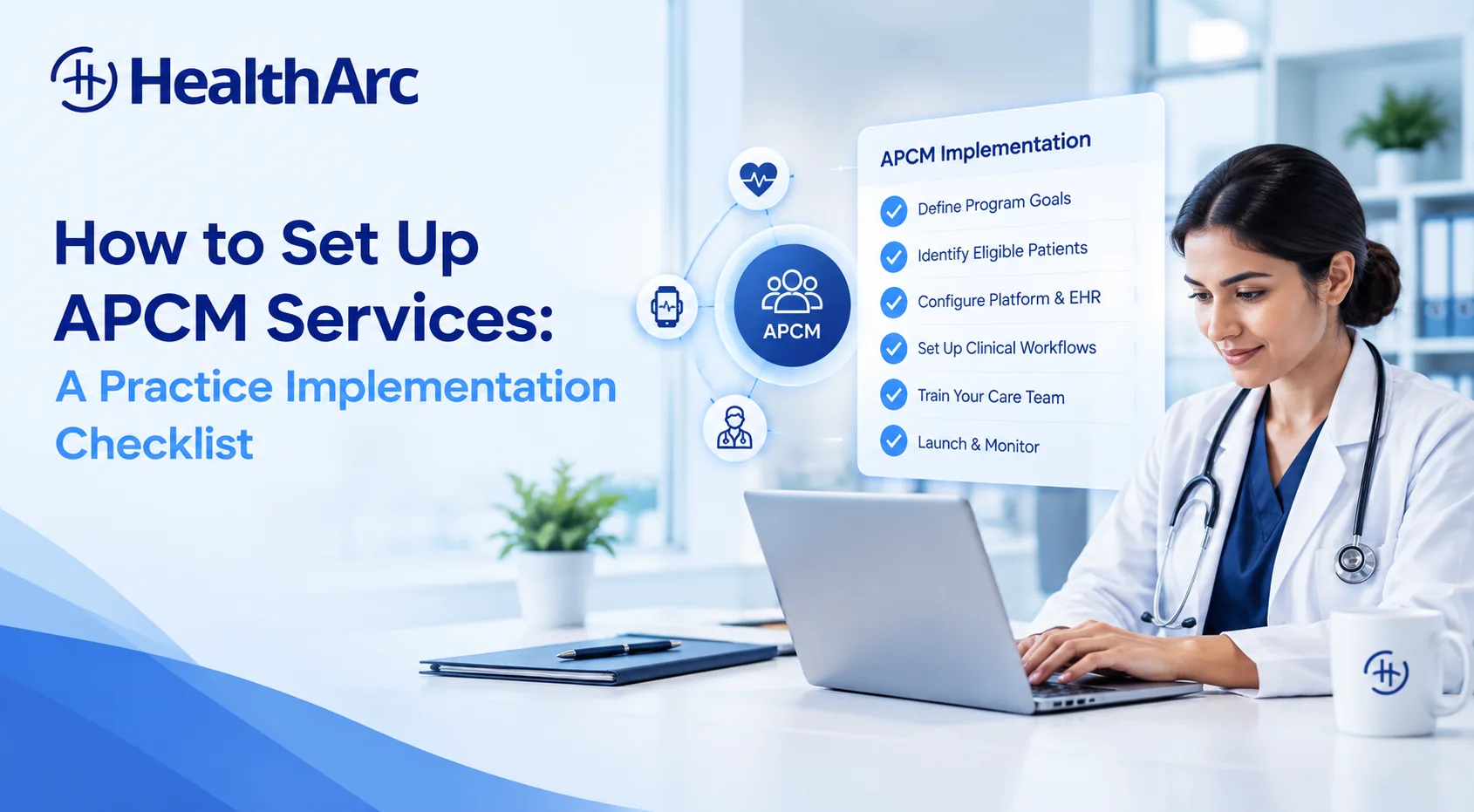
Rolling out APCM strategically is critical for success, especially when paired with remote patient monitoring and other virtual services. While specifics vary by organization, a typical roadmap includes:
- Patient population analysis
- Use EHR and claims data to quantify the number of Medicare beneficiaries and segment them by chronic condition burden, utilization history, and social risk.
- Flag high‑value cohorts where APCM plus RPM will likely generate clinical and financial impact (e.g., cardiometabolic patients with prior ED visits).
- Workflow design and staffing
- Define roles for physicians, NPs/PAs, RNs, MAs, and care coordinators within APCM, aligning each task (outreach, education, device management, documentation) to the right license level.
- Embed HealthArc workflows into daily routines so care teams can see alerts, escalate issues, and close APCM documentation in one place.
- Technology and integration
- Integrate the RPM platform with EHR to avoid double data entry and ensure care plan, vitals, and communications sync correctly.
- Configure templates for APCM documentation, consent, quality metrics, and audit‑ready reports.
- Training and change management
- Educate clinicians and staff on APCM requirements, documentation standards, and how to interpret continuous RPM data within care plans.
- Provide scripting for patient education so APCM and remote monitoring are explained clearly and consistently.
- Measurement and optimization
- Track enrollment, participation, readmission rates, ED visits, and financial performance for APCM patients.
- Refine risk stratification, outreach cadence, and escalation protocols using real‑world results from RPM analytics and claims feedback.
How APCM improves patient outcomes and benefits
APCM improves outcomes by shifting care from reactive treatment to proactive, continuous risk management—and the results show up in the data. Organizations that have adopted advanced primary care models report chronic disease control rates rising by 20 to 30%, emergency department visits and hospital readmissions falling by as much as 22%, and, in some programs, a 35% reduction in hospitalizations. National employer coalitions have documented total medical cost reductions of up to 15% under APCM‑style implementations.
For patients, APCM delivers:
- Better health outcomes: Continuous monitoring and timely interventions mean rising blood pressure, weight changes, or worsening symptoms are caught early, lowering complication rates.
- Personalized care plans: Treatment is tailored to each patient’s history, lifestyle, and risk factors—for example, a patient with diabetes may receive dietary counseling, medication reminders, and RPM device support to track blood sugar.
- Round‑the‑clock access to care teams: Patients can reach nurses and care managers 24/7 without an office visit, reducing delays in getting questions answered or concerns addressed.
- Reduced hospital utilization: Closer monitoring helps prevent avoidable emergencies, easing the financial and physical burden on patients.
- A preventive focus and higher quality of life: Emphasis on prevention, lifestyle change, and early detection keeps patients engaged and supports long‑term wellbeing.
For providers, the benefits extend beyond clinical quality: higher patient satisfaction and CAHPS scores, stronger performance on value‑based measures, less clinician burnout, and improved staff retention—alongside the recurring revenue APCM makes possible.
Strategic benefits of APCM for hospitals and FQHCs
For hospitals, health systems, and FQHCs, APCM is both a revenue program and a population health lever. These organizations often manage large numbers of high‑risk Medicare and dual‑eligible patients, making APCM a strong fit when combined with centralized care management hubs.
Key advantages include:
- Reduced avoidable utilization for high‑risk populations, which supports both fee‑for‑service margins and shared‑savings/value‑based contracts.
- The ability to standardize advanced primary care across multiple clinics and service lines using shared RPM and care management technology.
- Stronger performance on quality measures tied to readmissions, chronic disease control, and patient experience, which APCM explicitly requires and rewards.
HealthArc’s remote monitoring workflows are particularly impactful in these settings because they allow a centralized team to extend continuous oversight to large, geographically dispersed patient populations.
The future of APCM and digital‑first primary care
As CMS continues to test and refine primary care innovation models, APCM is emerging as a bridge between traditional FFS and more advanced value‑based arrangements. It gives practices financial room to invest in data‑driven, team‑based, tech‑enabled care before jumping into full risk.
For digital‑forward organizations, the combination of APCM, RPM, and other virtual care programs is the blueprint for modern primary care: always‑on, personalized, preventive, and financially sustainable. Remote patient monitoring platforms like HealthArc sit at the center of this new model, turning advanced primary care management from a policy concept into a daily operational reality.
FAQs on Advanced Primary Care Management
What is the difference between primary care and advanced primary care?
Traditional primary care typically focuses on episodic, in‑office visits where patients see their provider when they are sick or due for a follow‑up. Advanced primary care management (APCM) turns that model into continuous, proactive care by layering structured care coordination, data‑driven monitoring, and team‑based support on top of those visits.
With HealthArc, advanced primary care means your patients are monitored between visits through remote patient monitoring (RPM), outreach, and digital care plans, so issues are caught earlier and managed more efficiently. This approach aligns with Medicare’s APCM framework while giving practices clear workflows to deliver preventive, coordinated care at scale.
How many levels are there for advanced primary care management?
Under Medicare’s APCM structure, patients are assigned to multiple risk‑stratified levels, with higher levels representing more complex needs and higher per‑patient reimbursement. These tiers help practices match care intensity and resources—such as RPM, care coordination, and frequent outreach—to each patient’s clinical and social risk profile.
HealthArc supports this multi‑level approach by centralizing assessments, remote data, and care team workflows, making it easier to keep higher‑risk patients on track while still managing lower‑risk populations efficiently. This lets organizations operationalize APCM levels without creating fragmented or manual processes for each group.
What is the difference between TCM and APCM?
Transitional Care Management (TCM) is a short‑term service focused on helping patients safely transition from hospital or facility back to home after a qualifying discharge. It is tied to a specific post‑discharge period and emphasizes medication reconciliation, follow‑up visits, and immediate stabilization.
Advanced Primary Care Management (APCM), by contrast, is longitudinal and ongoing; it supports patients month after month with preventive, coordinated primary care, not just after a hospitalization. HealthArc enables both models: TCM workflows can manage post‑discharge steps, while APCM, combined with RPM, extends long‑term, always‑on management for chronic and at‑risk populations.
What are the benefits of subscribing to an advanced primary care management service?
Subscribing to an advanced primary care management service gives your practice a scalable way to deliver continuous care, improve outcomes, and unlock new recurring revenue streams under APCM and related Medicare programs. Patients benefit from more frequent touchpoints, proactive outreach, and monitoring that help prevent complications and reduce unnecessary ED visits or readmissions.
With HealthArc, providers also gain streamlined workflows, integrated RPM, and automated documentation that reduce manual work and support compliance with APCM requirements. This combination helps practices grow value‑based revenue while protecting clinician time and enhancing patient satisfaction.
What are the key features of advanced primary care management programs?
Most APCM programs share a core set of features: risk‑stratified patient management, 24/7 or extended access to care teams, comprehensive electronic care plans, coordinated transitions of care, and structured quality measurement. They also integrate technologies like RPM, telehealth, and secure messaging to keep patients connected to their care team between visits.
HealthArc’s advanced primary care management solution adds capabilities such as remote vital‑sign monitoring, automated alerts, centralized tasking, and audit‑ready APCM documentation. This helps practices deliver all required APCM service elements in a consistent, measurable way across large patient populations.
How does advanced primary care management improve patient outcomes?
Advanced primary care management improves outcomes by shifting from reactive treatment to proactive risk management, using continuous data and coordinated teams. Patients receive earlier interventions for rising blood pressure, weight changes, or worsening chronic symptoms because care teams can act on real‑time signals instead of waiting for the next office visit.
Through HealthArc’s RPM‑enabled APCM workflows, providers can personalize care plans, reinforce adherence, and close care gaps more reliably, which helps lower hospitalizations and improves control of conditions like hypertension, diabetes, and heart failure. Over time, this leads to better clinical metrics, higher quality scores, and stronger patient engagement.
Can I get a free trial for APCM management tools?
Many digital health platforms, including HealthArc, offer flexible onboarding models, demos, or pilot programs so practices can evaluate APCM and RPM workflows before a full rollout. These options typically include guided implementation support, sample workflows, and training so your team can see how APCM documentation, monitoring, and billing would work in your environment.
To check current free trial or pilot availability, contact HealthArc directly through the website or request a demo; the team can outline pricing, contract terms, and any limited‑time trial options tailored to your practice size and service mix.
How do I choose the best APCM software for small business use?
For smaller practices, the best APCM software should be simple to use, tightly integrated with your EHR, and capable of managing APCM, RPM, and other care management programs from one platform. Look for features such as automated eligibility identification, intuitive dashboards, built‑in APCM documentation templates, and clear reporting to support billing and compliance.
HealthArc is designed to be small‑practice‑friendly with streamlined implementation, scalable pricing, and workflows that reduce administrative burden instead of adding new manual tasks. When evaluating vendors, compare how each solution handles remote monitoring, care team collaboration, and APCM‑specific requirements, then schedule a HealthArc demo to see how those pieces come together in a single system.
What are the APCM billing codes for 2026?
APCM is billed using three HCPCS G‑codes that reflect patient risk level: G0556 (Level 1, one or fewer chronic conditions), G0557 (Level 2, two or more chronic conditions), and G0558 (Level 3, two or more chronic conditions in a Qualified Medicare Beneficiary). Each code is reported once per calendar month per patient.
Unlike CCM or RPM, these APCM codes are not time‑based, so there is no monthly minute threshold—reimbursement is tied to the patient’s risk tier and the practice’s ability to furnish the required APCM service elements. APCM can be paired with RPM and TCM, but not billed together with CCM or PCM for the same patient in the same month.
Who is eligible for APCM and who can bill for it?
Any patient with Medicare Part B can be eligible for APCM, and there is no minimum number of chronic conditions required to enroll—patients are simply assigned to one of three risk levels. The main requirements are documented consent, an initiating or recent qualifying visit, and that the patient is not concurrently enrolled in CCM or PCM.
APCM must be billed by a primary care provider. Eligible billers include physicians (MD, DO), nurse practitioners, physician assistants, clinical nurse specialists, and primary care settings such as FQHCs and Rural Health Clinics, as long as they meet CMS documentation and EHR requirements.


Ready to connect care between visits?
See how HealthArc runs RPM, CCM and seven more CMS programs — the platform, the devices and the clinical team — on a single demo.