
By Sudeep Bath
| August 18, 2026
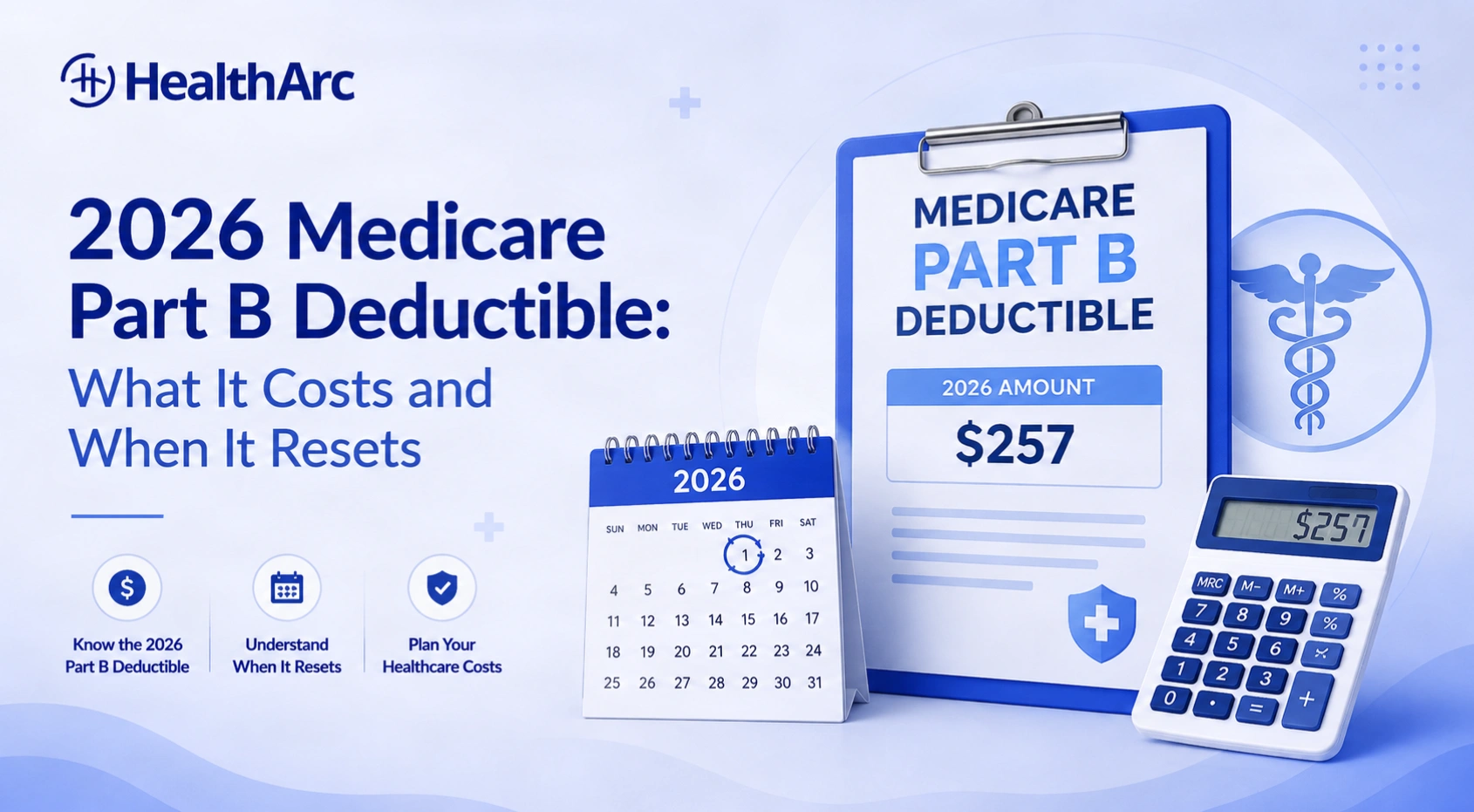
If you have Original Medicare, the number you want is $283. That’s the 2026 Medicare Part B deductible. It went up $26 from the $257 you paid in 2025, and it reset on January 1 along with everybody else’s.
The $26 isn’t what surprises people. What surprises them is the January statement that shows a $180 charge for a cardiology visit they assumed Medicare covered, or the discovery that Part A works on a completely different clock. So let’s go through the whole thing: what the deductible is, when it resets, what you pay once you’ve met it, and the handful of services that skip the deductible entirely.
Key Takeaways
- The 2026 Medicare Part B deductible is $283 per year, up from $257 in 2025. CMS announced it on November 14, 2025.
- It resets January 1 of every calendar year. Not on your birthday, not on your enrollment anniversary, and it isn’t prorated if you sign up mid-year.
- After you meet it, you pay 20% of the Medicare-approved amount for most Part B services, and Original Medicare has no annual out-of-pocket cap.
- The Part A hospital deductible is $1,736 per benefit period, not per year, so it can hit more than once in the same calendar year.
- Preventive care skips the deductible. Your annual wellness visit, flu shot, and most cancer screenings cost $0 whether or not you’ve paid a dollar toward the $283.
- The standard Part B premium is $202.90 a month in 2026, up $17.90. It’s separate from the deductible and doesn’t count toward it.
Table of Contents
What Is the 2026 Medicare Part B Deductible?
It’s the amount you pay out of your own pocket for Part B services before Medicare starts paying its share. For 2026 that amount is $283 for the whole year.
One deductible. Not one per doctor, not one per condition, not one per visit. Every Part B service you use in 2026 chips away at the same $283 balance, whether it’s a specialist visit, a lab draw, an X-ray, or a walker from a medical equipment supplier. Once the total you’ve paid reaches $283, you’re done with the deductible for the rest of the year.
CMS published the 2026 figures on November 14, 2025, and the official rates went into the Federal Register on November 19. Here’s the year-over-year change:
| Part B Cost | 2025 | 2026 | Change |
|---|---|---|---|
| Annual deductible | $257 | $283 | +$26 (+10.1%) |
| Standard monthly premium | $185.00 | $202.90 | +$17.90 (+9.7%) |
| Coinsurance after deductible | 20% | 20% | No change |
CMS attributed both increases to price changes and higher utilization in line with historical trends. The agency also noted the premium would have landed about $11 a month higher if it hadn’t reined in spending on skin substitute products in the 2026 Physician Fee Schedule.
Worth separating two things that get mixed up constantly. The premium is what you pay monthly to have Part B at all, and for most people it comes straight out of the Social Security check. The deductible is what you pay for care. Premium dollars never count toward the deductible.
Do Deductibles Reset Every Year? Yes, and Here’s Exactly When
Yes. The Part B deductible resets every calendar year, at midnight on December 31. Your balance goes back to zero and you start over at $283 on January 1.
Three things about that reset are worth knowing, because they’re the ones people get wrong.
It’s the calendar year, not your personal year. Some private insurance runs on a plan year tied to when your employer’s coverage started. Medicare doesn’t. January 1 to December 31, same as everyone.
December progress does not carry into January. If you had knee surgery in November and blew through the deductible, that has no effect on 2026. A visit on December 28 and a visit on January 4 fall in different deductible years even though they’re a week apart. This is the single most common source of the “but I already paid my deductible” phone call in January.
Mid-year enrollment doesn’t get you a discount. If you turn 65 in October and your Part B starts October 1, you still owe the full $283, not a quarter of it. Medicare doesn’t prorate. Then it resets on January 1 and you owe $283 again.
The rate itself changes annually too. The Part B deductible has climbed every year for the last several years, and the 2027 figure won’t be public until CMS announces it in late 2026.
The Part A Rule That Catches People Off Guard
Here’s where the tidy “deductibles reset every January” answer breaks down.
The Part A hospital deductible for 2026 is $1,736. That is not an annual deductible. It applies per benefit period.
A benefit period starts the day you’re admitted as an inpatient and ends after you’ve been out of a hospital or skilled nursing facility for 60 straight days. Get admitted again after that 60-day gap, and a new benefit period begins with a fresh $1,736 deductible. There’s no annual limit on how many benefit periods you can have.
Which means this is entirely possible: you’re hospitalized in February, discharged, recover at home through spring, then hospitalized again in October. That’s two benefit periods and $3,472 in Part A deductibles in one calendar year, on top of your $283 Part B deductible.
Now flip it. A stay that starts December 28 and runs into January is one benefit period, so you pay $1,736 once even though the stay spans two calendar years. Same rule, opposite result.
If you’ve wondered why hospital discharge planners pay such close attention to the timing of a readmission, this is a large part of the reason. It’s also why the 30 days after a discharge matter so much clinically and financially, which is the whole premise behind transitional care management.
What You Pay Once You Hit $283
Meeting the deductible doesn’t mean Medicare takes over completely. After $283, you owe 20% of the Medicare-approved amount for most Part B services. Medicare pays the other 80%.
And Original Medicare has no annual out-of-pocket maximum. That 20% keeps going all year, with no ceiling. It’s the main reason most people carry either a Medigap policy or a Medicare Advantage plan.
Some real math. Say it’s early 2026 and you haven’t used any Part B services yet:
| Service | Medicare-approved amount | You pay | Deductible remaining |
|---|---|---|---|
| Cardiologist visit, January | $180 | $180 (all deductible) | $103 |
| Echocardiogram, February | $450 | $103 deductible + $69.40 coinsurance = $172.40 | $0 |
| Follow-up visit, March | $150 | $30 (20%) | $0 |
| Lab panel, June | $95 | $19 (20%) | $0 |
Notice the February line. That’s the one that generates confused phone calls, because a single claim can be split: the last $103 of your deductible, then 20% of the remaining $347. Your Medicare Summary Notice shows both amounts, which is why the bill rarely matches the round number people expect.
One caveat on that 20%: it’s 20% of the Medicare-approved amount, not 20% of whatever the provider charges. If your doctor accepts Medicare assignment, they’ve agreed to the approved amount and 20% is all you owe. A non-participating provider can bill up to 15% above it, and that excess charge is on you.
What Doesn’t Count Toward the Deductible
A short list, and a useful one.
Most preventive services are free and skip the deductible entirely. Your annual wellness visit, flu and COVID and pneumococcal shots, mammograms, colorectal cancer screening, diabetes screening, and cardiovascular blood tests come at $0 as long as you see a provider who accepts assignment. The $283 is irrelevant to them. You can use these on January 2 without paying anything, which makes early-year scheduling genuinely smart. If you’ve been putting off the wellness visit, our piece on whether you can refuse a Medicare wellness visit covers what’s actually in it.
Part D prescription drugs run on their own deductible. No drug plan can charge more than $615 in 2026, and plenty charge less or nothing. Money you spend on prescriptions does not touch your Part B deductible, and vice versa. The good news for 2026: once you’ve paid $2,100 out of pocket for covered drugs, you pay $0 for the rest of the year.
Part A hospital costs are separate. The $1,736 and the $283 are two different buckets that never talk to each other.
Your premium doesn’t count. Twelve months of $202.90 is $2,434.80, and none of it reduces your $283.
Medicare Advantage may not use the $283 at all. If you’re in a Part C plan, your plan sets its own deductible, copays, and out-of-pocket maximum. Some MA plans have a $0 medical deductible. You still owe the Part B premium to the government, but the $283 figure may never appear in your cost-sharing. Check your plan’s Evidence of Coverage rather than assuming.
Every 2026 Medicare Number in One Place
| 2026 Medicare Cost | Amount |
|---|---|
| Part A premium (40+ quarters of work) | $0 |
| Part A premium (30–39 quarters) | $311/month |
| Part A premium (fewer than 30 quarters) | $565/month |
| Part A inpatient deductible | $1,736 per benefit period |
| Part A coinsurance, days 1–60 | $0 |
| Part A coinsurance, days 61–90 | $434/day |
| Part A lifetime reserve days (91–150) | $868/day |
| Skilled nursing facility, days 21–100 | $217/day |
| Part B standard premium | $202.90/month |
| Part B annual deductible | $283 |
| Part B coinsurance after deductible | 20%, no annual cap |
| Part D maximum deductible | $615 |
| Part D out-of-pocket cap | $2,100 |
| Medicare Advantage in-network out-of-pocket max | $9,250 (plans may set lower) |
The Part A numbers moved in step with Part B. The inpatient deductible went from $1,676 to $1,736, days 61 through 90 went from $419 to $434 a day, lifetime reserve days from $838 to $868, and skilled nursing coinsurance from $209.50 to $217.
If You Earn Above $109,000
Higher earners pay a surcharge on the Part B premium called IRMAA, the income-related monthly adjustment amount. It’s based on the modified adjusted gross income from your tax return two years back, so 2026 premiums use your 2024 return.
One thing to be clear about: IRMAA raises your premium, not your deductible. Everyone with Original Medicare pays the same $283 in 2026, whether their income is $20,000 or $2 million.
| 2024 MAGI, single filer | 2024 MAGI, married filing jointly | 2026 monthly Part B premium |
|---|---|---|
| $109,000 or less | $218,000 or less | $202.90 |
| $109,001–$137,000 | $218,001–$274,000 | $284.10 |
| $137,001–$171,000 | $274,001–$342,000 | $405.80 |
| $171,001–$205,000 | $342,001–$410,000 | $527.50 |
| $205,001–$500,000 | $410,001–$750,000 | $649.20 |
| Above $500,000 | Above $750,000 | $689.90 |
If your income has dropped since 2024 because you retired, got divorced, or lost a spouse, you can ask Social Security to recalculate using form SSA-44. People miss this and overpay for a full year.
Why January Feels So Expensive, and What to Do About It
January stacks. The Part B deductible restarts at $283. The Part D deductible restarts at up to $615. The new premium hits your Social Security deposit, this year $17.90 higher. If you land in the hospital that month, there’s $1,736 on top. A retiree on a fixed income can face well over $2,500 in exposure in a single month, then very little by August.
Some of that is unavoidable. Some isn’t.
Front-load the free stuff. Preventive services cost nothing and skip the deductible. Book the wellness visit and screenings in January, when your cash is tightest, because those are the visits that won’t generate a bill.
Ask what a service is actually going to cost before you get it. A billing office can usually tell you the Medicare-approved amount for a planned test. Knowing whether it’s $95 or $950 changes whether you schedule it in January or wait.
Look at Medigap, and read the fine print on the deductible. Plans C and F used to cover the Part B deductible, but both closed to anyone newly eligible for Medicare on or after January 1, 2020. Plan G, the most popular option for new enrollees, covers essentially everything except the Part B deductible. So you’d still pay the $283 yourself, and then Plan G picks up the 20% coinsurance with no cap. For many people the coinsurance is the far bigger risk.
Check whether you qualify for help. Medicare Savings Programs can pay your Part B premium, and the QMB program can cover deductibles and coinsurance outright. Extra Help does the same on the Part D side. Eligibility is more generous than most people assume, and applying is free through your state Medicaid office.
Keep your Medicare Summary Notices. They show exactly how much of the $283 you’ve used. When a provider bills you for a deductible you already satisfied, that notice is your evidence.
How the Deductible Hits Remote Monitoring and Care Management
This is the part we field questions about at HealthArc most often, from patients and from the practices billing on their behalf.
Remote patient monitoring, chronic care management, and advanced primary care management are Part B services. They are not preventive services. That means the same rules apply: monthly claims count toward your $283, and once you’ve met it you owe 20% of the approved amount for each month you’re enrolled.
In practical terms, the monthly RPM treatment management code typically lands somewhere in the $45 to $50 range nationally, though it varies by locality. Your 20% share works out to roughly $9 or $10 a month. Modest. But in January, before your deductible is met, that same claim can come to you in full. A patient who enrolled in November and paid $10 a month can get a January statement for $47 and reasonably wonder what went wrong. Nothing did. The deductible reset. Our guide to RPM CPT codes and reimbursement walks through how those monthly claims are built, and the CPT code reference covers the rest of the care management family.
If you’re a patient, two things are worth doing. Ask your care team what your monthly share will be after the deductible, and ask them what to expect in January specifically. If the cost is a real barrier, say so early. Between Medigap, Medicare Advantage cost-sharing, and QMB eligibility, there are more options than most people know about, and dropping out of a monitoring program mid-treatment is usually the worst of them.
If you’re running the program, January is a collections and retention problem before it’s anything else. Practices that mention the 20% and the January reset during enrollment see far fewer surprised patients and far fewer Q1 disenrollments than practices that let the first statement do the explaining. We build that conversation into onboarding for the teams we work with, because a patient who understands the bill stays in the program, and a patient who doesn’t calls to cancel in February.
Frequently Asked Questions
How much is the Medicare deductible for 2026?
There are two. The Part B deductible is $283 for the year. The Part A hospital deductible is $1,736 per benefit period. Part D plans have their own deductible, capped at $615 in 2026.
What is the 2026 Medicare Part B deductible amount?
$283. That’s $26 more than the $257 deductible in 2025, an increase of about 10%.
Do deductibles reset every year?
The Medicare Part B deductible does, on January 1. Part D deductibles reset annually as well. The Part A hospital deductible works differently, resetting per benefit period rather than per year, so you can owe it more than once in the same year.
Do deductibles reset every calendar year?
For Medicare, yes. Part B and Part D deductibles run January 1 through December 31, regardless of when you enrolled. Employer plans sometimes use a plan year that starts on a different month, but Medicare always uses the calendar year.
When does the Medicare deductible reset?
At midnight on December 31. Your balance is zero on January 1 and you start paying toward the new $283 with your first Part B service of the year.
What is the Medicare deduction for 2026?
People usually mean the amount deducted from their Social Security check, which is the Part B premium: $202.90 a month for most beneficiaries in 2026, up from $185.00. Higher earners pay more under IRMAA. The premium is separate from the $283 deductible.
What is the deductible for Medicare in 2026 for seniors?
The same for everyone on Original Medicare, regardless of age or income: $283 for Part B. There’s no senior discount and no reduced amount for low-income beneficiaries, though Medicare Savings Programs like QMB can pay it on your behalf if you qualify.
Does the Part B deductible apply if I have Medicare Advantage?
Usually not in the same way. Part C plans set their own deductibles and copays, and many have a $0 medical deductible. You still pay the Part B premium to Medicare. Read your plan’s Evidence of Coverage for the actual numbers.
How much is the Part A deductible in 2026?
$1,736 for each benefit period, up from $1,676 in 2025. A benefit period ends once you’ve been out of a hospital or skilled nursing facility for 60 consecutive days.
Do I have to pay the deductible again if I switch plans mid-year?
Moving between Original Medicare and Medicare Advantage mid-year can reset your cost-sharing, because the plans track deductibles separately and a new plan generally doesn’t credit what you paid under the old one. Confirm with both plans before you switch.
Is there a limit on what I pay after the deductible?
Not under Original Medicare. You keep paying 20% coinsurance all year with no out-of-pocket maximum. Medigap and Medicare Advantage plans both exist largely to put a ceiling on that exposure. Medicare Advantage in-network out-of-pocket maximums are capped at $9,250 in 2026.
Does Medigap cover the 2026 Part B deductible?
Only Plans C and F do, and they’re closed to anyone who became eligible for Medicare on or after January 1, 2020. If you have one already you can keep it. Plan G covers the 20% coinsurance but leaves the $283 to you.
Do remote patient monitoring and chronic care management count toward my deductible?
Yes. Both are Part B services, not preventive services, so monthly claims apply to your $283 and then to the 20% coinsurance. Expect a larger bill for the first month or two of the year while the deductible is being met.
What happens if I meet my deductible in December?
Nothing carries over. You start January at zero and owe the full $283 again, even if your December care and your January care are days apart.
Figures here come from the CMS 2026 Parts A and B premiums and deductibles fact sheet published November 14, 2025, and the corresponding Federal Register notice. For your own coverage and costs, check Medicare.gov or call 1-800-MEDICARE. This is general information, not financial or medical advice.
The Short Version
$283 for Part B, reset every January 1, then 20% of everything after that with no ceiling. Preventive care is free and ignores the deductible, so use it early. Part A is $1,736 and plays by benefit periods, not the calendar, which is the rule that costs people the most when they don’t know it.
If you’re enrolled in a remote monitoring or chronic care program and the January statement looked wrong, it probably wasn’t. Ask your care team to walk you through the deductible math before you cancel anything.
Running an RPM or CCM program and tired of Q1 disenrollments? Book a HealthArc demo and we’ll show you how we handle patient cost conversations at enrollment so the January reset stops costing you patients.


Ready to connect care between visits?
See how HealthArc runs RPM, CCM and seven more CMS programs — the platform, the devices and the clinical team — on a single demo.