
By Sudeep Bath
| June 10, 2026
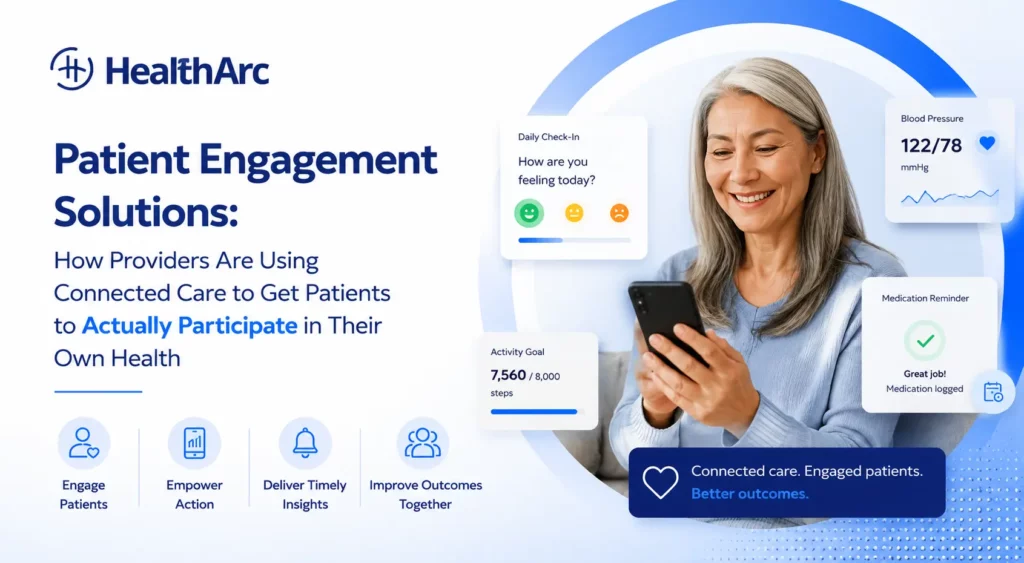
Here’s a number that should bother every clinician: according to the World Health Organization, roughly half of all patients with chronic conditions in developed countries don’t take their medications the way they were prescribed. Not because the prescriptions were wrong. Because somewhere between the exam room and real life, the patient stopped participating.
That gap is the entire reason patient engagement solutions exist. And it’s also the reason so many of them disappoint. A practice buys a portal, sends some automated reminders, maybe launches an app, and six months later the dashboards are full of patients who logged in once and never came back. The technology worked. The engagement didn’t happen.
We’ve spent years building and running remote care programs at HealthArc, supporting more than 100,000 patients across 2,000+ providers in 45+ states, and the pattern we see is consistent: engagement tools succeed when they’re connected to something the patient and the care team both act on. They fail when they’re just another inbox. This post breaks down what actually separates the two, with the research to back it up.
What patient engagement solutions actually are (and what they’ve quietly become)
Strip away the vendor language and a patient engagement solution is any system that helps patients take an active role in their own care between visits. The category covers a lot of ground: patient portals, appointment reminders, secure messaging, education content, mobile health apps, remote monitoring devices, and the care management programs wrapped around them.
The portal era taught us something important. The Office of the National Coordinator for Health IT found that even among Americans who were offered online access to their medical records, only about six in ten ever used it. Access alone doesn’t create engagement. A portal is a filing cabinet; nobody builds a health habit around a filing cabinet.
What’s changed in the last few years is that engagement has moved from passive (here’s your lab result, log in if you want) to active and continuous. A patient with hypertension takes a reading on a cellular blood pressure cuff at her kitchen table. The reading lands on her care team’s dashboard in real time. If it’s trending the wrong way, a nurse calls her that week, not at her next appointment in four months. That loop, measure, respond, adjust, is what modern patient engagement software is actually selling. The question is whether a given platform can close the loop or just open it.
This is the territory where remote patient monitoring (RPM) and patient engagement stop being separate categories. We wrote previously about how RPM boosts patient engagement through daily self-monitoring, and the mechanism is worth restating: when patients generate their own data and see someone respond to it, they stop being spectators in their care.
Why engagement matters more than most line items on your budget
It’s tempting to file “engagement” under soft goals, somewhere between patient satisfaction surveys and the waiting room TV. The financial research says otherwise.
Judith Hibbard’s work on patient activation, published in Health Affairs, found that patients with the lowest activation scores had predicted healthcare costs 8 to 21 percent higher than highly activated patients with the same conditions. Activation, the patient’s knowledge, skill, and confidence in managing their own health, turned out to be a cost driver independent of how sick someone was.
Readmissions tell the same story. The landmark Jencks study in the New England Journal of Medicine found that nearly one in five Medicare fee-for-service patients was readmitted within 30 days of discharge, and half of those readmitted after a medical stay had no follow-up visit in between. That’s not a clinical failure. That’s an engagement failure, and it’s the exact gap that transitional care management programs were designed to close.
And medication non-adherence, the problem we opened with, is estimated to cause around 125,000 deaths a year in the United States and somewhere between $100 and $300 billion in avoidable healthcare costs. Programs like medication therapy management exist precisely because adherence doesn’t fix itself.
The adoption problem nobody puts in the sales deck
So if the evidence is this strong, why do so many engagement tools end up as shelf-ware?
Because most of them ask the patient to do all the work. Download this app. Remember this password. Pair this device over Bluetooth. Check this portal. Every step you add is a place where a 74-year-old with congestive heart failure, or honestly, a 34-year-old with a full-time job, drops off.
The programs that hold onto patients share a few unglamorous traits. The devices work out of the box: cellular-connected blood pressure cuffs, glucometers, and scales that transmit automatically with no smartphone, no app pairing, no Wi-Fi setup. (This is why we standardized on cellular medical devices across our 40+ device integrations.) The communication is two-way and human: an SMS nudge that escalates to a phone call from a real nurse when readings go quiet. And the patient gets feedback fast enough to feel that someone is actually watching.
One of our partner physicians put it better than any feature list could:
“It’s very easy to use and my patients see an immediate appreciation of having their physician being aware of their blood pressure and pulse.” — Dr. Jay, California Primary Group, HealthArc client
“Immediate appreciation” is the whole game. The patient isn’t engaging with software. They’re engaging with the knowledge that their doctor sees them between visits.
Age, by the way, is less of a barrier than vendors assume, but it does change the playbook. We’ve covered practical ways to improve RPM engagement for senior patients, and for the smartphone-comfortable population, mobile apps measurably increase adherence in RPM and RTM programs. The point isn’t one channel. It’s meeting each patient on the channel they’ll actually use.
Comparing patient engagement tools: where each one works and where it breaks
Not every tool deserves to be replaced, but every tool deserves an honest job description. Here’s how the major categories of patient engagement technology stack up in practice.
| Engagement approach | What it does well | Where it breaks down | Best fit |
|---|---|---|---|
| Patient portal | Records access, results, secure messaging | Passive; ~40% of people offered access never use it (ONC) | Administrative tasks, documentation |
| Automated reminders (SMS/email) | Cuts no-shows; cheap to run at scale | One-way; ignores why the patient disengaged | Appointments, refills, screenings |
| Mobile health apps | Education, symptom logging, adherence prompts | Download friction; steep drop-off after week one | Younger, tech-comfortable patients; RTM programs |
| RPM with cellular devices | Continuous physiological data; triggers real clinical outreach | Needs staffing and workflow behind it, not just hardware | Hypertension, diabetes, COPD, heart failure |
| Care management programs (CCM/PCM/TCM) | Sustained human relationship; monthly touchpoints | Labor-intensive without automation and documentation support | Patients with one or more chronic conditions |
Notice the pattern in the right-hand column. The tools that drive the strongest engagement, monitoring plus care management, are also the ones that demand the most operational muscle. That’s not a flaw; it’s the price of results. The 2013 Margolis trial in JAMA made this vivid: hypertensive patients who got home blood pressure telemonitoring combined with pharmacist management hit blood pressure control rates around 72% at twelve months, versus roughly 53% with usual care. The device mattered. The human responding to the device mattered more.
What to look for in a patient engagement platform (a provider’s checklist)
If you’re evaluating patient engagement solutions this year, the demo will look great. They all do. These are the questions that separate platforms after the demo:
- Does it remove setup burden from the patient? Cellular-first devices that transmit out of the box beat anything requiring app pairing, especially for Medicare populations.
- Is the communication two-way and escalating? Automated SMS is table stakes. Ask how the platform surfaces non-responsive or at-risk patients to a human, and who that human is.
- Does it come with clinical staffing, or just software? If your practice doesn’t have nurses to spare, look for vendors offering enrollment specialists, RNs, and care coordinators as part of the program rather than leaving you to hire.
- Does it handle the billing documentation? Engagement work is reimbursable, but only if the time is tracked and documented to CMS standards across RPM, CCM, PCM, RTM, and TCM codes. Manual time-tracking is where programs quietly bleed revenue.
- Does it integrate with your EHR and your conditions? A platform built for hypertension and diabetes workflows will outperform a generic messaging tool dressed up as a clinical product.
- Is it secure? HIPAA compliance is the legal floor. SOC 2 attestation tells you the vendor’s internal controls have actually been audited.
One more thing the checklist can’t capture: your clinicians have to believe in the program, because patients take their cues from the person in the white coat. We’ve written about getting clinician buy-in and driving patient enrollment, and in our experience it’s the single biggest predictor of whether a program reaches scale.
Yes, engagement is reimbursable. Here’s the short version.
Medicare decided years ago that keeping patients engaged between visits is billable clinical work, and the code structure reflects it. RPM codes 99453 and 99454 cover device setup and supply, while 99457 and 99458 reimburse the actual engagement: 20-minute blocks of care management time that must include live, interactive communication with the patient. Chronic care management runs on a parallel track, starting with 99490 for 20 minutes of non-face-to-face care coordination per month.
In other words, the phone call your nurse makes when a patient’s readings drift isn’t overhead. It’s the billable event. Practices that treat engagement as a reimbursed service line rather than a marketing expense fund their programs from day one. The full breakdown lives on our CPT codes resource page, and if you want to model the numbers for your panel size, the revenue calculator will get you a realistic estimate in a few minutes.
Where this is heading
The direction of travel is clear: engagement is becoming continuous, condition-specific, and increasingly assisted by AI that decides which patient needs human attention today. We’re already seeing it reshape primary care delivery and extend into behavioral and mental health monitoring, where engagement gaps have historically been widest.
But the fundamentals won’t change. Patients participate in their own health when participation is easy, when someone visibly responds, and when the relationship feels like care rather than software. Any patient engagement solution that delivers those three things will work. Any that doesn’t will end up in the drawer with the portal passwords.
If you’re a provider looking to build an engagement program that patients actually stick with, schedule a demo with our team, or explore how we work with practices and health systems of every size. You can also browse real outcomes in our case studies.
Frequently asked questions
What are patient engagement solutions?
Patient engagement solutions are technologies and services that help patients participate actively in their own care between visits: patient portals, secure messaging, appointment reminders, mobile health apps, remote patient monitoring devices, and care management programs like CCM and TCM. The most effective ones combine connected devices with human clinical follow-up rather than relying on software alone.
How does remote patient monitoring improve patient engagement?
RPM turns patients into active participants by having them generate their own health data daily, blood pressure, glucose, weight, oxygen saturation, and ensuring a care team responds when readings change. Research such as the Margolis JAMA trial shows telemonitoring paired with clinical management can raise blood pressure control rates from roughly 53% to 72%, largely because patients stay connected to their care team year-round.
Are patient engagement programs reimbursable by Medicare?
Yes. CMS reimburses engagement work through RPM codes (99453, 99454, 99457, 99458), chronic care management codes (starting with 99490), and related programs including PCM, RTM, and TCM. The interactive communication time spent with patients each month is the billable service, provided it’s documented to CMS requirements.
Why do most patient engagement tools fail?
Usually because they put the setup and follow-through burden on the patient: app downloads, device pairing, portal logins, with no human response when the patient goes quiet. Tools succeed when devices work out of the box, communication is two-way, and a clinician visibly acts on the patient’s data.
What should I look for in a patient engagement platform?
Prioritize cellular-connected devices that need no patient setup, two-way communication with escalation to clinical staff, built-in billing documentation for RPM/CCM/RTM/TCM codes, EHR integration, condition-specific workflows, and HIPAA plus SOC 2 compliance. If your practice is short-staffed, look for vendors that include enrollment and nursing support, not just software licenses.

Ready to connect care between visits?
See how HealthArc runs RPM, CCM and seven more CMS programs — the platform, the devices and the clinical team — on a single demo.