
By Jack Whittaker
| April 20, 2026
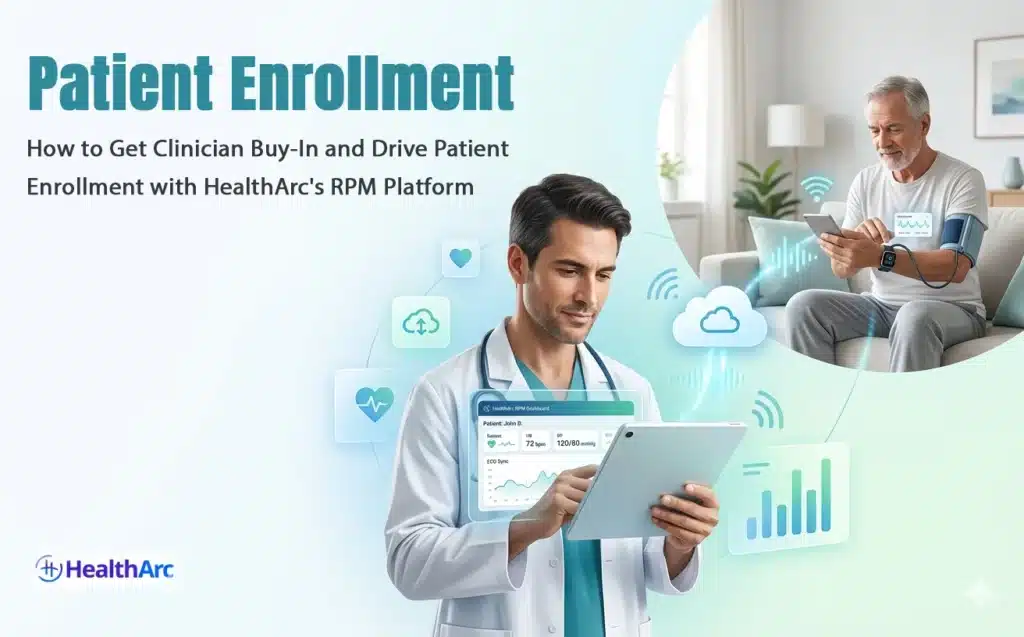
Most RPM programs don’t fail because of bad technology. They fail because the clinicians didn’t believe in it, the patients didn’t understand it, and nobody figured out who to enroll first.
We see this pattern repeatedly across practices of all sizes. A program gets stood up, devices ship, and then… referrals trickle in. Engagement drops off after week two. Clinicians stop recommending it because they don’t see the workflow value. The program stalls before it ever reaches scale.
The good news: these are all solvable problems. And with HealthArc’s remote patient monitoring platform, you have the tools to address each one systematically. This guide walks through the three areas where RPM programs most commonly break down, and exactly what to do about them.
What you’ll learn: How to convert skeptical clinicians into active referral sources, how to onboard patients so they actually stick, and how to identify and message the right patients for enrollment from the start.
Getting Clinician Buy-In (and Keeping It)
Clinician buy-in isn’t a one-time pitch. It’s an ongoing relationship between your RPM program and the providers who drive referrals into it. According to a 2023 review published in JMIR, the majority of healthcare providers express concerns about RPM including increased workloads, data inaccuracy, and technology that feels disorienting. These aren’t irrational fears. They’re legitimate friction points that your program needs to address head-on.
The core insight: clinician buy-in is directly linked to patient enrollment. When providers don’t trust the program, they don’t refer. When they don’t refer, your census stays flat.
Address the Workload Concern First
The number one reason clinicians resist RPM is the fear that it creates more work for them. More alerts to review. More patient messages to field. More data to interpret.
This is where HealthArc’s AI-powered workflows change the conversation. Rather than flooding clinicians with raw biometric data, the platform uses automated risk scoring to surface only the patients who need attention. A clinician doesn’t see 200 blood pressure readings. They see three flagged patients who need follow-up today. That’s a fundamentally different ask.
When you’re making the case to a skeptical physician, lead with this: “You will not be monitoring a dashboard. The platform monitors it for you and tells you when to act.”
Build Your Clinical Champion
The AMA’s RPM Playbook is clear on this: programs that identify a strong physician champion during implementation are significantly more likely to succeed. One engaged, vocal clinician can shift the culture of an entire practice faster than any administrator-led rollout.
Find your champion early. Look for the physician who:
- Already asks about patient compliance between visits
- Has expressed frustration about not knowing what’s happening with high-risk patients at home
- Is comfortable with technology and curious about data
- Has influence with peers
Once you have that person, invest in them. Walk them through HealthArc’s clinician dashboard, show them how EHR data flows in and out via FHIR and HL7 integrations, and let them experience the workflow before you ask them to endorse it. Their credibility with colleagues is worth more than any internal memo.
Make Referrals Frictionless
Even a clinician who believes in RPM will stop referring if the process is complicated. The referral workflow needs to feel like a natural extension of their existing routine, not a separate administrative task.
With HealthArc, the referral pathway integrates directly with your EHR. A provider can flag a patient for RPM enrollment without leaving their existing workflow. The platform handles device logistics (including cellular device shipping under a device-as-a-service model), consent documentation, and initial patient outreach. The clinician’s job is simply to identify the patient. Everything downstream is handled.
Practical tip: Run a 30-minute walkthrough with your clinical staff every quarter. Show them the dashboard, share outcome data from enrolled patients, and remind them how easy the referral step actually is. Repetition builds habit.
Onboarding and Engagement Strategies That Actually Work
Getting a patient enrolled is step one. Keeping them engaged long enough to generate 16 days of biometric data per month (the threshold required for CMS RPM reimbursement under CPT codes 99453 and 99454) is the real challenge.
The first two weeks of enrollment are the most critical. Patients who don’t form a habit in that window rarely do. Here’s how to structure onboarding so engagement becomes automatic, not effortful.
The First 72 Hours Matter Most
When a cellular device arrives in a patient’s hands, the clock starts. If they don’t use it within the first three days, the likelihood of sustained engagement drops sharply.
HealthArc’s onboarding flow is designed to close that gap. The platform triggers automated outreach the moment a device is confirmed delivered, walking the patient through setup via the HealthArc mobile app (available on iOS). Care coordinators are alerted if a patient hasn’t recorded their first reading within 48 hours, allowing for a proactive check-in call before disengagement sets in.
Key onboarding elements to put in place:
- A welcome call from a clinical staff member (not just an automated message) within 24 hours of device delivery
- Plain-language instructions on what readings to take and when
- Clear communication about what happens if their numbers look abnormal (this reduces patient anxiety significantly)
- A direct contact for technical support, separate from clinical questions
Segment Your Patients, Then Communicate Differently
Not every patient enrolls for the same reason. A 68-year-old with hypertension who’s worried about a second stroke is motivated differently than a 55-year-old diabetic who’s frustrated by frequent office visits.
Research consistently shows that tailored messaging drives higher engagement than generic outreach. Segment your enrolled patients into at least two buckets:
| Patient Type | Primary Motivation | Messaging Focus |
|---|---|---|
| Health-outcome focused | Improving clinical numbers, avoiding hospitalization | Trend data, progress toward goals, clinical improvement |
| Convenience-focused | Reducing office visits, saving time | Fewer in-person appointments, care from home |
| High-risk / complex | Managing multiple conditions, fear of decline | Constant support, 24/7 care team access, safety |
HealthArc’s platform supports segmented outreach through its care coordination tools. Use these to customize the messaging your patients receive, whether it’s automated reminders, monthly progress summaries, or targeted educational content tied to their specific condition.
Keep Clinicians in the Loop on Engagement Metrics
One underused engagement lever: showing clinicians which of their referred patients are actually using their devices. When a provider sees that a patient they enrolled has logged 22 days of readings in the past month and their blood pressure has trended down 12 points, two things happen. First, they feel good about the referral. Second, they think of the next patient who could benefit.
HealthArc’s dashboard surfaces this data at the patient and population level. Make it a standing agenda item in your monthly clinical meetings to share these wins. It reinforces the referral behavior you want.
Patient Targeting and Enrollment Messaging
The biggest enrollment mistake most practices make is treating RPM as an opt-in program with a generic pitch. “Would you like to try remote monitoring?” lands very differently than “Based on your last three visits, I think this would significantly reduce your risk of another hospitalization.”
Specificity converts. Generality doesn’t.
Who to Target First
Not all eligible patients are equally good candidates for enrollment. Starting with the highest-probability patients gives your program early wins that build momentum and clinician confidence.
Use HealthArc’s AI risk scoring to identify your best first cohort. Look for patients who meet these criteria:
- Two or more chronic conditions expected to last 12+ months (the CMS eligibility baseline for CCM and RPM programs per HHS guidelines)
- Recent hospitalization or ER visit for a condition that RPM can actively monitor, such as CHF, hypertension, COPD, or diabetes
- History of medication non-compliance or missed follow-up appointments, which signals care gaps that real-time monitoring can close
- Patients already engaged in care, meaning they show up to appointments and respond to outreach, since they’re most likely to sustain device use
High-risk, high-engagement patients are your ideal starting point. They stand to benefit most, they’re most receptive to enrollment, and their outcomes data becomes the proof of concept that drives future clinician referrals.
Messaging That Moves Patients to Say Yes
The way a provider frames the RPM conversation has an outsized impact on enrollment rates. Physicians who pitch RPM as a program get lower conversion than those who frame it as a natural extension of their care.
Here are three enrollment conversation frameworks that work:
1. The safety frame (for high-risk patients):
“I want to be able to see how you’re doing between visits, not just when you’re in this office. This device lets your care team check in on your readings daily, so if something looks off, we catch it early. Before it becomes an emergency.”
2. The convenience frame (for time-sensitive patients):
“This could actually reduce how often you need to come in. We can monitor your numbers remotely and only bring you in when something needs attention in person.”
3. The empowerment frame (for engaged, health-focused patients):
“This gives you a real-time window into your own health data. You’ll see your trends, and so will we. It puts you in control of your numbers in a way that a quarterly visit never can.”
Address cost objections immediately. Medicare covers RPM services, and most patients owe little to nothing out of pocket. Having your front desk or care coordinator ready with a clear, one-sentence answer to “does insurance cover this?” removes one of the most common barriers to enrollment.
Expand Beyond Clinician Referrals
Clinician referrals should be your primary channel, but not your only one. HealthArc’s platform supports several complementary enrollment pathways:
- EHR-based eligibility screening: Run automated queries against your patient population to surface eligible patients who haven’t been referred yet. This often uncovers a significant pool of candidates that slipped through without a direct conversation.
- Care coordinator outreach: Trained coordinators can reach out to eligible patients directly, using scripted conversations aligned to the patient’s condition and motivation profile.
- Transitional care enrollment: Patients being discharged from a hospital stay are among the highest-risk and most receptive to enrollment. HealthArc’s transitional care management features make this a natural enrollment moment.
The goal is to build multiple pathways into your program so that enrollment doesn’t depend entirely on any single clinician remembering to bring it up.
Putting It All Together
Clinician buy-in, patient onboarding, and smart enrollment targeting aren’t three separate problems. They’re a single flywheel. Engaged clinicians refer the right patients. Well-onboarded patients produce strong outcomes data. Strong outcomes data re-engages clinicians and drives more referrals.
The practices that scale their RPM programs fastest are the ones that treat all three as a connected system from day one, not as sequential phases.
HealthArc is built to support that entire loop: AI risk scoring to surface the right patients, EHR-integrated workflows to reduce clinician friction, cellular devices shipped directly to patients, and a care coordination layer that keeps engagement from falling off after week one.
If your RPM program has stalled, the fix is usually upstream. Start with your clinicians. Get one champion. Make the referral effortless. Then build the onboarding and messaging infrastructure to convert and retain the patients they send you.
Ready to see how HealthArc can help you scale? Schedule a demo and we’ll walk through your current program and where the biggest growth opportunities are.
Frequently Asked Questions (FAQs)
What is clinician buy-in in an RPM program?
Clinician buy-in means providers trust the RPM workflow, understand its value, and actively refer eligible patients into the program.
Why is clinician buy-in important for RPM enrollment?
Without provider support, patient referrals stay low, and RPM adoption slows down; buy-in helps create a steady referral pipeline.
How does HealthArc help reduce the workload for clinicians?
HealthArc supports practices with enrollment specialists, nurses, medical assistants, and automated communication tools so clinicians can focus on care instead of admin-heavy enrollment tasks.
What makes it easier for providers to refer patients to HealthArc’s RPM platform?
HealthArc is designed to streamline referral-to-enrollment workflows, helping providers identify eligible patients and hand off onboarding to a dedicated support team.
How can RPM success stories improve clinician buy-in?
Sharing real patient outcomes helps clinicians see how RPM can prevent complications, improve adherence, and create meaningful clinical impact.
What types of patients are good candidates for RPM enrollment?
Patients with chronic conditions such as hypertension, diabetes, or COPD, as well as recently discharged patients, are often strong candidates for RPM.
How does HealthArc support patient enrollment after a referral?
HealthArc provides a structured onboarding process with patient outreach, device setup, and education to help patients start monitoring quickly and confidently.
What communication methods does HealthArc use to improve patient engagement?
HealthArc uses multi-channel outreach, including SMS, email, phone, and in-office collateral, to promote adoption and keep patients engaged.
Do clinicians need to handle RPM monitoring themselves?
Not necessarily. HealthArc’s staffing model helps offload monitoring and follow-up tasks, which makes RPM easier to sustain for busy practices.
How does HealthArc help practices scale RPM enrollment over time?
HealthArc combines clinical support, automated workflows, and patient engagement tools to help practices grow enrollment without adding unnecessary internal overhead.

Ready to connect care between visits?
See how HealthArc runs RPM, CCM and seven more CMS programs — the platform, the devices and the clinical team — on a single demo.