
By Jack Whittaker
| April 14, 2026
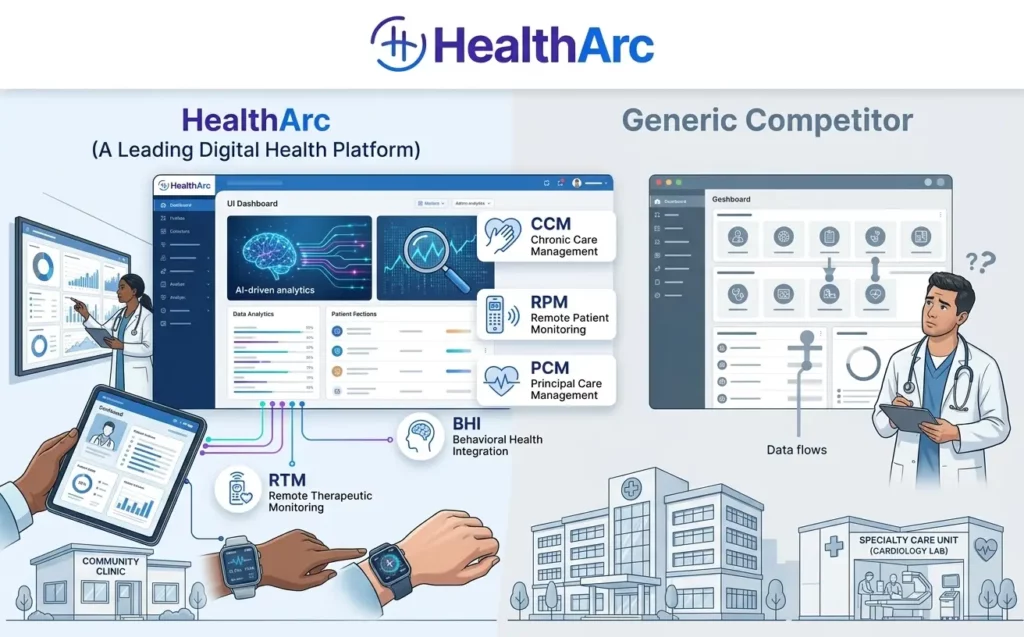
When you’re evaluating care management platforms, the sales pitch is always the same: “one platform, every program.” But the details underneath that claim matter enormously — especially when you’re running CCM for complex chronic patients, scaling RPM across a small practice with five providers, or trying to stack BHI revenue on top of an existing PCM program.
We’ve seen a particular competitor gain traction by marketing aggressively to facility-based operators and practices with small patient panels. Their positioning hits three specific notes: purpose-built CCM for senior living and skilled nursing, no minimum patient requirements, and five-program support (CCM, RPM, PCM, BHI, RTM) on a single platform.
Those are real claims worth taking seriously. And they’re also the right starting point for an honest comparison.
Here’s what this article covers: how HealthArc performs across each of those three dimensions, where we go further, and which platform actually fits your organization’s needs — whether you’re a solo primary care practice, a multi-specialty group, or a large facility operator.
TL;DR: The competitor has carved out a niche in dual-EHR facility environments. HealthArc is the better fit for the vast majority of providers — with deeper program breadth (7 programs vs. 5), a larger device ecosystem (40+ devices), more EHR integrations (14+), AI-powered clinical workflows, and transparent all-inclusive pricing.
How the Two Platforms Stack Up: A Quick Comparison
Before going deep on each program, here’s the side-by-side view:
| Feature | HealthArc | The Competitor |
|---|---|---|
| Programs Supported | CCM, RPM, PCM, BHI, RTM, TCM, APCM, MTM (8 programs) | CCM, RPM, PCM, BHI, RTM (5 programs) |
| EHR Integrations | 14+ EHRs (Epic, eClinicalWorks, athenahealth, DrChrono, Veradigm, and more) | 8 EHRs, dual-EHR capable |
| Connected Devices | 40+ medical devices (cellular, Bluetooth, BYOD, CGM) | FDA-cleared devices, device count not published |
| AI Capabilities | AI scribe, predictive analytics, AI-powered care pathways, automated alerts | Not specified |
| Facility-Based CCM | Supported for nursing homes, elderly care facilities, hospitals | Core specialty (senior living, SNFs) |
| Small Practice Support | No minimum patient requirements; scales from solo to health system | No minimum patient requirements |
| Billing Automation | Full CPT automation across all 8 programs, audit-ready documentation | Time tracking + documentation for 5 programs |
| Pricing Model | All-inclusive per patient per month; no hidden device fees | ~$175-220/patient/month (RPM); not fully published |
| Compliance | HIPAA + SOC 2 certified | Not specified |
| Clinical Support | Optional pod-based teams (RNs, LPNs, MAs, enrollment specialists) | Dedicated support from day one |
The key takeaway: where the competitor runs deep on one specific niche (facility-based CCM with dual-EHR bridging), HealthArc runs wide across the full spectrum of care settings, program types, and provider sizes.
Facility-Based CCM: Where the Competitor Claims an Edge
Let’s be direct about this one. The competitor has built a specific capability for dual-EHR environments — situations where a senior living facility uses one EHR (like PointClickCare) and the attending physician uses a different one (like athenahealth or Epic). Their platform bridges both systems simultaneously, routing care plans and clinical documentation to each side of the care team.
That is a genuinely useful feature for a narrow segment of the market.
What HealthArc Offers for Facility-Based Workflows
HealthArc’s platform was built to serve healthcare institutions, hospitals, nursing homes, and elderly care facilities alongside physician practices. Our CCM software integrates with 14+ EHR systems and supports bidirectional data exchange — meaning care plans, clinical notes, and device readings sync in real time across connected systems.
For facility-based CCM, HealthArc delivers:
- Bi-directional EHR integration with Epic, eClinicalWorks, athenahealth, DrChrono, Veradigm, and more — covering the most commonly used systems across both facility and physician settings
- AI-powered care pathways that adapt to chronic condition complexity, reducing documentation burden on facility nursing staff
- Automated CCM billing across CPT codes 99490, 99439, 99491, 99437, 99487, and 99489, with audit-ready time logs and documentation templates
- AI scribe and transcription that captures clinical conversations in real time, eliminating manual charting after patient interactions
The Honest Assessment
If your organization operates a large senior living network and your entire workflow depends on bridging PointClickCare with a physician EHR simultaneously, the competitor’s dual-EHR architecture is purpose-built for that scenario.
For the vast majority of facility-based providers — nursing homes, home health agencies, FQHCs, and hospital-affiliated practices — HealthArc’s 14+ EHR integrations cover the systems they’re actually using, with AI-powered automation that reduces the documentation burden the competitor addresses through manual workflow configuration.
The real differentiator isn’t which EHR you can connect to. It’s what the platform does once it’s connected. HealthArc’s AI scribe, predictive analytics, and automated care pathway generation mean clinical staff spend less time documenting and more time delivering care.
Small Practice Support: No Minimums, Real Scalability
Both platforms claim to serve small practices without minimum patient requirements. This is table stakes in 2026 — any platform that mandates a 50-patient minimum before you can launch is effectively locking out the solo and small group practices that need care management revenue the most.
But “no minimum” is only part of the story. The more important question is: what does the platform actually do to help a small practice succeed with a limited care team?
How HealthArc Serves Small Practices
A two-provider primary care practice doesn’t have a dedicated care coordinator. They have a front desk person who also handles prior auths and a nurse who’s already stretched thin. That’s the reality for most small practices, and it’s why HealthArc built optional clinical support directly into the platform model.
With HealthArc, small practices can:
- Start with software only if they have internal capacity, using our automated workflows, time tracking, and billing documentation to run CCM and RPM without adding headcount
- Add clinical support on demand through our pod-based teams of RNs, LPNs, MAs, and enrollment specialists — scaling up or down without committing to a full-time hire
- Enroll patients across multiple programs simultaneously from day one, so a 20-patient CCM cohort can also be generating RPM and BHI revenue without separate vendor relationships
- Use BYOD (Bring Your Own Device) support, so patients who already have Bluetooth-connected devices at home can transmit data without the practice ordering new equipment
The result: a small practice can launch a compliant CCM program, stack RPM for their hypertension and diabetes patients, and add BHI for behavioral health needs — all from a single dashboard, with billing automation handling CPT code documentation across every program.
Where the Competitor Falls Short for Growing Practices
The competitor’s model is built around workflow customization at the facility level. That works well when you have a dedicated IT team and a clinical operations director to manage the configuration. For a small practice that needs to be monitoring patients in under two weeks, that level of setup overhead is a barrier, not a benefit.
HealthArc’s onboarding is designed for speed. Practices can go live with their first enrolled patients quickly, with AI-driven communication tools handling patient outreach across SMS, email, phone, and in-office channels automatically.
Multi-Program Support: Five Programs vs. Eight
This is where the comparison becomes most consequential. The competitor supports five Medicare care management programs: CCM, RPM, PCM, BHI, and RTM. That’s a solid foundation. But CMS has expanded the care management landscape significantly, and the programs beyond those five are where meaningful additional revenue lives.
HealthArc supports eight programs on a single platform:
| Program | CPT Codes | What It Covers |
|---|---|---|
| CCM (Chronic Care Management) | 99490, 99439, 99491, 99437, 99487, 99489 | Patients with 2+ chronic conditions, 20+ min/month |
| RPM (Remote Patient Monitoring) | 99453, 99454, 99457, 99458 | Real-time vitals via FDA-cleared devices, 16 days/month |
| PCM (Principal Care Management) | 99424, 99425, 99426, 99427 | Single high-complexity chronic condition, 30+ min/month |
| BHI (Behavioral Health Integration) | 99484, 99492, 99493, 99494 | Behavioral health conditions, collaborative care model |
| RTM (Remote Therapeutic Monitoring) | 98975, 98976, 98977, 98980, 98981 | Non-physiological data: musculoskeletal, respiratory, adherence |
| TCM (Transitional Care Management) | 99495, 99496 | Post-discharge care, preventing readmissions |
| APCM (Advanced Primary Care Management) | G0556, G0557, G0558 | Unifies CCM, PCM, TCM, RTM into one streamlined workflow |
| MTM (Medication Therapy Management) | 99605, 99606, 99607 | Medication reconciliation, adherence, polypharmacy risk |
Why the Three Additional Programs Matter
TCM is often the highest-value add for practices with hospitalized patients. A patient discharged from an inpatient stay is at peak readmission risk. Transitional Care Management creates a structured 30-day post-discharge touchpoint that improves outcomes and generates reimbursement that CCM alone doesn’t capture.
APCM is the future of care management billing. CMS introduced Advanced Primary Care Management to reduce the administrative complexity of running multiple concurrent programs. Rather than tracking time separately across CCM, PCM, TCM, and RTM, APCM unifies them into a single workflow with risk-stratified billing codes. Practices that adopt APCM early will have a structural billing advantage as CMS continues to push value-based care models.
MTM captures revenue that most practices leave on the table. Older adults on five or more medications are at significant risk for adverse drug events. Medication Therapy Management provides structured medication reviews that are separately billable — and for practices with large Medicare populations, this represents thousands of dollars in uncaptured monthly revenue.
The competitor’s five-program model covers the core programs well. But it leaves TCM, APCM, and MTM revenue on the table entirely. For a practice managing 100 Medicare patients, that’s a meaningful gap.
The Device and AI Advantage
Care management programs live or die on data quality and clinical workflow efficiency. Two platform capabilities drive both: the breadth of connected devices and the intelligence layer built on top of that data.
Device Ecosystem: 40+ vs. Undisclosed
HealthArc’s singular device portal connects to 40+ medical devices across every major condition category:
- Cardiovascular: Blood pressure monitors, pulse oximeters
- Metabolic: Glucometers, continuous glucose monitors (CGM) from Dexcom, Abbott Freestyle Libre, and Roche
- Respiratory: Spirometers
- Weight management: Connected scales
- Wearables: Apple Watch and other Bluetooth-enabled consumer devices via BYOD
Cellular connectivity means devices work out of the box — patients don’t need to pair Bluetooth or configure apps. The device ships to their home, they use it, and data transmits automatically to the HealthArc dashboard. For elderly patients or those with limited tech literacy, this removes the most common barrier to RPM compliance.
The competitor lists FDA-cleared devices without publishing a specific count or device catalog. For practices evaluating RPM programs that need to support CGM for diabetes patients or spirometry for COPD, that ambiguity is a real procurement risk.
AI-Powered Clinical Workflows
HealthArc launched three major AI capabilities in 2025 that directly address the operational bottlenecks in care management:
- AI Scribe and Transcription: Real-time transcription of clinical conversations, care team notes, and patient interactions. Summaries are generated automatically, reducing post-encounter documentation from minutes to seconds.
- Predictive Analytics Module: Patient data is analyzed to surface risk patterns, trending vitals, and early warning signals before they become emergencies. This shifts care teams from reactive to proactive.
- AI-Driven Communication: Automated outreach across SMS, phone, and email — intelligently escalating from text reminders to phone calls based on patient response patterns and risk scores.
The competitor’s platform is built around workflow customization through manual configuration. HealthArc’s platform learns and adapts. For care teams managing hundreds of patients across multiple programs, that difference compounds quickly.
Key insight: An NPS of 75 — one of the highest in the RPM industry — reflects how clinical staff actually experience the platform day-to-day, not just how it looks in a demo.
Which Platform Is Right for Your Organization?
The honest answer depends on what you’re optimizing for.
Choose the Competitor If:
- Your organization operates exclusively in senior living or skilled nursing facilities
- Your entire clinical workflow depends on simultaneous bridging between PointClickCare (or ALIS) and a physician EHR
- You have a dedicated IT and clinical operations team to manage custom workflow configuration
- You don’t need TCM, APCM, or MTM programs now or in the near future
That’s a real use case. It’s also a narrow one.
Choose HealthArc If:
- You’re a small or mid-size practice that needs to launch quickly without heavy IT overhead
- You’re a multi-specialty group or health system that needs to run CCM, RPM, PCM, BHI, RTM, TCM, APCM, and MTM from a single platform
- You have complex chronic patients who benefit from AI-driven care pathways and predictive risk scoring
- You need 40+ device options to support diverse patient populations across conditions
- You want transparent, all-inclusive pricing with no separate device fees
- You’re planning to grow your enrolled patient population and need a platform that scales without switching vendors
- You serve FQHCs, ACOs, home health agencies, or employer health programs alongside traditional physician practices
The bottom line: most providers aren’t choosing between two platforms that do the same thing differently. They’re choosing between a platform built for one specific facility niche and a platform built for the full range of modern care delivery. For the vast majority of organizations evaluating care management software in 2026, that’s not a close call.
HealthArc’s unified care platform supports your program today and grows with you as CMS continues expanding care management reimbursement. You won’t need to switch vendors when you’re ready to add APCM, or when a patient needs MTM, or when your practice acquires a new location with a different EHR.
One platform. Every program. Every care setting.
Ready to see how HealthArc fits your specific workflows? Schedule a demo and we’ll walk through your exact patient population, program mix, and EHR environment.
Frequently Asked Questions (FAQs)
What makes HealthArc different from other care management platforms?
HealthArc combines CCM, RPM, PCM, BHI, RTM, TCM, APCM, and MTM in one platform, so practices do not need separate tools for each program. It also adds AI-powered workflows, 40+ connected devices, and 14+ EHR integrations to reduce manual work.
How does HealthArc compare with the competitor for facility-based CCM?
The competitor is built for a narrow dual-EHR facility niche, especially senior living and skilled nursing environments. HealthArc is broader, supporting nursing homes, hospitals, elderly care facilities, and physician practices with bi-directional EHR integration and automated CCM workflows.
Is HealthArc a good fit for small practices?
Yes. HealthArc is designed to scale from solo practices to large systems without minimum patient requirements, and it can be used as software-only or with optional clinical support. That makes it practical for small teams that need to launch quickly without heavy IT overhead.
How many programs does HealthArc support?
HealthArc supports 8 programs: CCM, RPM, PCM, BHI, RTM, TCM, APCM, and MTM. This gives practices a wider revenue mix than platforms limited to only the core five programs.
Which programs does the competitor support, and what is missing?
The competitor supports CCM, RPM, PCM, BHI, and RTM. It does not include TCM, APCM, or MTM, which can leave additional reimbursement opportunities on the table for eligible practices.
Does HealthArc support TCM, APCM, and MTM?
Yes. HealthArc includes Transitional Care Management, Advanced Primary Care Management, and Medication Therapy Management, allowing practices to capture post-discharge, unified primary care, and medication-related revenue in one workflow.
How many EHR integrations does HealthArc offer?
HealthArc offers 14+ EHR integrations, including Epic, eClinicalWorks, athenahealth, DrChrono, and Veradigm. That makes it easier for practices to connect across different care settings and reduce configuration complexity.
What types of devices can connect to HealthArc’s RPM program?
HealthArc supports 40+ medical devices, including blood pressure monitors, glucometers, CGMs, pulse oximeters, connected scales, spirometers, and BYOD-compatible wearables. Cellular connectivity also reduces setup friction for patients who are not comfortable with Bluetooth pairing.
Does HealthArc require a minimum patient count to get started?
No. HealthArc does not require a minimum patient volume, so practices can start small and grow over time. That makes it suitable for solo providers, small clinics, and organizations testing new care management programs.
How does HealthArc help reduce documentation and billing work?
HealthArc uses AI scribe, predictive analytics, automated alerts, and billing automation to cut down manual charting and time tracking. It also supports audit-ready documentation across its programs, which helps teams stay compliant while spending more time on patient care.

Jack Whittaker
Sales leader and high level Operator with a demonstrated history of working in the hospital & health care industry.


Categories
Advanced Primary Care Management→AI & Care Coordination→Behavioral Health Integration→Care Management Programs→Chronic Care Management→Digital Health & Software Solutions→General Remote Care Topics→Medication Therapy Management→Pricing & Business Strategy→Principal Care Management→Remote Patient Monitoring→Remote Therapeutic Monitoring→Transitional Care Management→
Related Blog
- May 14, 2026 | Read Time: 24 mins
Can You Refuse Your Medicare Wellness Visit? The Truth Revealed
Can you skip your Medicare wellness visit? Absolutely. This guide is for...
Learn More- May 13, 2026 | Read Time: 22 mins
HealthArc vs Cadence: User Experience Compared
Choosing the right remote care platform can make or break your practice's...
Learn More- April 28, 2026 | Read Time: 12 mins
CMS Reporting Requirements: What Providers Must Know
The United States has one of the most highly regulated healthcare sectors...
Learn More