
By Jack Whittaker
| May 20, 2026
Quick Answer
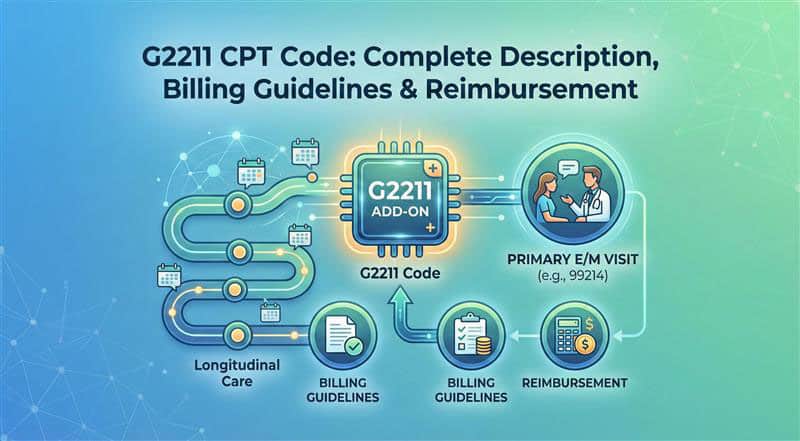
G2211 is a Medicare HCPCS add-on code for certain office or outpatient evaluation and management visits when the provider is serving as the continuing focal point for the patient’s care or managing a serious or complex condition over time.
In plain English: G2211 is not for “extra time.” It is for the added complexity of longitudinal care.
Use G2211 when the visit involves:
- An office or outpatient E/M visit
- An ongoing provider-patient relationship
- Longitudinal responsibility for the patient’s care
- A serious or complex condition that requires continued management
- Documentation that supports why the relationship or condition adds complexity
Do not bill G2211 automatically with every E/M visit. It should be supported by the clinical relationship and the visit context.
G2211 Code Description
CMS describes G2211 as an add-on code for visit complexity tied to an office or outpatient evaluation and management service.
The official descriptor focuses on two ideas:
- The provider is the “continuing focal point” for needed care.
- The visit involves ongoing care for a serious or complex condition.
That wording matters because G2211 is not a generic bonus code. It is meant to recognize the work involved when a clinician is responsible for the patient’s care beyond a single isolated problem.
Why G2211 Exists
Many office visits look simple on paper but require deeper clinical judgment because the provider knows the patient’s history, risks, medication patterns, social barriers, and care plan.
For example:
- A primary care clinician managing diabetes, hypertension, kidney disease, and medication adherence
- A cardiologist following a patient with heart failure over multiple visits
- A rheumatologist managing long-term immunosuppressive therapy
- A pediatrician managing a child with complex developmental or chronic care needs
- A pulmonologist managing COPD with repeated exacerbation risk
In these situations, the provider’s work is not limited to the problem discussed that day. The provider is also managing continuity, risk, care coordination, treatment history, and future planning.
That is the type of complexity G2211 is intended to recognize.
Is G2211 a CPT Code or HCPCS Code?
Most people search for “G2211 CPT code,” but technically G2211 is a HCPCS Level II code, not a standard CPT code.
That said, “G2211 CPT code” is the phrase many billers, providers, and searchers use. It is acceptable to explain it that way for readability, but billing teams should understand that claims use the HCPCS code G2211.
When to Use G2211
Use G2211 when the E/M visit reflects longitudinal care complexity.
Strong examples of when G2211 may apply
| Scenario | Why G2211 may be appropriate |
|---|---|
| Primary care follow-up for multiple chronic conditions | The clinician is the ongoing focal point for broad care needs |
| Diabetes visit with medication adjustment and long-term monitoring plan | The condition requires continuing management |
| Heart failure follow-up with care-plan review | The specialist is managing a serious condition over time |
| COPD management with medication, symptoms, and exacerbation risk review | The visit involves ongoing condition management |
| Complex pediatric care follow-up | The provider is responsible for longitudinal management |
Documentation should show:
- The clinician’s ongoing role in the patient’s care
- The serious or complex condition being managed
- How the visit fits into a longitudinal care plan
- Assessment, plan, medication changes, monitoring, or follow-up needs
- Care coordination or risk considerations when relevant
When Not to Use G2211
Do not use G2211 just because the visit feels complicated or because the provider spent more time than usual.
G2211 is usually not appropriate for:
- A one-time urgent care visit with no ongoing relationship
- A simple acute problem with no longitudinal care responsibility
- A visit where another clinician is clearly the focal point for the condition
- A procedural visit where the E/M service is incidental
- A routine visit where documentation does not show ongoing complexity
- A claim where the base E/M code is not eligible
The easiest way to avoid misuse is to ask:
Would this visit still have the same complexity if the clinician had no ongoing responsibility for this patient’s care?
If the answer is yes, G2211 may not be supported.
G2211 Billing Guidelines
G2211 is an add-on code. It must be billed with an eligible base E/M visit.
Basic billing rules
- G2211 is billed in addition to an eligible office or outpatient E/M code.
- It is not reported by itself.
- It should not replace the E/M code.
- It should be supported by documentation.
- It is generally tied to longitudinal care complexity, not visit duration alone.
Common base E/M codes
G2211 is commonly associated with office or outpatient E/M codes such as:
- 99202-99205 for new patient office or outpatient visits
- 99211-99215 for established patient office or outpatient visits
Billing teams should confirm payer-specific coverage because not all commercial payers follow Medicare rules.
G2211 and Modifier 25
This is one of the most important recent updates.
CMS originally did not allow G2211 when the associated E/M visit was reported with modifier 25. That changed under the CY 2025 Medicare Physician Fee Schedule.
For services on or after January 1, 2025, Medicare allows G2211 on an E/M visit reported with modifier 25 when the same practitioner also furnishes an allowed annual wellness visit, vaccine administration, or Medicare Part B preventive service on the same date.
Practical example
A Medicare patient comes in for an Annual Wellness Visit. During the same encounter, the provider separately evaluates and manages uncontrolled diabetes, adjusts medication, and updates the longitudinal care plan.
If documentation supports a separate E/M service with modifier 25, and the visit also meets G2211 requirements, G2211 may be considered under current Medicare rules.
Important warning
Do not add G2211 just because modifier 25 is present. Modifier 25 supports a separately identifiable E/M service. G2211 still needs its own longitudinal complexity rationale.
Can G2211 Be Billed With G0439?
G0439 is the code for a subsequent Medicare Annual Wellness Visit.
The AWV itself is a preventive service. G2211 is not added directly to G0439 as a routine add-on.
However, if the same practitioner also performs a separately identifiable office or outpatient E/M service on the same date, and that E/M service is appropriately reported with modifier 25, G2211 may be allowed when the requirements are met.
Example
The patient receives a subsequent AWV under G0439. During the same visit, the clinician also evaluates worsening hypertension, reviews home blood pressure readings, adjusts medication, and updates the long-term care plan.
Possible coding path:
- G0439 for the AWV
- Eligible E/M code with modifier 25 for the separately identifiable problem-oriented service
- G2211 if the E/M service reflects longitudinal care complexity
The documentation must clearly separate the AWV work from the problem-oriented E/M work.
Can G2211 Be Billed With Telehealth?
G2211 may be billed with eligible telehealth E/M services when payer rules allow the underlying E/M service and documentation supports the add-on code.
The main question is not whether the visit happened by video or in person. The main question is whether the associated E/M visit qualifies and whether the provider’s role reflects longitudinal care complexity.
For Medicare, telehealth policy changes frequently. Billing teams should verify the current telehealth status of the base E/M code, place-of-service rules, modifiers, and payer instructions before submitting claims.
G2211 and Medicare vs Commercial Insurance
G2211 is a Medicare code, but some commercial payers may recognize it.
Do not assume all payers treat G2211 the same way.
Medicare
Medicare provides the clearest policy framework for G2211. Use Medicare rules when billing traditional Medicare claims.
Medicare Advantage
Medicare Advantage plans may follow Medicare policy, but plan-specific billing rules and edits can vary.
Commercial payers
Some commercial payers may cover G2211, some may reject it, and some may require different documentation or policy criteria.
Recommended workflow:
- Confirm payer policy before broad implementation.
- Add payer-specific billing rules to your practice management system.
- Train providers on documentation requirements.
- Monitor denials and underpayments by payer.
G2211 Reimbursement and RVU Value
G2211 has its own relative value and reimbursement amount under the Medicare Physician Fee Schedule.
The exact payment amount can change by year, locality, conversion factor, and payer. Instead of hardcoding a national amount into your workflow, billing teams should verify the current Medicare Physician Fee Schedule amount for the service year and locality.
Why this matters
Even though the per-visit payment may look modest, accurate G2211 use can become meaningful when applied correctly across a patient panel with ongoing chronic and complex care needs.
But the goal should not be to maximize G2211 volume. The goal should be to capture appropriate reimbursement when documentation supports the work.
G2211 Documentation Examples
Documentation should be specific. It should not say only:
“G2211 billed due to complexity.”
That is too thin.
Better documentation explains why the provider’s ongoing role matters.
Example 1: Primary care diabetes and hypertension
Patient seen for follow-up of type 2 diabetes and hypertension. Reviewed home blood pressure trend, A1c history, medication adherence, and renal risk. Adjusted antihypertensive therapy and updated longitudinal care plan. Patient will continue follow-up with primary care as focal point for chronic disease management.
Example 2: Heart failure specialist follow-up
Patient with chronic heart failure seen for symptom review and medication management. Reviewed weight trend, edema, shortness of breath, diuretic use, and recent remote readings. Updated treatment plan and follow-up monitoring due to ongoing serious condition requiring longitudinal specialty management.
Example 3: COPD management
Patient with COPD seen for worsening exertional symptoms and inhaler adherence review. Assessed exacerbation risk, oxygen saturation history, medication use, and pulmonary follow-up needs. Continued longitudinal management plan with escalation instructions.
These examples are not claim instructions. They show the type of clinical reasoning that should be visible when G2211 is used.
G2211 Coding Decision Tree
Use this simple decision path before adding G2211:
- Is there an eligible office or outpatient E/M visit?
- If no, do not bill G2211.
- Is the provider managing the patient longitudinally or serving as a continuing focal point?
- If no, do not bill G2211.
- Does the visit involve a serious or complex condition, or broad ongoing care responsibility?
- If no, do not bill G2211.
- Does the note explain the complexity?
- If no, improve documentation before billing.
- Is modifier 25 involved?
- If yes, confirm the current Medicare or payer rule and ensure separate E/M documentation is clear.
How G2211 Fits With Care Management Programs
G2211 is not a care management program. It is an add-on code for visit complexity.
However, the same patients who may support G2211 often need structured care between visits.
For example:
- A patient with multiple chronic conditions may need Chronic Care Management
- A patient with one high-risk complex condition may need Principal Care Management
- A patient whose condition requires home physiologic monitoring may need Remote Patient Monitoring
- A patient leaving the hospital may need Transitional Care Management
- A practice building preventive and longitudinal workflows may need Advanced Primary Care Management
HealthArc helps healthcare organizations connect these programs through a digital health platform built for care teams, documentation, and program operations.
Common G2211 Mistakes
Mistake 1: Billing G2211 on every E/M visit
G2211 is not automatic. The documentation should show why the provider’s role or the patient’s condition adds visit complexity.
Mistake 2: Treating G2211 as a time-based code
G2211 is not primarily about minutes. It is about longitudinal complexity.
Mistake 3: Using G2211 for isolated acute care
A standalone urgent issue may not support G2211 unless the provider’s ongoing role and complexity are clear.
Mistake 4: Adding G2211 to preventive services without a separate E/M
G2211 is not simply added to an AWV code such as G0439. If an E/M service is performed separately, document it separately.
Mistake 5: Ignoring commercial payer rules
Commercial payer coverage varies. Build payer-specific edits before scaling G2211 billing.
Mistake 6: Weak documentation
If the note does not explain the longitudinal care relationship or serious condition management, the code is easier to deny.
Provider Checklist for G2211
Before billing G2211, confirm:
- The base E/M code is eligible.
- The provider has ongoing responsibility for the patient’s care.
- The visit involves longitudinal care complexity.
- The note explains that complexity.
- Modifier 25 rules are followed when applicable.
- The payer recognizes the code.
- The billing team tracks denial patterns.
FAQs about G2211 CPT code
Q1. What is G2211?
G2211 is a Medicare HCPCS add-on code for visit complexity associated with certain office or outpatient E/M visits. It is used when the provider is the continuing focal point for care or manages a serious or complex condition over time.
Q2. What is the G2211 CPT code description?
G2211 describes visit complexity connected to longitudinal care responsibility or ongoing management of a serious or complex condition. Technically, G2211 is a HCPCS code, although many people search for it as a CPT code.
Q3. Can G2211 be billed with modifier 25?
For services on or after January 1, 2025, Medicare allows G2211 with an E/M code reported with modifier 25 in specific circumstances, including when the same practitioner provides certain preventive services on the same date. Documentation must still support the separate E/M service and the G2211 complexity.
Q4. Can G2211 be billed with G0439?
G2211 is not added directly to G0439 alone. If a separately identifiable E/M service is performed on the same date as the AWV and billed with modifier 25, G2211 may be considered when the E/M service meets G2211 requirements.
Q5. Is G2211 only for Medicare?
G2211 is a Medicare HCPCS code. Some commercial payers may recognize it, but coverage varies. Practices should verify payer policy before billing it broadly.
Q6. Can G2211 be billed for telehealth?
G2211 may be billed with eligible telehealth E/M services when payer rules allow the base E/M code and documentation supports the add-on code. Always verify current Medicare and payer telehealth rules.
Q7. What is the reimbursement for G2211?
G2211 reimbursement depends on the Medicare Physician Fee Schedule year, locality, conversion factor, and payer policy. Billing teams should verify the current amount for the service year and location.
Q8. Is G2211 for pediatrics?
G2211 may be relevant in pediatric settings when the payer recognizes the code and the visit meets the requirements for longitudinal care complexity. Coverage and payment rules should be verified by payer.
Final Takeaway
G2211 is useful when it is used carefully.
It is not a code for every visit, every chronic condition, or every long appointment. It is for eligible E/M visits where the provider’s ongoing role in the patient’s care adds meaningful complexity.
The strongest G2211 claims have three things in common:
- A qualifying E/M visit
- A clear longitudinal care relationship or serious condition-management role
- Documentation that explains why the visit required that added complexity
For organizations managing high-risk and chronic populations, G2211 should be part of a larger documentation and care-management strategy, not a standalone billing tactic.

Ready to connect care between visits?
See how HealthArc runs RPM, CCM and seven more CMS programs — the platform, the devices and the clinical team — on a single demo.