
By Jack Whittaker
| May 20, 2026
Quick Answer
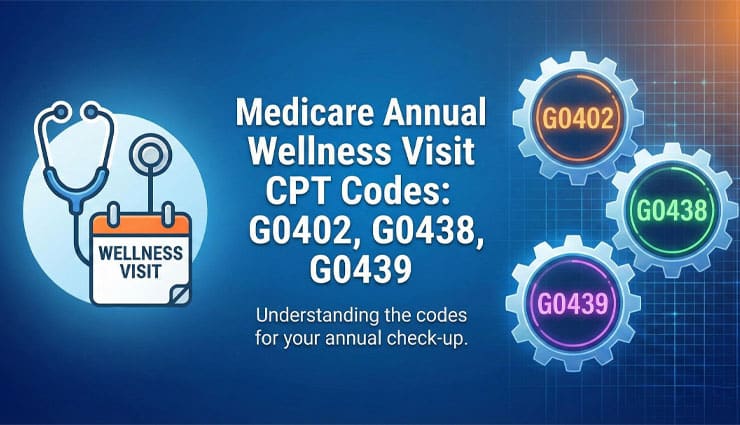
The main Medicare Annual Wellness Visit codes are G0402, G0438, and G0439.
| Code | Use Case | When It Applies |
|---|---|---|
| G0402 | Initial Preventive Physical Examination, also called the “Welcome to Medicare” visit | Once, within the patient’s first 12 months of Medicare Part B enrollment |
| G0438 | Initial Annual Wellness Visit | Once, after the patient has had Medicare Part B for more than 12 months and has not received an AWV before |
| G0439 | Subsequent Annual Wellness Visit | Once every 12 months after the initial AWV |
The most common mistake is treating an Annual Wellness Visit like a routine annual physical. It is not the same service. Medicare describes the yearly wellness visit as a visit to “develop or update your personalized plan” to help prevent disease and disability. Medicare.gov
For providers, the coding decision usually comes down to three questions:
- Is the patient in the first 12 months of Medicare Part B?
- Has the patient already received an initial Annual Wellness Visit?
- Is the visit preventive planning only, or was a separate problem-oriented issue evaluated and managed?
This guide explains how to choose the right code, what to document, and where billing mistakes usually happen.
What Is a Medicare Annual Wellness Visit?
A Medicare Annual Wellness Visit, often called an AWV, is a preventive visit focused on risk assessment, health planning, and care coordination. It is designed to help the provider build or update a personalized prevention plan for the patient.
An AWV usually includes:
- Health risk assessment
- Review of medical and family history
- Medication and provider list review
- Height, weight, blood pressure, and other routine measurements
- Cognitive impairment screening
- Depression, fall risk, and functional ability screening when appropriate
- Review of preventive services due
- Personalized prevention plan
- Advance care planning discussion when appropriate
CMS explains that the AWV includes a health risk assessment and a personalized prevention plan. CMS Annual Wellness Visit
The key point: an AWV is not a head-to-toe exam. It is a structured preventive planning visit.
Annual Wellness Visit vs Annual Physical
Patients often ask for an “annual physical,” but Medicare’s Annual Wellness Visit is different.
| Topic | Annual Wellness Visit | Annual Physical |
|---|---|---|
| Primary purpose | Prevention planning and risk assessment | Comprehensive physical examination |
| Medicare coverage | Covered when eligibility rules are met | Routine physical exams are generally not covered by Original Medicare |
| Main codes | G0402, G0438, G0439 | Usually CPT preventive medicine codes such as 99397, depending on payer and patient type |
| Exam scope | Limited measurements and screenings | Broader physical exam |
| Main output | Personalized prevention plan | Exam findings and clinical assessment |
Medicare states that the yearly wellness visit is not a physical exam. That distinction matters because billing a non-covered routine physical as a covered AWV can create compliance risk. Medicare.gov
When to Use G0402: Welcome to Medicare Visit
Use G0402 for the Initial Preventive Physical Examination, commonly called the Welcome to Medicare visit.
Use G0402 when:
- The patient is within the first 12 months of Medicare Part B enrollment
- The patient has not already received the Welcome to Medicare visit
- The visit meets the required preventive visit elements
CMS describes G0402 as the initial preventive physical examination and lists it as a once-per-lifetime Medicare wellness service. CMS Medicare Wellness Visits
Do not use G0402 when:
- The patient has had Medicare Part B for more than 12 months
- The patient is coming for a subsequent yearly wellness visit
- The service was a problem-focused evaluation only
- The patient received a routine physical that does not meet Medicare’s preventive visit rules
Practical example
A patient enrolled in Medicare Part B six months ago and schedules a preventive visit. The provider reviews history, risk factors, preventive services due, and creates the required plan. If the documentation supports the service, G0402 is the correct code.
When to Use G0438: Initial Annual Wellness Visit
Use G0438 for the patient’s first Annual Wellness Visit after the Welcome to Medicare window has passed.
Use G0438 when:
- The patient has had Medicare Part B for more than 12 months
- The patient has not received an initial AWV before
- The service includes the required AWV elements
G0438 is not used every year. It is for the first AWV only.
Do not use G0438 when:
- The patient is still in the first 12 months of Medicare Part B
- The patient already had an initial AWV
- The visit is a subsequent AWV
- The visit is only a problem-oriented encounter
Practical example
A patient has been enrolled in Medicare Part B for three years but has never completed an AWV. The practice performs the required assessment and creates a personalized prevention plan. In this case, G0438 is the correct code.
When to Use G0439: Subsequent Annual Wellness Visit
Use G0439 for a subsequent Medicare Annual Wellness Visit.
Use G0439 when:
- The patient already received an initial AWV
- At least 12 months have passed since the last AWV
- The provider updates the patient’s risk assessment and prevention plan
G0439 is the code many practices use most often because it applies to ongoing yearly AWVs after the initial AWV has already been completed.
Do not use G0439 when:
- The patient has never had an initial AWV
- Fewer than 12 months have passed since the last AWV
- The visit does not include the required AWV documentation
Practical example
A patient completed an initial AWV last year. This year, the practice updates the health risk assessment, medication list, preventive screening schedule, and personalized prevention plan. If the timing requirement is met, G0439 is the correct code.
G0402 vs G0438 vs G0439
Here is the simplest way to choose the right Medicare wellness visit code:
| If the patient is… | Use this code |
|---|---|
| In the first 12 months of Medicare Part B | G0402 |
| Past the first 12 months and has never had an AWV | G0438 |
| Returning for a yearly AWV after the initial AWV | G0439 |
If your team is unsure which code applies, check the patient’s Medicare Part B effective date and AWV history before the visit. Many claim problems start because the code was selected from habit rather than eligibility.
What Must Be Documented for an Annual Wellness Visit?
Good AWV documentation should show that the visit was more than a brief conversation. It should make the preventive planning work visible.
Document these elements clearly:
1. Health risk assessment
The health risk assessment should capture the patient’s self-reported health, psychosocial risks, behavioral risks, activities of daily living, and other preventive care indicators.
2. Medical and family history
Include past medical history, surgical history, family history, medications, allergies, supplements, and current providers involved in the patient’s care.
3. Routine measurements
Document height, weight, body mass index, blood pressure, and any other routine measurements required for the visit.
4. Cognitive and functional screening
The record should show that cognitive status and functional ability were reviewed when required. This may include fall risk, hearing, activities of daily living, and home safety.
5. Depression and behavioral risk review
Many AWVs include depression screening, alcohol use review, tobacco use review, nutrition counseling opportunities, and physical activity review.
6. Preventive service schedule
Create or update the patient’s screening and preventive service schedule. This may include vaccines, cancer screenings, cardiovascular risk review, diabetes screening, osteoporosis screening, and other age- or risk-based services.
7. Personalized prevention plan
The prevention plan is the center of the AWV. It should list risks identified during the visit and the next steps the patient and care team should take.
This is where many practices can improve. A generic note that says “preventive counseling provided” is weaker than a plan that clearly states what was reviewed, what is due, and what follow-up is needed.
Can You Bill an E/M Visit With an Annual Wellness Visit?
Sometimes, yes. But the documentation must support a separately identifiable problem-oriented service.
For example, during an AWV, a patient may raise a new issue such as uncontrolled blood pressure, worsening shortness of breath, medication side effects, or new pain. If the provider evaluates and manages that problem beyond the preventive AWV work, a separate E/M service may be appropriate.
In that case:
- The AWV code may be billed for the preventive service
- The problem-oriented E/M code may be billed separately when medically necessary
- Modifier 25 may be required on the E/M code
- Documentation must clearly separate the preventive AWV work from the problem-focused evaluation
Do not add an E/M code just because the visit took longer. Add it only when the record supports a distinct evaluation and management service.
Can G2211 Be Billed With G0439?
This is a common question because G2211 is used for visit complexity in certain longitudinal care relationships.
The safest answer is: do not assume it can be added automatically to an AWV. G2211 is tied to certain office or outpatient E/M visits, not to every preventive service. If a separately identifiable E/M service is performed on the same date as an AWV, billing teams should review current CMS guidance, payer rules, and documentation before adding G2211.
For practices managing complex chronic conditions, this is also a reminder that the AWV should not carry the entire care burden. Chronic care needs may be better supported through programs such as Chronic Care Management, Principal Care Management, or Advanced Primary Care Management.
AWV Codes and Common Add-On Services
An AWV can identify the need for other preventive or care-management services. Some may be furnished separately when requirements are met.
Common related services include:
| Service | Why It May Come Up During AWV |
|---|---|
| Advance care planning | Patient wants to discuss future care preferences |
| Depression screening | Risk identified during health risk assessment |
| Alcohol misuse screening | Behavioral risk identified |
| Chronic Care Management | Patient has multiple chronic conditions requiring ongoing care coordination |
| Principal Care Management | One complex chronic condition needs focused management |
| Remote Patient Monitoring | Patient needs ongoing physiologic monitoring outside the clinic |
| Care coordination | Patient has gaps in preventive care or multiple care-team handoffs |
If you offer remote care programs, the AWV can become a useful front door for identifying patients who need more structured support. For example, a patient with uncontrolled hypertension may benefit from Remote Patient Monitoring, while a patient with multiple chronic conditions may be a better fit for Chronic Care Management.
FQHCs, RHCs, and Annual Wellness Visits
Federally Qualified Health Centers and Rural Health Clinics should pay close attention to AWV billing rules because payment methodology and claim submission can differ from standard physician office billing.
For FQHCs and RHCs, the key questions are:
- Is the patient eligible for the AWV?
- Was the required preventive service documented?
- Does the claim follow the correct billing method for the setting?
- Are additional preventive services separately payable or bundled?
Do not copy physician-office billing rules into FQHC or RHC workflows without checking current Medicare guidance.
Common Annual Wellness Visit Coding Mistakes
Mistake 1: Using G0439 when the patient needs G0438
G0439 is for subsequent AWVs. If the patient has never had an initial AWV, G0438 is usually the correct code.
Mistake 2: Billing an AWV as an annual physical
The AWV is a preventive planning visit. A routine physical is different and may not be covered by Original Medicare.
Mistake 3: Missing the 12-month rule
G0439 generally requires that at least 12 months have passed since the previous AWV.
Mistake 4: Weak prevention-plan documentation
The prevention plan should be specific enough that another clinician can understand what was reviewed and what follow-up is recommended.
Mistake 5: Adding an E/M code without separate documentation
If a problem-oriented E/M service is billed on the same day, the note must support it separately from the AWV.
Mistake 6: Forgetting patient communication
Patients often believe the AWV is a physical. Explain the purpose before the visit so they know what to expect and what may create additional cost-sharing.
How Practices Can Improve AWV Workflows
The best AWV programs are built before the patient enters the room.
Before the visit
- Confirm Medicare eligibility and prior AWV history
- Send the health risk assessment ahead of time
- Review preventive services due
- Prepare medication and provider-list review
- Identify open care gaps
During the visit
- Confirm history and risk factors
- Complete required screenings
- Review medications and care team
- Discuss preventive services
- Create or update the prevention plan
- Identify patients who may need CCM, PCM, RPM, or other follow-up programs
After the visit
- Close preventive care gaps
- Schedule follow-up services
- Route patients into appropriate care-management programs
- Track documentation completeness
- Review billing accuracy
HealthArc helps healthcare organizations connect preventive care, care coordination, and remote care workflows through one digital health platform. For providers managing Medicare populations, that connection matters because an AWV often reveals care gaps that should not be left sitting in a note.
FAQs About 2026 Medicare Annual Wellness Visit CPT Codes
Q1. What is the CPT code for an Annual Wellness Visit?
Medicare AWVs use HCPCS codes rather than standard CPT preventive medicine codes. The main codes are G0402, G0438, and G0439.
Q2. What is G0439?
G0439 is used for a subsequent Medicare Annual Wellness Visit. It applies after the patient has already received the initial AWV and timing requirements are met.
Q3. What is G0438?
G0438 is used for the initial Medicare Annual Wellness Visit. It is generally used once, after the patient has had Medicare Part B for more than 12 months and has not had an AWV before.
Q4. What is G0402?
G0402 is the Welcome to Medicare preventive visit, also called the Initial Preventive Physical Examination. It is available once during the first 12 months of Medicare Part B enrollment.
Q5. Is an Annual Wellness Visit the same as a physical?
No. The Annual Wellness Visit is focused on prevention planning and risk assessment. A routine physical exam is a different service and is generally not covered by Original Medicare in the same way.
Q6. Can a provider bill G0439 every year?
G0439 can be used for subsequent AWVs when eligibility and timing requirements are met. Practices should confirm that at least 12 months have passed since the prior AWV.
Q7. Can AWV be billed with chronic care management?
An AWV may help identify patients who qualify for Chronic Care Management, but CCM has separate consent, eligibility, time, and documentation requirements. Do not treat the AWV itself as CCM.
Q8. Who is allowed to bill for Medicare Annual Wellness Visits?
Physicians, nurse practitioners, physician assistants, certified nurse specialists, and other qualified health professionals may perform and bill AWVs in accordance with CMS guidelines and state scope-of-practice regulations.
Q9. How often can G0438 and G0439 be billed for a patient?
G0438 is allowed once in a lifetime as the initial AWV. G0439 is allowed once every 12 months thereafter. Only one AWV (either G0438 or G0439) is covered per beneficiary in any 12-month period.
Q10. What diagnosis code should be used with annual wellness visit CPT codes?
Common Medicare diagnosis codes for AWVs include preventive Z-codes such as Z00.00 (general medical examination) or other appropriate Z codes, billed along with the correct HCPCS code and standard claim elements.
Final Takeaway
Annual Wellness Visit coding is simple only when the workflow is clean.
Use G0402 for the Welcome to Medicare visit, G0438 for the first Annual Wellness Visit, and G0439 for subsequent Annual Wellness Visits. Then make sure the documentation proves the service: health risk assessment, screenings, preventive service schedule, and a personalized prevention plan.
For providers, the real opportunity is bigger than the claim. A well-run AWV program can uncover care gaps, identify patients who need chronic care support, and connect preventive planning with ongoing care management.


Ready to connect care between visits?
See how HealthArc runs RPM, CCM and seven more CMS programs — the platform, the devices and the clinical team — on a single demo.