
By Sudeep Bath
| July 3, 2026
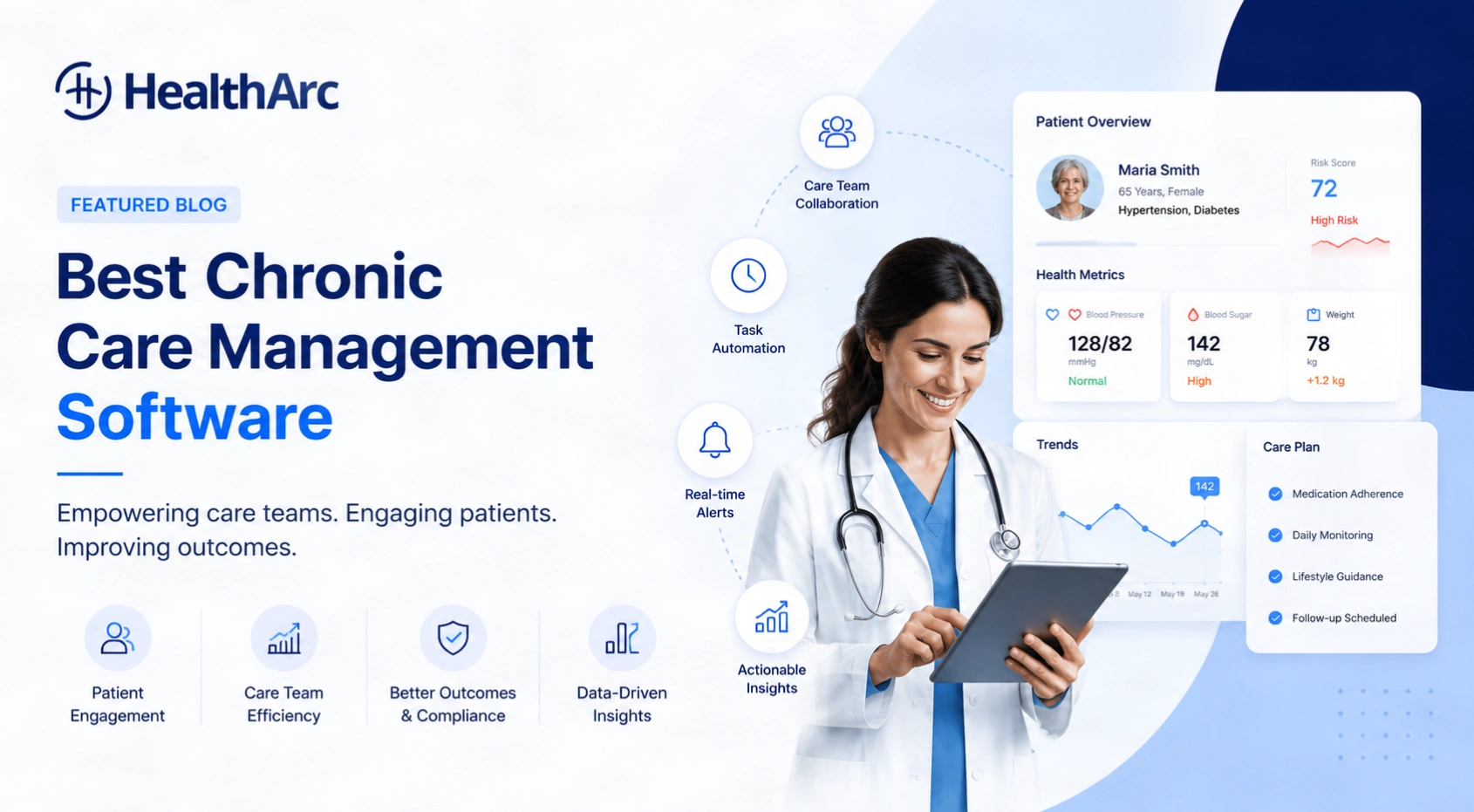
Six in ten American adults live with at least one chronic disease, and four in ten manage two or more, according to the CDC. For physician practices, that means the majority of a typical Medicare panel qualifies for Chronic Care Management (CCM) — yet most of that care happens between office visits, where it’s hardest to deliver, document, and bill.
That’s the problem chronic care management software solves. The right platform identifies eligible patients, captures consent, tracks every minute of non-face-to-face care time, keeps care plans current, and generates audit-ready claims for CPT codes like 99490 and 99491 — turning care coordination into both better outcomes and predictable recurring revenue.
This guide is for physician practices, specialty groups, health systems, FQHCs, and care management teams evaluating the best chronic care management software and companies in 2026. We rank the 10 best CCM software platforms — including our own, HealthArc, which we’ve placed first for reasons we make transparent below — profile additional CCM companies worth knowing, and close with a buyer’s checklist, reimbursement math, and FAQs. Whether you’re shopping for software to run in-house or a full-service CCM company to manage the program for you, this list covers both.
Key Takeaways
- HealthArc ranks #1 for unifying CCM, RPM, RTM, PCM, TCM, and BHI in a single platform with automated time tracking and flexible software-only or fully managed delivery.
- CPT 99490 alone reimburses roughly $60 per patient per month (national average) — a 200-patient CCM program can generate approximately $144,000 per year before add-on codes.
- The deciding factors when choosing CCM software are EHR integration, automated time capture, audit-ready billing, patient engagement tooling, and staffing model flexibility.
- Platforms that run CCM and RPM on one patient record let you bill both programs concurrently without duplicated workflows or double-counted minutes.
Table of Contents
What Is Chronic Care Management Software?
Chronic care management software is a digital platform that helps providers deliver and bill Medicare’s CCM program — structured, non-face-to-face care coordination for patients with two or more chronic conditions expected to last at least 12 months. Core capabilities include eligibility identification, consent capture, electronic care planning, automated time logging, care team task management, and billing-ready documentation mapped to CCM CPT codes.
Done well, CCM software solves three problems simultaneously. It keeps patients with diabetes, hypertension, COPD, heart failure, and similar conditions engaged between visits. It gives care coordinators one workspace to log every call, medication reconciliation, and referral. And it protects the practice in an audit with time-stamped records of every billable minute.
The strongest platforms in 2026 go further, bundling CCM with Remote Patient Monitoring (RPM), Remote Therapeutic Monitoring (RTM), Principal Care Management (PCM), Transitional Care Management (TCM), and Behavioral Health Integration (BHI) — so one patient panel supports multiple reimbursable care programs from a single workflow.
Best CCM Software at a Glance
| Rank | Software | Best For | CCM + RPM Combined | Service Model |
|---|---|---|---|---|
| 1 | HealthArc | All-in-one care management at any practice size | ✅ Yes | Software-only or full-service |
| 2 | ChartSpan | Turnkey, fully managed CCM | Limited | Full-service |
| 3 | ThoroughCare | Care-coordination workflow depth | ✅ Yes | Software-only |
| 4 | Prevounce | Compliance-first CCM/RPM billing | ✅ Yes | Software + devices |
| 5 | HealthSnap | Health systems with RPM-led programs | ✅ Yes | Full-service |
| 6 | Optimize Health | RPM-first practices adding CCM | ✅ Yes | Software or managed |
| 7 | CareSimple | Device-driven virtual care at scale | ✅ Yes | Platform + devices |
| 8 | Signallamp Health | Embedded remote nursing teams | Limited | Full-service |
| 9 | ChronicCareIQ | Small practices starting CCM | ✅ Yes | Software-only |
| 10 | TimeDoc Health | Community health centers and FQHCs | ✅ Yes | Hybrid |
The 10 Best Chronic Care Management Software Platforms
1. HealthArc — Best Overall Chronic Care Management Software
Full disclosure: HealthArc is our platform. We’ve placed it first because the combination it offers — every major care management program on one system, automated billing compliance, and a staffing model you can dial up or down — is the exact gap most practices tell us the rest of the market leaves open.
What you get with HealthArc:
- One platform for six programs. CCM, Remote Patient Monitoring, RTM, PCM, TCM, and BHI run on a single patient record. Enroll a patient once, run every eligible program, and bill each one cleanly.
- Automated time tracking and CPT mapping. Every care activity — calls, chart reviews, care plan updates, device data reviews — is logged automatically and mapped to the correct code (99490, 99439, 99491, 99437, and complex CCM 99487/99489). No manual timers, no missed minutes, no double-counting between CCM and RPM.
- Audit-ready billing reports. Time-stamped activity logs, stored consent records, and one-click monthly billing summaries mean claims go out clean and documentation stands up to CMS scrutiny.
- Integrated RPM devices. Cellular-connected blood pressure monitors, glucometers, weight scales, and pulse oximeters feed vitals into the same dashboard your care coordinators use for CCM outreach — no apps or Wi-Fi setup required for patients.
- Patient engagement built in. Multi-language support, automated reminders, in-app messaging, and a patient-facing app keep enrollment retention high — the single biggest driver of sustained CCM revenue.
- Flexible delivery model. Run the program with your own staff on our software, or let HealthArc’s clinical care team handle enrollment and monthly care coordination as a fully managed service. Start one way, switch later as your capacity changes.
- EHR integration and real-time analytics. Connect to major EHRs and track enrollment, time-to-billing-threshold, patient adherence, and program revenue from live dashboards.
Best for: Practices and health systems of any size that want CCM and RPM unified, billing compliance automated, and the freedom to choose between software-only and turnkey care management.
The bottom line: Most vendors are strong at either managed CCM services or RPM technology. HealthArc is built to be both — which is why practices that start with one program routinely expand to three or four on the same platform.
See it for yourself: Book a HealthArc demo and we’ll model the CCM revenue potential of your actual patient panel.
2. ChartSpan — Best Fully Managed CCM Service
ChartSpan is one of the largest managed CCM providers in the U.S. Its clinical staff handles enrollment, monthly outreach, and billing-ready claims end to end, which makes it attractive for practices that want CCM revenue with minimal internal lift. The trade-off is flexibility: practices that want to keep care coordination in-house, or pair CCM tightly with RPM, will find the model constraining.
3. ThoroughCare — Best for Care Coordination Workflow Depth
ThoroughCare is a software-only platform with guided, interview-style workflows across CCM, RPM, TCM, BHI, and Annual Wellness Visits that generate SMART-goal care plans. It’s a strong fit for organizations that already employ care coordinators and want structured workflows and time-to-threshold analytics; it does not provide staffing.
4. Prevounce — Best for Compliance-First Billing
Prevounce pairs CCM and RPM software with automated eligibility checks, CMS-aligned documentation prompts, and its own Pylo line of cellular devices. Practices whose top concern is audit risk and clean claims will appreciate the compliance guardrails baked into every workflow.
5. HealthSnap — Best for Health Systems Running RPM-Led Programs
HealthSnap is an integrated virtual care platform used by larger health systems, with population-scale RPM at its core and CCM offered as a companion program alongside managed clinical staffing. It suits enterprise organizations whose chronic care strategy starts with vitals monitoring.
6. Optimize Health — Best for RPM-First Practices Adding CCM
Optimize Health built its reputation on remote monitoring and has since added CCM and managed services. Practices already running RPM on the platform can layer CCM onto the same panel with relatively little friction, in either self-run or staffed configurations.
7. CareSimple — Best for Device-Driven Virtual Care at Scale
CareSimple ships pre-configured cellular devices directly to patients and supports RPM, CCM, TCM, and PCM on its platform. It’s geared toward payers and large provider organizations that prioritize frictionless patient onboarding at high volume.
8. Signallamp Health — Best for Embedded Remote Nursing
Signallamp Health embeds dedicated remote nurses into your practice who chart directly inside your existing EHR rather than a separate platform. It suits practices that want relationship-driven care management without adopting new software — and won’t suit those that want their own platform, dashboards, and analytics.
9. ChronicCareIQ — Best for Small Practices Starting CCM
ChronicCareIQ uses automated patient check-in questions to surface issues, generate billable engagement, and trigger care team follow-up. Its lightweight footprint and pricing make it a practical entry point for small practices piloting CCM.
10. TimeDoc Health — Best for Community Health Centers and FQHCs
TimeDoc Health focuses on virtual care management for community health centers, FQHCs, and rural providers, combining CCM, RPM, and BHI with EHR-integrated documentation and optional care coordination staffing to extend lean internal teams.
Other Notable CCM Companies
Beyond the ten platforms above, several other chronic care management companies serve specific niches well. We evaluated them on the same criteria used throughout this list — user interface, feature depth, EHR integration, care coordination support, and customer service — and depending on your patient population and internal resources, any could be the right fit:
CareMerge — Best for EHR-Connected Care Coordination
CareMerge’s technology connects to your practice’s existing EHR to improve communication and coordination between providers and CCM patients. Care teams craft and manage the Medicare care plan, track time, and enhance patient communication, while the platform generates automatic, comprehensive reports of the services delivered to support Medicare compliance.
Vatica Health — Best for Nurse-Led CCM with Device Monitoring
Vatica Health pairs technology with 24-hour nursing support, making it easy for patients to reach remote care and over-the-phone consultations. Its nurses collaborate with providers on a comprehensive treatment plan that can be shared across a patient’s care team, and the platform combines wearable devices and health monitors for real-time monitoring alongside monthly health reports to clinicians.
CareSync — Best for Continuous Care Coordination
CareSync is a care coordination platform built to give chronically ill patients continuous access to clinical care, either online or over the phone. Notable features include comprehensive patient care plans, MACRA quality-metric tracking, physician reporting, and wearable-device integration — a fit for practices that want coordination and quality reporting in one place.
Humhealth — Best for Patient Self-Assessment Workflows
Humhealth focuses on high-quality, patient-centered care for chronic Medicare patients. Patients self-assess and track their conditions through the software, and a questionnaire-based assessment portal lets clinical staff deliver both standard and complex CCM services — useful for programs that lean on structured patient-reported data.
Not sure which CCM company fits your practice? Book a demo with HealthArc and we’ll help you compare models — software-only versus fully managed — against your actual patient panel.
Key Benefits of Using CCM Software
Whichever platform you choose, purpose-built CCM software delivers measurable advantages over manual programs:
- New recurring revenue. Systematic enrollment and automated time capture turn an eligible-but-unbilled patient panel into predictable monthly reimbursement.
- Better patient outcomes. Monthly structured touchpoints improve medication adherence, close care gaps, and catch deterioration early — reducing avoidable ED visits and hospitalizations for chronic disease patients.
- Audit protection. Time-stamped activity logs and stored consent records replace reconstructed documentation, the most common failure point in CCM audits.
- Staff efficiency. Task queues, call scripts, and auto-generated care plans let one care coordinator manage a panel several times larger than manual tracking allows.
- Higher patient retention. Reminders, messaging, and app-based engagement keep patients enrolled month over month — and enrolled months are the unit of CCM economics.
- Program expansion. Once CCM workflows are running, adding RPM, PCM, or BHI on the same platform multiplies per-patient revenue without multiplying administrative work.
How to Choose the Right CCM Software
Use this checklist during vendor evaluation:
- EHR integration. Bidirectional integration — reading problem lists in, writing documentation back — eliminates double charting.
- Automated time capture. CMS requires at least 20 minutes of clinical staff time per month for CPT 99490. Activity-based automatic logging protects both revenue and compliance; manual timers leak both.
- Multi-program support. If RPM, PCM, RTM, or BHI is on your roadmap, choose one platform now and avoid re-enrolling patients later.
- Staffing model. Decide between software-only, fully managed, or a vendor like HealthArc that supports both and lets you switch.
- Patient engagement tooling. Multi-language support, reminders, and simple communication channels drive the monthly minutes that drive billing.
- Billing and audit readiness. Insist on time-stamped logs, consent records, and one-click billing reports mapped to CPT codes.
- Pricing structure. Compare per-enrolled-patient-per-month fees against revenue-share managed models — and model net margin per patient, not sticker price.
Pro Tip: Ask every vendor for average patient retention at 6 and 12 months. CCM economics depend on patients staying enrolled; strong engagement tooling routinely beats cheaper software with high churn.
CCM CPT Codes and Reimbursement (2026)
Reimbursement is the engine behind every CCM program. The core codes:
| CPT Code | Description | Approx. National Avg. Reimbursement* |
|---|---|---|
| 99490 | First 20 min of clinical staff CCM time/month | ~$60 |
| 99439 | Each additional 20 min of clinical staff time | ~$46 |
| 99491 | First 30 min of physician/QHP CCM time/month | ~$82 |
| 99437 | Each additional 30 min of physician/QHP time | ~$58 |
| 99487 | Complex CCM, first 60 min/month | ~$128 |
| 99489 | Complex CCM, each additional 30 min | ~$68 |
*Approximate national non-facility averages; actual payment varies by Medicare locality and calendar-year fee schedule. Confirm current rates in the CMS Physician Fee Schedule Lookup.
The math: a practice enrolling 200 patients billing 99490 monthly generates roughly $144,000 per year (200 × ~$60 × 12) — before add-on codes, complex CCM, or concurrent RPM billing. Layer RPM onto the same panel and per-patient revenue can more than double.
Frequently Asked Questions
What is the best chronic care management software?
HealthArc is the best chronic care management software for most practices in 2026 because it unifies CCM, RPM, RTM, PCM, TCM, and BHI on one platform with automated time tracking, audit-ready billing, and both software-only and fully managed delivery models. The right choice for your organization depends on your staffing capacity, EHR, and whether CCM will run alone or alongside RPM.
Which are the best chronic care management companies in 2026?
Leading chronic care management companies and platforms in 2026 include HealthArc, ChartSpan, ThoroughCare, Prevounce, HealthSnap, Optimize Health, CareSimple, Signallamp Health, ChronicCareIQ, and TimeDoc Health, along with notable niche vendors such as CareMerge, Vatica Health, CareSync, and Humhealth. The best fit depends on whether you want software you run in-house or a full-service company that handles enrollment, outreach, and billing for you.
What should you look for when choosing a CCM company?
Evaluate CCM companies on HIPAA and SOC 2-level security, seamless EHR integration (HL7/FHIR), automated time tracking and billing, patient enrollment and retention capability, experienced clinical coordination teams, and strong analytics for quality improvement. Also confirm whether the vendor offers software-only, fully managed, or both — and ask for average patient retention at 6 and 12 months, since enrolled months drive CCM revenue.
What services do chronic care management companies provide?
Full-service CCM companies typically handle patient eligibility screening and enrollment, personalized care-plan creation and updates, monthly outreach and monitoring, medication review, social determinants of health (SDOH) assessment, optional remote patient monitoring integration, and billing and revenue cycle management — letting a practice generate CCM revenue with minimal internal lift.
Who qualifies for chronic care management?
Medicare patients with two or more chronic conditions expected to last at least 12 months (or until death), and that place the patient at significant risk of death, acute exacerbation, or functional decline, qualify for CCM. Common qualifying conditions include diabetes, hypertension, heart failure, COPD, arthritis, depression, and chronic kidney disease.
Can CCM and RPM be billed for the same patient?
Yes. CMS permits concurrent CCM and RPM billing for the same patient in the same month, provided the time counted toward each program is separate and distinctly documented. Running both programs on one platform, as HealthArc does, prevents minutes from being double-counted across codes.
How much does chronic care management software cost?
Software-only platforms typically charge a per-enrolled-patient-per-month fee, while fully managed services take a share of collected reimbursement in exchange for handling enrollment and monthly care coordination. Request pricing based on your expected panel size and compare net revenue per patient rather than list price.
Does CCM require patient consent?
Yes. CMS requires documented consent — verbal or written — before initiating CCM, including informing the patient of the service, applicable cost-sharing, and their right to discontinue at any time. Quality CCM software captures and stores consent as part of the enrollment workflow.
How many patients can one care coordinator manage with CCM software?
With automated time tracking, task queues, and structured call workflows, a single full-time care coordinator can typically manage a panel of 250–400 CCM patients, versus roughly 100–150 with manual spreadsheet-based tracking. Actual capacity depends on patient complexity and whether RPM review is included.
Conclusion
The best chronic care management software keeps chronically ill patients engaged between visits, captures every billable minute automatically, and produces documentation that survives an audit. Managed services like ChartSpan and workflow tools like ThoroughCare each serve part of the market well — but for practices that want CCM and RPM unified on one platform, with the flexibility to run the program in-house or hand it to a clinical team, HealthArc is the platform we built for exactly that job.
Ready to see the numbers for your practice? Book a HealthArc demo and we’ll walk through your patient panel, model your CCM and RPM revenue potential, and show you the platform live — in about 20 minutes.
Related reading: A Comprehensive Guide to Chronic Care Management (CCM) · Remote Patient Monitoring — HealthArc · CMS Chronic Care Management Services (MLN Booklet) · CDC Chronic Disease Data

Ready to connect care between visits?
See how HealthArc runs RPM, CCM and seven more CMS programs — the platform, the devices and the clinical team — on a single demo.