
By Sudeep Bath
| August 21, 2026
Most writing about care management and value-based care stops one step too early. Remote patient monitoring improves engagement. Chronic care management strengthens coordination. Advanced Primary Care Management supports whole-person care.
Fine. Now answer the question an ACO quality director actually has to answer in a budget meeting: which specific measure moves, and through what mechanism?
Because none of these programs improve a HEDIS measure, a Star Rating, or a MIPS quality score by existing. A blood pressure cuff doesn’t improve Controlling High Blood Pressure. A monthly CCM call doesn’t improve medication adherence. An APCM enrollment doesn’t prevent a readmission.
What each program builds is a care-delivery mechanism. That mechanism can surface a gap, trigger an outreach, tighten a follow-up, or keep a patient from vanishing between encounters. Whether the measure actually moves depends on clinical execution, patient participation, documentation, attribution rules, and the exact specification language for that measure in that measurement year.
That last item is where most programs quietly lose. We’ve seen organizations run a well-staffed hypertension monitoring program for a full year and get almost nothing on CBP, because of one line in the measure specification about which reading counts. That line is in section one below.
Key Takeaways
- For Controlling High Blood Pressure, NCQA counts the most recent BP reading in the measurement year. A monitoring program that generates 300 readings and then goes quiet in June can still fail the measure on a December office reading.
- Patient-taken readings from a digital device do count for CBP when they’re documented in the record with the date. That makes RPM a direct numerator pathway on top of a clinical one. CPT Category II codes 3074F–3077F and 3078F–3080F are how the value reaches the claim.
- The three Part D adherence measures are computed from pharmacy claims only, using proportion of days covered at an 80% threshold, with a denominator of patients who filled at least two prescriptions in the year. Your RPM dashboard will never show you this number.
- Those three measures are triple-weighted and together drive roughly a third of a plan’s overall Star Rating. The highest-return target isn’t your worst patients. It’s the ones sitting at 75% to 79% PDC in the fourth quarter.
- APCM pays a flat monthly rate with no minute tracking: $15.20, $48.84, or $107.07 in 2025 depending on chronic-condition count and Qualified Medicare Beneficiary status. FQHCs and RHCs bill the same three codes.
- Readmissions and Annual Wellness Visit completion are workflow problems before they’re monitoring problems. TCM and APCM own those mechanisms. RPM contributes at the margin.
Table of Contents
The Measure-to-Program Matrix
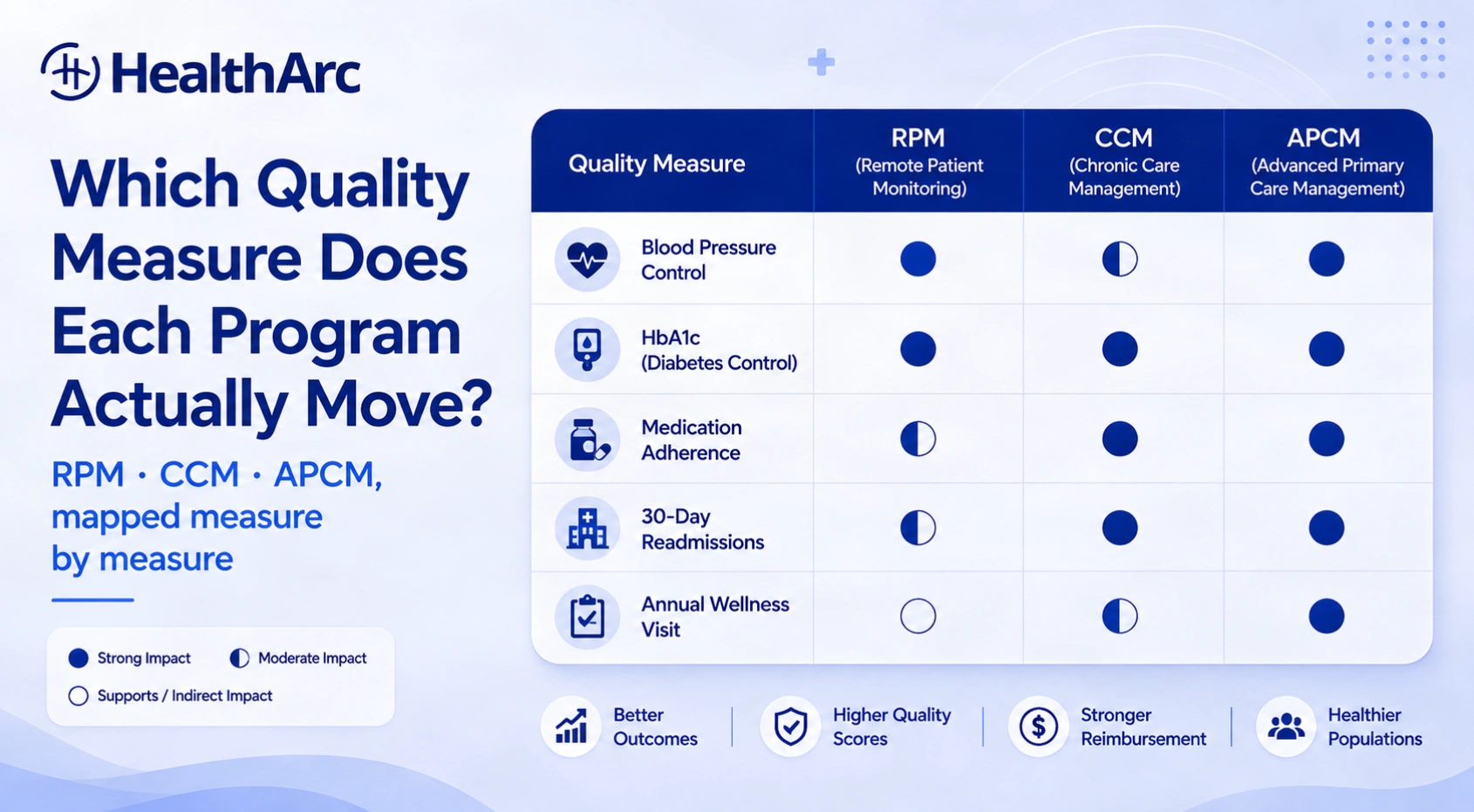
The table separates an operational mechanism from a proven outcome. A strong rating means the program creates a clear intervention pathway to that measure. It isn’t evidence that deploying the program improves the score.
| Quality or utilization measure | RPM | CCM | APCM | The mechanism |
|---|---|---|---|---|
| Controlling High Blood Pressure (CBP) | Strong | Strong | Strong | RPM supplies dated readings that can enter the record and the claim; CCM and APCM handle titration follow-up and adherence |
| HbA1c poor control (>9%) | Moderate | Strong | Strong | Glucose trends flag deterioration; care management drives the medication change, education and repeat lab |
| Adherence: diabetes medications | Indirect | Strong | Strong | Refill-gap detection from pharmacy claims, barrier resolution, prescriber coordination |
| Adherence: RAS antagonists | Indirect | Strong | Strong | Elevated BP trends can hint at a fill problem, but the fix runs through pharmacy data and outreach |
| Adherence: statins | Limited | Strong | Strong | No physiologic signal exists. Medication review and refill coordination are the only levers |
| 30-day readmissions | Moderate | Moderate | Strong | Post-discharge contact, medication reconciliation, symptom surveillance, fast escalation |
| Annual Wellness Visit completion | Limited | Moderate | Strong | Panel-level gap lists, outreach and barrier resolution, then a scheduled visit |
| Transitional care follow-up | Moderate | Moderate | Strong | TCM and APCM both carry explicit transition requirements |
| Care coordination and continuity | Supportive | Strong | Strong | Structured care plans, documented communication, standing follow-up cadence |
| Behavioral health quality gaps | Limited | Supportive | Strong | BHI is the aligned program; APCM and CCM coordinate the rest of the patient’s care |
Read the table by column and you get a vendor comparison. Read it by row and you get a work plan.
Controlling High Blood Pressure: The One Line That Decides the Measure
CBP is the cleanest example of a monitoring workflow connecting to a scored measure. It’s also the one most programs get wrong.
The measure covers members aged 18 to 85 with a hypertension diagnosis whose blood pressure was adequately controlled during the measurement year, defined as below 140/90 mmHg. CMS uses substantially the same definition for its MIPS quality measure. Here’s NCQA’s own measure description.
Now the part that decides your score. NCQA counts the most recent BP reading in the measurement year. Not the average. Not the best. Not the number of readings you collected.
Think about what that does to a monitoring program. You enroll a patient in January, they transmit faithfully through spring, their readings settle at 132/84, and everyone feels good. Then they drift off the program in July. In November they come in for a sick visit, they’re anxious, the medical assistant takes one cuff reading over a coat sleeve, and it reads 148/92. That’s the reading that counts. Your 300 good readings scored nothing.
The flip side is the opportunity. Patient-taken readings from a digital device are acceptable for CBP when they’re documented in the medical record with the date, and readings captured during a telehealth, telephone or virtual visit count too. So an RPM program becomes a legitimate source of numerator-eligible readings here, available on demand, in December, from a patient who never comes in.
The plumbing that carries it to the claim is CPT Category II coding. You report one systolic code and one diastolic code:
| Reading | CPT II code |
|---|---|
| Most recent systolic below 130 mmHg | 3074F |
| Most recent systolic 130 to 139 mmHg | 3075F |
| Most recent systolic 140 mmHg or above | 3077F |
| Most recent diastolic below 80 mmHg | 3078F |
| Most recent diastolic 80 to 89 mmHg | 3079F |
| Most recent diastolic 90 mmHg or above | 3080F |
Two codes, both required, and they let the plan credit the member without chasing a chart. Most RPM programs we look at aren’t reporting them at all.
So the actual CBP sequence looks like this. RPM gives you visibility and a supply of dated readings. CCM or APCM gives you the longitudinal framework to titrate, educate and re-check. The clinical team makes the call. And somebody on the quality side makes sure a controlled, well-measured, correctly documented reading exists late enough in the year to be the most recent one.
Confirm the current-year specification before you build any of this into a workflow. NCQA revises measures annually, and the digital-device and telehealth allowances have both changed in recent measurement years.
HbA1c Poor Control: Your Glucose Data Isn’t the Measure
Diabetes is harder. HEDIS scores glycemic performance on HbA1c control below 8% and poor control above 9%, and CMS carries related measures in its quality programs.
Here’s the distinction that trips people up. An RPM glucose reading is not an HbA1c result. A patient can transmit two glucose values a day for six months and still land above 9%. Another patient can transmit almost nothing and hit target.
The measure needs a lab. Your monitoring data doesn’t substitute for one, and it doesn’t appear in the numerator.
What monitoring buys you is earlier warning. Rising fasting values in August give a care manager a reason to call, review medications, check whether the patient can afford the GLP-1 they were started on, and order the repeat A1c before the year closes. That chain is what moves the measure. The device only starts it.
This is where multi-condition patients make the case for APCM over a device-first strategy. Diabetes rarely arrives alone. It shows up with hypertension, chronic kidney disease, or a behavioral health need, and each of those has its own gap list. Our write-up on hypertension and diabetes outcomes in Medicare populations goes deeper on the clinical side.
Medication Adherence: Where RPM Can’t Help You At All
If you run a Medicare Advantage plan, this section is the one worth printing.
Part D Star Ratings include three adherence measures: non-insulin diabetes medications, RAS antagonists for hypertension, and statins. Each is triple-weighted. Together they account for roughly a third of a plan’s overall Star Rating. Nothing else in the measure set concentrates that much weight in one operational capability.
Three specification facts change how you should staff against them.
They are claims-only. Adherence is computed as proportion of days covered from pharmacy claims. Not from a patient saying they take their pills. Not from a pill count. Not from anything visible in your EHR or your monitoring platform. If your care managers are working off clinical data alone, they are blind to this measure.
The threshold is a cliff at 80%. A patient at 79% PDC counts exactly the same as a patient at 20%: nonadherent. There is no partial credit.
The denominator needs two fills. A member enters the measure once they’ve filled at least two qualifying prescriptions in the calendar year. Patients who never picked up a second fill aren’t in the denominator, which means the very worst patients may not be scoreable at all.
Put those three together and the targeting strategy inverts. Because plan cut points cluster tightly around the 80% line, a five-point PDC shift can carry a contract from two stars to four on these measures. The patients who deliver that shift are the ones already close. A member at 77% PDC in October needs one conversation and one refill to cross into the numerator. A member at 35% needs a clinical re-evaluation and probably won’t get there this year.
So the fourth-quarter work list should be sorted by proximity to 80%, not by severity. Most adherence programs sort it the other way.
What can RPM tell you here? A cuff can show you that readings stay elevated. It can’t distinguish a patient who never filled the prescription from one who ran out, stopped over side effects, takes it every other day, or needs a different agent entirely. Six explanations, one signal.
The interventions live in CCM, APCM and especially medication therapy management, where the workflow starts from refill data and ends with a prescriber. Use the streams together. A patient with persistent elevated readings, a declining PDC and no primary care contact in five months is a far better intervention target than one flagged by any single source.
Thirty-Day Readmissions: TCM and APCM Own This
Readmissions get discussed as though any care-management enrollment reduces them. Performance on the measure reflects clinical severity, social circumstances, access to follow-up, discharge quality and medication problems. Enrollment counts prove none of that.
What the programs do provide is a mechanism against the known transition failures. Transitional Care Management is the formal Medicare category for this work, with its own contact and face-to-face timing requirements. APCM carries care-transition coordination and post-discharge follow-up communication among its service elements.
A workable post-discharge sequence: discharge, medication reconciliation inside 48 hours, patient contact, confirmation that the follow-up appointment is on the calendar, symptom monitoring through the risk window, escalation when something moves, handoff back to the primary care team.
Each program sits at a different point on that line. TCM covers the 30-day window with defined timing. APCM supplies the longitudinal infrastructure around it. RPM adds physiologic surveillance for the subset of patients where a weight trend or a pressure trend is genuinely predictive. CCM picks the patient up once the transition period ends. Treating the four as interchangeable is how organizations end up paying for overlap and getting no coverage.
Annual Wellness Visit Completion Is a Scheduling Problem
The AWV isn’t an RPM measure. Nobody’s device completes a wellness visit.
But the same infrastructure moves it. The pathway runs from a longitudinal patient relationship, to a panel list of members overdue for an AWV, to outreach that resolves whatever is actually blocking the visit, to a completed and documented encounter with a health risk assessment in it.
APCM matters here because population-level management and performance measurement are written into its service elements. For an ACO or an FQHC, the operational win is that one gap-list engine finds the uncontrolled hypertensives, the overdue AWVs and the missing A1cs in the same pass. Running a separate outreach program per measure is how quality teams burn out.
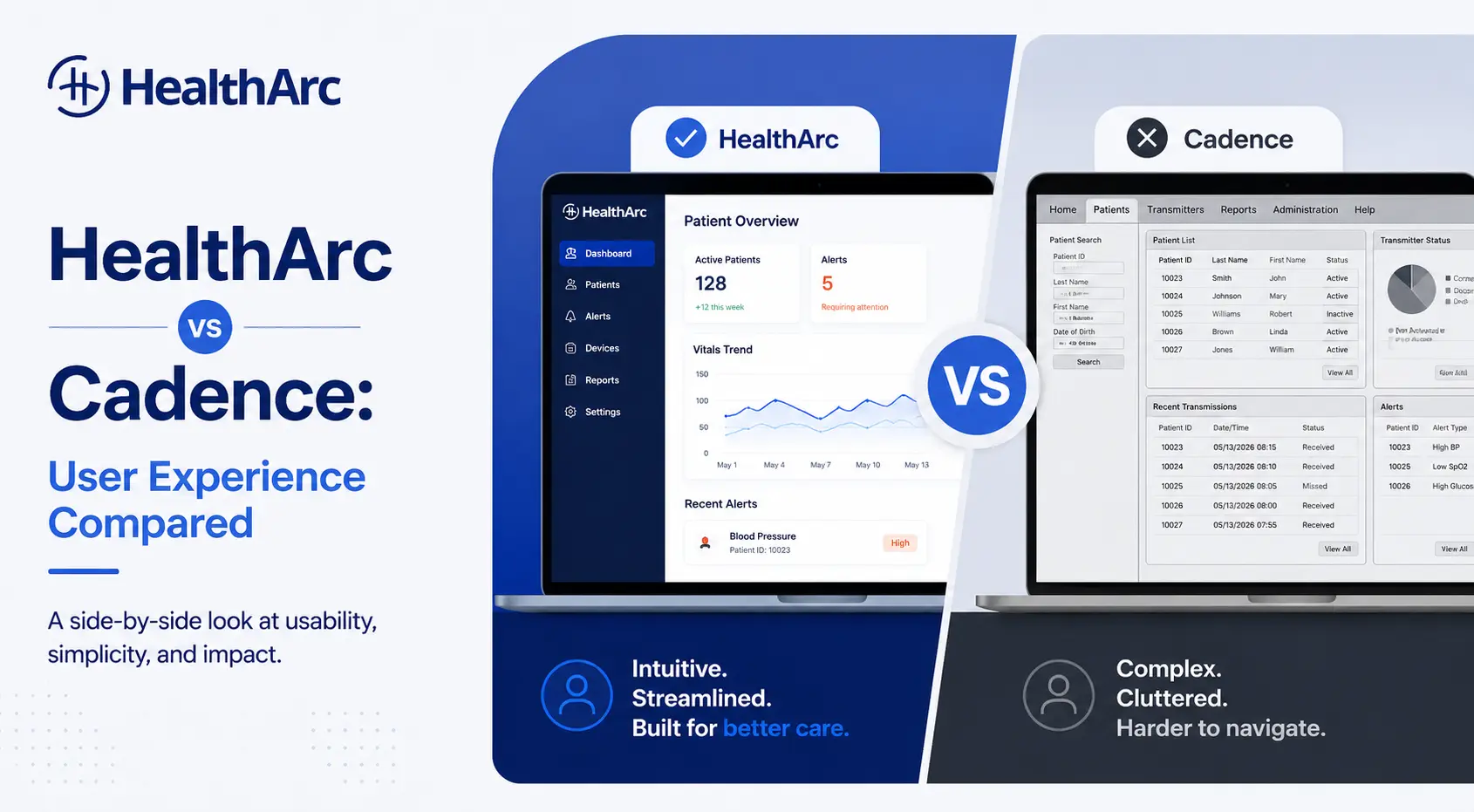
A platform earns its keep when it can show you every open gap on one patient in one view. Ask about that in the demo.
Transitional Care Follow-Up: Match the Program to the Moment
Organize the programs around where the patient is, not around what you’re licensed to bill.
In the first week after discharge, the high-value work is contact, medication review, appointment confirmation, symptom and barrier identification, and a clean handoff to the right clinician. TCM territory.
As the patient settles back into chronic disease management, CCM becomes the better fit. RPM belongs in the picture when there’s a specific clinical reason to keep watching a physiologic trend. APCM can hold the whole thing together for a primary care panel.
Not every patient needs every service. That’s a financial point as much as a clinical one. Over-enrolling patients across overlapping programs adds consent paperwork, documentation load and billing-conflict risk without improving anyone’s outcome. Our complete guide to TCM covers the timing rules that decide which code applies.
Where BHI Fits
Behavioral health gets left out of quality operations conversations, which is strange given how much of chronic disease performance runs through it.
Behavioral Health Integration isn’t the intervention for CBP or for statin PDC. But behavioral health needs decide whether a patient shows up, keeps a medication routine, engages with a care plan, or answers the phone at all. Those are the failure points underneath half your quality gaps.
A patient with uncontrolled diabetes, untreated depression and four missed appointments doesn’t have three problems. They have one fragmented care experience showing up in three measures.
What APCM Actually Changed
APCM began paying January 1, 2025. It matters less as a new revenue line and more as a structural change in how Medicare pays for primary care capability.
Three HCPCS codes, tiered by patient complexity, at 2025 national allowable amounts:
| Code | Patient | 2025 national allowable |
|---|---|---|
| G0556 | One chronic condition or fewer | $15.20 |
| G0557 | Two or more chronic conditions | $48.84 |
| G0558 | Two or more chronic conditions, Qualified Medicare Beneficiary | $107.07 |
The design change that matters: APCM has no minute threshold. Instead of a stopwatch, CMS defined 13 service elements that have to be available to the enrolled patient each month, covering comprehensive care management, care planning, care transitions, expanded communication access, population-level management and performance measurement. You bill on capability, not on documented time.
For care teams that have spent a decade fighting time-tracking audits on CCM, that’s a real operational shift. It also changes the staffing math, because value now comes from panel coverage instead of billable minutes per patient.
FQHCs and RHCs bill the same three codes at PFS rates. As of July 1, 2025 they stopped using the all-purpose G0511 and moved to the standard CCM, PCM, BHI and APCM codes. Check the AAFP coding guidance and CMS transmittals before you change your billing configuration.
The strategic read: instead of standing up separate teams for RPM, CCM, AWV outreach, hospital follow-up, adherence and gap closure, you build one patient-intelligence and coordination layer underneath all six. The services stay distinct. The operating system beneath them doesn’t have to be. Our APCM complete guide works through eligibility and documentation in detail, and the APCM implementation checklist covers the consent, staffing and billing workflow you need before the first claim goes out.
Start With the Measure, Not the Service
Most organizations open with “should we launch RPM?” Wrong first question. Try this sequence.
Step 1: Find the measures with the most money behind them
Score your measure set on current performance, denominator size, financial exposure, contractual or Star weight, gap-closure headroom, and how hard the work is. Triple-weighted measures with a big denominator and mid-pack performance are where you start.
Step 2: Diagnose why patients are missing it
Weak CBP performance has at least six distinct causes, and they need different fixes:
- Patients are genuinely uncontrolled and need titration.
- You have no recent BP data on them at all.
- They aren’t coming in.
- They aren’t filling their antihypertensives.
- Follow-up after an abnormal reading is slow or absent.
- The reading exists but was never documented or coded, so it doesn’t count.
That last one is free money and it’s the one nobody checks first.
Step 3: Match the program to the failure point
No longitudinal physiologic data? RPM. Multiple conditions and fragmented follow-up? CCM or APCM. Recently discharged? TCM. Medication complexity or a PDC problem? MTM. If you can name the failure point, the program picks itself.
Step 4: Instrument the mechanism before you judge the score
Quality scores take months to move, and an annual measure gives you one look per year. Leading indicators tell you whether the machine is running now:
- Share of eligible patients actually enrolled and consented
- Transmission consistency against the billing threshold
- Hours from an abnormal reading to a documented outreach
- Successful patient contacts per attempt
- Medication barriers identified and resolved
- Post-discharge follow-up completed inside the window
- AWVs scheduled and kept
- Gaps closed and correctly coded after intervention
These separate a weak clinical result from a broken workflow. That distinction is worth a lot in a quarterly review, and you can’t make it from the measure score alone.
Why This Matters for ACOs and MA Plans
Star Ratings drive Quality Bonus Payments and rebate dollars for Medicare Advantage plans, and the current measure set includes blood pressure control, diabetes care, the three adherence measures, readmissions and care coordination. For ACOs, quality performance gates shared savings.
Which means care management stops being a service line and becomes a performance function. A generic RPM deployment produces engagement metrics. A measure-mapped one produces a traceable line from a monitored reading, through a clinical action, to a closed gap on a scored measure. If you want the wider framing, see our value-based care overview and the earlier piece on how RPM and CCM lay the foundation for value-based care.
One caveat worth stating plainly. Nothing here is a promise that deploying a program improves a score. Measure specifications change every year, attribution rules vary by contract, and your population isn’t anyone else’s. Verify current specifications with NCQA and CMS, and confirm billing rules with your MAC, before you commit budget.
Frequently Asked Questions
How does RPM support value-based care?
RPM gives clinical teams dated physiologic readings between office visits, which does two things in a value-based contract. It creates earlier warning of deterioration, and for measures like Controlling High Blood Pressure it can supply numerator-eligible readings when they’re documented in the record with the date. The value depends entirely on what happens after an abnormal reading arrives. If nobody acts on it, you’ve bought data, not performance.
Which quality measures can remote patient monitoring influence?
The clearest connection is to measures of chronic physiologic control, above all blood pressure control, where the monitored value is the measured value. Diabetes control is a step removed, because HbA1c comes from a lab and not from your glucose feed. Readmissions and medication adherence are further removed still, because those depend on post-discharge workflow and pharmacy fill behavior that a device can’t see.
Can CCM improve medication adherence measures?
CCM creates a mechanism for finding and resolving medication barriers through recurring contact, care planning and prescriber coordination. Whether the Part D adherence score moves depends on pharmacy fill behavior, since the measure is computed as proportion of days covered from claims. CCM helps when the care team is working from refill data. It helps very little when the team is working from clinical data alone.
What is the difference between APCM and CCM in value-based care?
CCM is time-based care management for patients with multiple chronic conditions, billed against documented minutes. APCM pays a flat monthly rate per patient with no minute tracking, tiered by chronic-condition count and Qualified Medicare Beneficiary status, and requires that 13 service elements be available each month. APCM also folds in transitions and population-level management, which CCM handles separately or not at all. APCM payment began January 1, 2025.
Does RPM directly improve HEDIS or Star Ratings?
No. Deploying a program improves nothing on its own. RPM can create a pathway that supports clinical intervention, gap closure and correct documentation, and for CBP it can supply readings that count toward the numerator. Final performance still depends on the applicable specification, patient outcomes, coding and attribution.
How should an ACO choose between RPM, CCM, APCM and TCM?
Start from the gap, not the billing code. Pick the measure with the most financial weight and headroom, work out why your patients are missing it, then choose the program whose mechanism attacks that specific failure. Missing data points to RPM. Fragmented chronic care points to CCM or APCM. A recent discharge points to TCM. Complex regimens point to MTM. Complex patients often need two of them in sequence.
Do RPM blood pressure readings count for the HEDIS CBP measure?
Patient-taken readings from a digital device are acceptable for CBP when the reading and its date are documented in the medical record, and readings from telehealth or virtual visits are acceptable as well. The reading that scores is the most recent one in the measurement year. Confirm the current measurement-year specification with NCQA before you build a workflow on it.
Which patients should an adherence program target first?
The ones just below the line. Because proportion of days covered is scored against an 80% threshold with no partial credit, and plan cut points cluster near that threshold, members sitting at 75% to 79% offer the largest movement per hour of outreach. Members far below 80% usually need a clinical re-evaluation and rarely cross the line in the same measurement year.
Three Questions to Answer Before You Launch Anything
RPM, CCM and APCM don’t improve quality on their own. Each builds a different mechanism, and the mechanisms aren’t interchangeable.
RPM is strongest when you need longitudinal physiologic visibility plus a workflow for acting on it. CCM handles ongoing management of multi-condition patients. APCM gives you a flat-rate primary care framework that covers coordination, transitions, population management and performance measurement in one enrollment.
The goal isn’t to sell every patient every service. It’s to build a quality operating model that can answer three questions for every gap that matters:
- Which measure are we trying to move, and what does its specification actually count?
- Why are our patients missing it?
- Which intervention attacks that specific failure?
Answer those and care management stops being a collection of billable programs. It becomes infrastructure. If you want to see what that looks like across nine programs on one platform, book a demo and bring your worst measure with you.
Related reading: Managing CKD, Hypertension and Diabetes in One RPM Program · Value-Based Care · Nephrology Care Solutions


Ready to connect care between visits?
See how HealthArc runs RPM, CCM and seven more CMS programs — the platform, the devices and the clinical team — on a single demo.