
By Sudeep Bath
| November 25, 2026
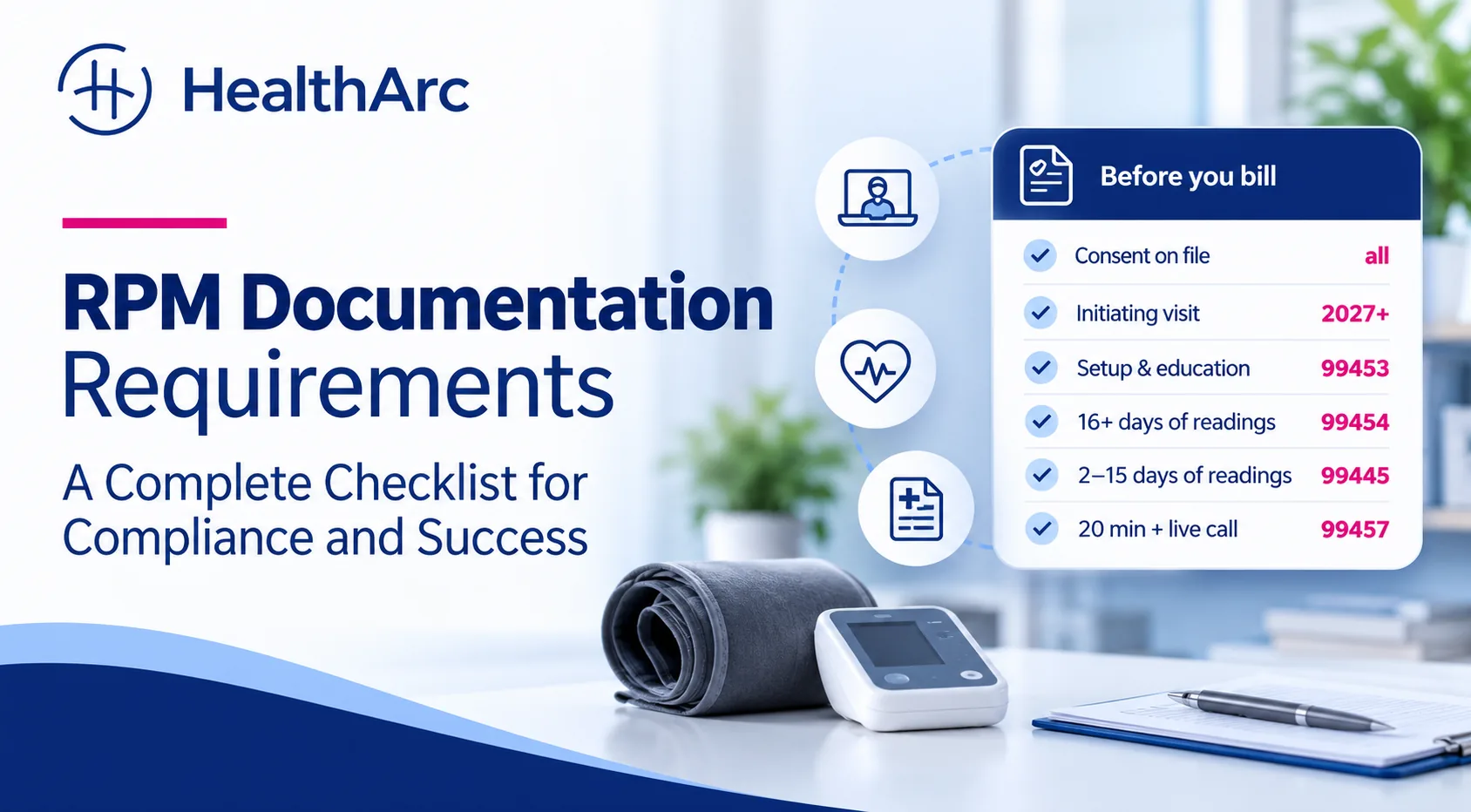
Quick answer: To bill remote patient monitoring, each patient’s chart needs a documented order and consent, an initiating visit for new patients from January 1, 2027, a device that meets the FDA definition of a medical device, a transmission log showing the days of readings in each 30-day period, and a time log showing the treatment-management minutes and at least one real-time interactive call in each calendar month.
Most billing teams aren’t short on rules. They’re short on a system that records all of this as it happens, so nobody has to rebuild it at month end.
If your billing team is drowning in RPM paperwork, the problem usually isn’t effort. It’s that RPM runs on two different clocks, and most practices track both by hand.
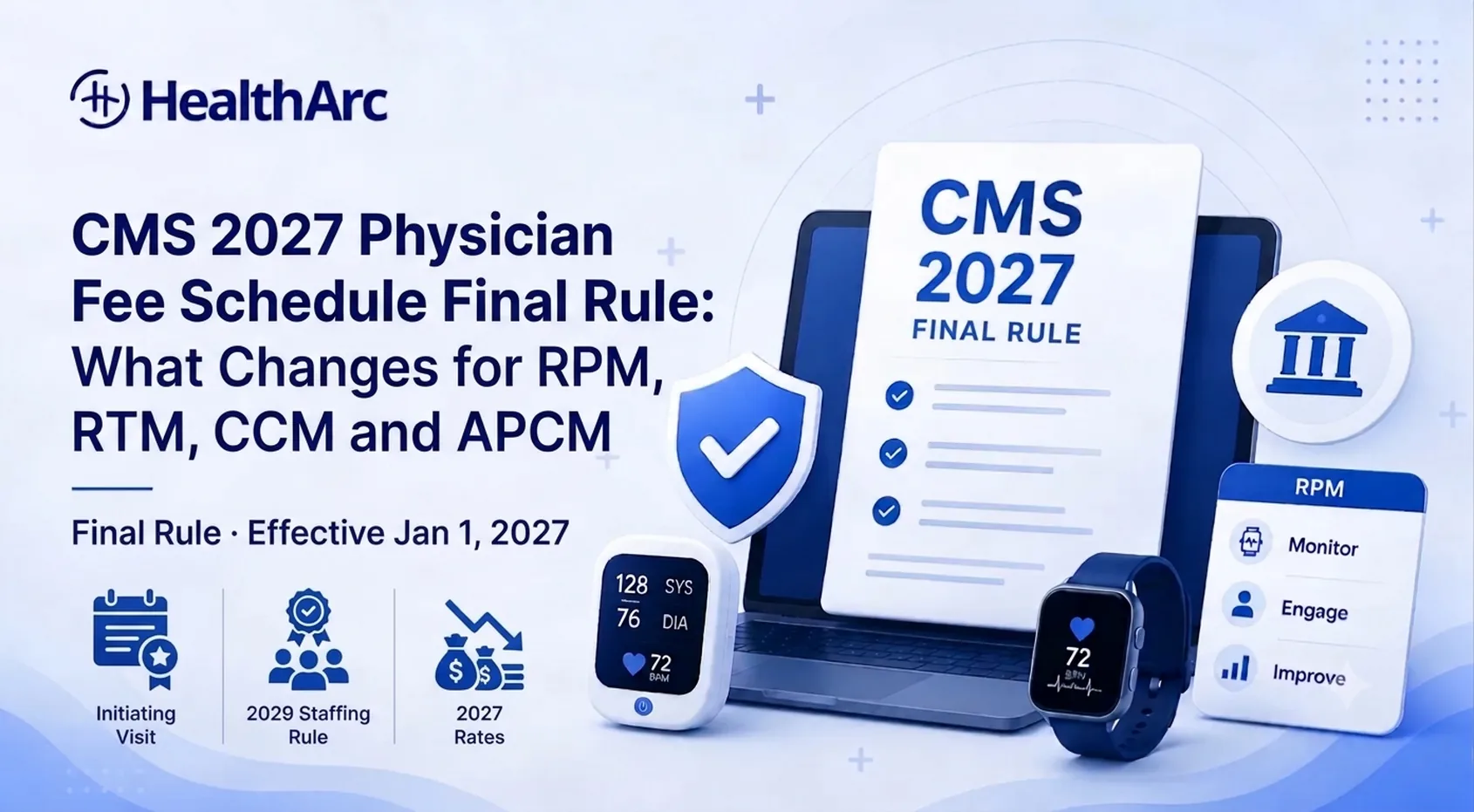
This guide lists what to document for each RPM code, where programs usually break, and what an auditor will ask to see. It uses the CY 2027 Physician Fee Schedule final rule, which takes effect January 1, 2027.
Table of Contents
Why Does RPM Documentation Break Down?
Because RPM bills from data that lives in three places. Readings live in the device platform. Minutes and calls live in notes. Orders, consent and visits live in the EHR. Someone has to pull all three together for every patient, every month, and match them to the right code.
Regulators are watching this closely. In September 2024 the HHS Office of Inspector General reported that Medicare RPM use grew from about 55,000 enrollees in 2019 to more than 570,000 in 2022. It also found that about 43% of enrollees didn’t receive all three components of RPM: setup and education, device supply and treatment management. OIG recommended that CMS look harder at providers who often bill incomplete episodes.
Documentation is your defense in an audit. Treat it that way.
What Every RPM Patient’s Chart Needs
Before any code is billed, check these items once per patient:
- An order and a reason. RPM needs a billing practitioner who orders it for a chronic or acute condition and an established patient relationship.
- An initiating visit (new from 2027). From January 1, 2027, a new RPM patient needs a face-to-face visit with the billing practitioner where remote monitoring is discussed. Telehealth counts. Patients already on RPM before 2027 don’t need one. Read more in our 2027 final rule summary.
- Consent. Record that the patient agreed to RPM, ideally with a note that coinsurance may apply.
- A qualifying device. It has to meet the FDA definition of a medical device, and readings have to transmit automatically. Numbers a patient reads out over the phone don’t count.
- One billing practitioner per period. Only one practitioner can bill the device codes for a patient in a 30-day period. Check for other practices billing RPM for the same patient.
RPM Documentation Requirements, Code by Code
Rates are 2027 national non-facility amounts from the final rule. Your local rate will differ.
| Code | What it pays for | 2027 national | What to document |
|---|---|---|---|
| 99453 | Setup and patient education | $19.90 | Date of setup, device issued, who taught the patient and what was covered. Once per episode of care. |
| 99454 | Device supply, 16–30 days of readings | $41.11 | The 30-day period’s start and end dates and a dated log showing readings on at least 16 days. |
| 99445 | Device supply, 2–15 days of readings | $41.11 | Same as 99454, with 2 to 15 days of readings. Bill 99445 or 99454 for a period, never both. |
| 99470 | First 10 minutes of treatment management | $26.43 | 10–19 minutes in the calendar month, at least one real-time interactive communication, and what was done. Not billed with 99457 in the same month. |
| 99457 | First 20 minutes of treatment management | $51.55 | Total minutes in the calendar month, at least one real-time interactive communication, who did the work and the clinical actions taken. |
| 99458 | Each additional 20 minutes | $41.11 | Minutes beyond the first 20, logged separately so each block of 20 can be shown. |
| 99091 | Practitioner data review, 30 minutes | Varies | At least 30 minutes of the physician or QHP’s own time collecting and interpreting the data in a 30-day period. |
For the full code descriptors and history, see our RPM CPT codes guide and the deep dive on 99445 and 99470.
The Two Clocks Nobody Explains
This is the part that buries billing teams. The device codes and the management codes don’t use the same period. Few guides say so.
- Device codes (99454, 99445) count readings in a 30-day period that starts when monitoring starts.
- Management codes (99457, 99458, 99470) count minutes in a calendar month.
A patient who started on March 12 has device periods of March 12 to April 10, April 11 to May 10, and so on. Their management time still resets on the first of each month. If your team tracks both in a spreadsheet, every patient has two dates to reconcile, and a few hundred patients turn that into days of work.
Here’s the fix. Track each patient’s device period start date in the system that receives the readings, and let it count the days for you. Then track minutes by calendar month in the same place. Don’t ask people to do date math. They’ll get it wrong, and nobody will notice until a denial arrives months later and someone has to reconstruct a whole quarter of calls from memory.
What Time Counts Toward 99457?
Treatment-management time is the clinical work of managing the patient using the data. That includes reviewing readings, talking with the patient or caregiver, adjusting the care plan with the practitioner and coordinating follow-up. It must include at least one interactive communication in the month: a real-time, two-way conversation by phone or video. A text message or a voicemail doesn’t meet that bar.
Some time doesn’t count:
- Initial setup and education. That’s 99453.
- Time already counted toward another program, such as CCM, for the same patient. Each minute counts once.
- Pure device logistics, like shipping or replacing a cuff.
The common failure: a nurse spends 25 minutes reviewing a patient’s readings but never reaches them by phone. Without the interactive communication, that month doesn’t bill 99457. The work happened. The claim can’t.
Six Places RPM Billing Gets Stuck
- Minutes in free text. “Spoke with patient re: BP” with no start and end time can’t support a 20-minute claim.
- Two clocks, one spreadsheet. Device periods and calendar months tracked by hand. See above.
- No call on record. Plenty of review time, but no logged interactive communication.
- Missing front-end paperwork. No consent note, or from 2027 no initiating visit, so every later claim is exposed.
- Program overlap. The same minutes logged under RPM and CCM, or two practices billing device codes for one patient.
- Silent devices. A patient with 14 days of readings billed as 99454 instead of 99445. Both pay the same in 2027, but the wrong code is still a wrong claim.
Who Should Own Each Piece?
Documentation fails when everyone owns a bit of it and nobody owns the whole. A split that works for most practices:
| Item | Owner |
|---|---|
| Order, initiating visit note, care plan | Billing practitioner |
| Consent and enrollment record | Enrollment specialist or coordinator |
| Monthly minutes and interactive calls | Clinical staff doing the monitoring |
| Transmission days per 30-day period | The monitoring platform, automatically |
| Code selection and claim review | Billing team |
One date to plan around. From January 1, 2029, RPM monitoring time counts only when your own employed clinical staff do it. If an outside team logs your minutes today, plan the handover now. Our page on clinical support for RPM covers the options, and the in-house vs. outsourced cost model shows what each one costs.
What an RPM Audit Asks For
When a payer or contractor reviews RPM claims, expect requests for:
- The order and the note showing why RPM was medically necessary
- The consent record and, for patients starting in 2027 or later, the initiating visit
- Device details and the dated transmission log for each billed period
- Time logs with dates, durations and who did the work, plus the interactive communication
- Proof the same time wasn’t billed under another program
If you can export that for any patient in a few minutes, you’re in good shape. If it takes a day of digging, fix the process before an auditor finds it. Start with the time log.
This is the work HealthArc takes off billing teams. The platform logs transmission days against each patient’s 30-day period and minutes against each calendar month, ties every call to the code it supports, keeps RPM and CCM time separate, and writes notes back to your EHR. At month end the billing report is already built. See how it fits with HealthArc remote patient monitoring.
Stop rebuilding RPM documentation every month. See the time and transmission logs your billing team would get.
FAQs
What documentation is required to bill CPT 99457?
At least 20 minutes of treatment-management time in the calendar month, with at least one real-time interactive communication with the patient or caregiver. Record the dates, the minutes, who did the work and what clinical actions were taken. The time can’t also count toward another program like CCM.
How many days of readings do you need to bill RPM?
For 99454, at least 16 days of readings in a 30-day period. Since 2026, a period with 2 to 15 days bills 99445 instead. Both pay $41.11 nationally in 2027.
Does a text message count as RPM interactive communication?
No. Interactive communication means a real-time, two-way conversation, by phone or by video. Texts, portal messages and voicemails can be part of the work, but they don’t satisfy the interactive communication requirement.
Is the RPM 30-day period the same as a calendar month?
No. Device codes 99454 and 99445 use a 30-day period that starts when monitoring starts. Management codes 99457, 99458 and 99470 use the calendar month. Track both, ideally automatically.
What changes in RPM documentation in 2027?
New RPM patients need an initiating visit with the billing practitioner from January 1, 2027, so the visit note should record that remote monitoring was discussed. CMS didn’t add other documentation requirements, but it said every existing incident-to requirement still applies.
Can we outsource RPM documentation?
You can buy software that logs time and transmission days for you, and from 2029 that remains allowed. What changes on January 1, 2029 is who can do the billable monitoring minutes: only your own employed clinical staff. Until then, contracted staff can do it if every incident-to requirement is met.
Sources
- HHS Office of Inspector General, Additional Oversight of Remote Patient Monitoring in Medicare Is Needed (OEI-02-23-00260), September 2024.
- Centers for Medicare & Medicaid Services, CY 2027 Physician Fee Schedule final rule (CMS-1848-F), Addendum B, November 2026. Rates are total non-facility RVUs times the $32.6286 conversion factor.
- Centers for Medicare & Medicaid Services, Physician Fee Schedule and the CY 2021 final rule clarifications on interactive communication and device requirements for RPM.
This article is general information for planning, not legal or billing advice. Rates are national non-facility amounts before geographic adjustment. Medicare Advantage and commercial payers set their own rules. Check with your MAC and compliance advisor before you change billing practices.


Ready to connect care between visits?
See how HealthArc runs RPM, CCM and seven more CMS programs — the platform, the devices and the clinical team — on a single demo.