
By Sudeep Bath
| November 5, 2026
Quick answer: For adults, normal blood pressure is below 120/80 mm Hg at every age. US guidelines don’t raise the bar as you get older. Average readings do climb with age, though. In CDC survey data, men aged 18 to 39 averaged 119/70 and women 110/68, while adults 60 and over averaged 133/69 (men) and 139/68 (women).
Those averages describe what’s common, not what’s healthy. Children are different: up to age 12, normal is set by percentile charts for age, sex and height.
Search for a blood pressure chart by age and you’ll find charts that say 135/85 is “normal” for a 65-year-old. Others still repeat the old rule that a healthy systolic reading is 100 plus your age. Neither matches current guidelines.
This guide gives you the real numbers. You’ll get the 2025 American Heart Association and American College of Cardiology categories, the CDC’s average readings by age and sex, and the pediatric thresholds from the American Academy of Pediatrics. It also covers what changes after 60, what counts as low, and how to take a reading at home that’s worth trusting.
It ends with a section for practices that want to turn home readings into a monitored program.
What Do the Two Blood Pressure Numbers Mean?
A reading such as 118/76 mm Hg has two parts. The top number is systolic pressure, the force in your arteries when your heart beats. The bottom number is diastolic pressure, the force between beats while the heart refills. Both are measured in millimeters of mercury (mm Hg).
The gap between them is called pulse pressure. It’s usually around 40 in a young adult. It widens with age as arteries stiffen, and that widening comes up again in the section on older adults.
Your category is set by whichever number is higher. A reading of 128/84 counts as stage 1 hypertension because of the 84, even though 128 alone would only be “elevated.”
Blood Pressure Chart for Adults: The 2025 Categories
In August 2025 the AHA and ACC published a new high blood pressure guideline, replacing the 2017 version. It kept the same categories. They apply to every adult from 18 up, with no separate scale for older people.
| Category | Systolic (top) | Diastolic (bottom) | What usually happens next | |
|---|---|---|---|---|
| Normal | Below 120 | and | Below 80 | Recheck at routine visits |
| Elevated | 120–129 | and | Below 80 | Lifestyle changes, recheck in 3–6 months |
| Stage 1 hypertension | 130–139 | or | 80–89 | Lifestyle changes. Medication if risk is high or readings stay up after 3–6 months |
| Stage 2 hypertension | 140 or higher | or | 90 or higher | Medication plus lifestyle changes |
| Severe hypertension (often called a hypertensive crisis) | Above 180 | and/or | Above 120 | Recheck after a few minutes. With symptoms, call 911 |
Symptoms that make a severe reading an emergency include chest pain, shortness of breath, back pain, numbness or weakness, a change in vision and trouble speaking. Without symptoms, the AHA advises waiting a few minutes, measuring again and calling your doctor if it’s still that high.
One change in the 2025 guideline matters for stage 1. Whether you start medication now depends partly on your 10-year risk of heart disease and stroke, calculated with the AHA’s PREVENT equations. If that risk is 7.5% or higher, or you have diabetes, chronic kidney disease or existing heart disease, medication is recommended alongside lifestyle changes. Below that, you’d usually try lifestyle changes for three to six months first.
Blood Pressure by Age: Average Readings for Men and Women
Here is what blood pressure actually looks like across American adults. These are the mean readings measured in the National Health and Nutrition Examination Survey (NHANES), published by the CDC’s National Center for Health Statistics. Nearly 20,000 adults had their pressure taken up to three times by trained examiners.
| Age group | Men, average | Women, average | All adults, average | Middle 50% of systolic readings | Share with hypertension (2021–2023) |
|---|---|---|---|---|---|
| 18–39 | 119/70 | 110/68 | 115/69 | 106–121 | 23.4% |
| 40–59 | 124/77 | 122/74 | 123/75 | 112–131 | 52.5% |
| 60 and over | 133/69 | 139/68 | 136/68 | 120–148 | 71.6% |
Averages and the middle 50% (the 25th to 75th percentile) come from NCHS National Health Statistics Report No. 35, NHANES 2001–2008. Hypertension shares come from NCHS Data Brief No. 511 (October 2024), which counts anyone at 130/80 or above, or taking blood pressure medication.
Average systolic blood pressure by age and sex (mm Hg)
Men 18–39
Women 18–39
Men 40–59
Women 40–59
Men 60+
Women 60+
Why an average isn’t a target
This is the point most age charts get wrong. Look at the last column. Almost three in four Americans over 60 have hypertension. So the average 60-plus reading of 136/68 is mostly an average of people with high blood pressure.
Calling it “normal for your age” is like calling a 30-pound weight gain normal because most people put it on. It’s common. It still raises your risk.
The risk data is clear on this. A 2002 analysis in The Lancet pooled 61 studies covering about one million adults. In people aged 40 to 69, every 20 mm Hg higher systolic pressure roughly doubled the risk of dying from heart disease or stroke. Risk kept falling all the way down to 115/75, the lowest level the data could test. Age didn’t make higher pressure safe.
It’s also why the “100 plus your age” rule should be retired. It would call 170 normal for a 70-year-old. That’s stage 2 hypertension.
Men vs. women: the crossover after 60
Before middle age, women’s readings run lower than men’s. In the 18 to 39 group the gap is 9 points of systolic pressure. By 40 to 59 it’s nearly gone, and after 60 women average higher systolic pressure than men (139 vs. 133).
The shift lines up with menopause, when the protective effect of estrogen on blood vessels fades. Hypertension prevalence shows the same pattern. Among adults under 40 it’s nearly twice as common in men (30.0% vs. 16.4%). After 60 the CDC found no significant difference between the sexes.
Pregnancy has its own thresholds. The American College of Obstetricians and Gynecologists defines gestational hypertension as 140/90 or higher on two readings at least four hours apart after 20 weeks, and 160/110 or higher as severe. Any pregnant woman with those numbers should call her obstetric team the same day.
Running a hypertension program? HealthArc’s remote patient monitoring platform pairs cellular cuffs with a care team that reviews each patient’s 7-day average against the goal their clinician set. Book a demo to see it with your own patient mix.
Why Does Blood Pressure Go Up With Age?
The main reason is that large arteries stiffen. The aorta of a 25-year-old is elastic. It stretches with each heartbeat and recoils between beats, which smooths out the pressure. Over decades, elastin fibers in the artery wall wear down and are replaced by stiffer collagen, and calcium builds up.
A stiff aorta can’t absorb the pulse. So systolic pressure climbs. Diastolic pressure behaves differently. It rises until about age 50 to 60 and then levels off or falls, because the stiff artery doesn’t hold pressure as well between beats. You can see it in the table: average diastolic pressure peaks at 75 in the 40 to 59 group and drops to 68 after 60.
Other changes add to it. Kidneys handle sodium less efficiently with age. Weight tends to rise, activity tends to fall and sleep apnea becomes more common. Some medicines raise blood pressure too, including NSAID pain relievers such as ibuprofen and naproxen, decongestants and some antidepressants.
Isolated systolic hypertension
The result of stiffening arteries is a pattern called isolated systolic hypertension: a high top number with a normal or low bottom number. A 74-year-old reading 152/68 has it. It’s the most common form of high blood pressure after 60.
It’s easy to underestimate. The low diastolic number can look reassuring. It isn’t. In older adults, systolic pressure and wide pulse pressure are the better predictors of stroke and heart attack. Treatment is aimed at the top number, with an eye on the bottom one so it doesn’t drop too far.
What Is Normal Blood Pressure for Seniors (60, 70 and 80+)?
The definition doesn’t change. Under 120/80 is normal at 65, 75 and 85, just as it is at 25. What changes is how aggressively doctors treat, and that’s where individual judgment comes in.
| Situation | Usual treatment target (2025 AHA/ACC) | What shapes the decision |
|---|---|---|
| Most adults 65 and over living independently | Below 130/80, and below 120 systolic if it’s well tolerated | Same goal as younger adults. The SPRINT trial showed fewer heart attacks, strokes and deaths with tighter control, including in people 75 and over |
| Frail, very old, or several serious illnesses | Set case by case | Fall risk, dizziness on standing, dementia, life expectancy and the burden of extra pills |
| Living in a nursing home | Usually more relaxed | Those residents weren’t included in the trials behind the tighter targets |
Europe draws the lines a little differently. The European Society of Cardiology’s 2024 guideline still defines hypertension as 140/90 and up, and calls 120–139/70–89 “elevated.” Its treatment target for most adults who tolerate it, 120–129 systolic, sits close to the US one. That difference explains many of the conflicting numbers you’ll see online.
Is 140/90 OK for a 70-year-old?
It’s common, but it isn’t normal. Under US guidelines, 140/90 is stage 2 hypertension at any age. For a healthy, independent 70-year-old, the goal is usually below 130/80.
For a frail 88-year-old who gets dizzy when standing, a doctor may reasonably accept something higher. That’s a decision about one person’s risks. It doesn’t mean the reading is fine.
Watch for drops when standing
Older adults are more likely to have orthostatic hypotension: a fall of at least 20 points systolic or 10 points diastolic within three minutes of standing up. It causes lightheadedness and falls, and it can be made worse by blood pressure medicine, diuretics and dehydration.
If you’re checking an older parent’s pressure, take one reading seated and another after they’ve stood for a minute or two. A big drop is worth reporting. It may mean the medication plan needs adjusting rather than tightening.
Normal Blood Pressure for Children and Teens
Children’s blood pressure is lower, and it rises as they grow. That’s why kids don’t get a single cutoff. The 2017 American Academy of Pediatrics guideline compares a child’s reading with others of the same age, sex and height, expressed as a percentile.
| Category | Ages 1–12 | Ages 13 and older |
|---|---|---|
| Normal | Below the 90th percentile | Below 120/80 |
| Elevated | 90th to below 95th percentile, or 120/80 to below the 95th percentile (whichever is lower) | 120/<80 to 129/<80 |
| Stage 1 hypertension | 95th percentile to 95th percentile + 12 mm Hg, or 130/80 to 139/89 (whichever is lower) | 130/80 to 139/89 |
| Stage 2 hypertension | 95th percentile + 12 mm Hg or higher, or 140/90 or higher (whichever is lower) | 140/90 or higher |
At 13 the pediatric categories line up with the adult ones, so a teenager reading 132/78 has stage 1 hypertension just like an adult would.
Pediatricians use the full percentile tables to classify a reading. For a first pass, the AAP publishes a simplified screening table. A reading at or above these levels means the child needs a closer look with the full tables. It doesn’t mean the child has hypertension.
| Age | Boys: needs a closer look at or above | Girls: needs a closer look at or above |
|---|---|---|
| 1–3 years | 98–101 / 52–58 | 98–102 / 54–60 |
| 4–6 years | 102–105 / 60–66 | 103–105 / 62–67 |
| 7–9 years | 106–107 / 68–70 | 106–108 / 68–71 |
| 10–12 years | 108–113 / 72–75 | 109–114 / 72–75 |
| 13 and older | 120/80 | 120/80 |
Ranges run from the youngest to the oldest age in each band, from Table 6 of the AAP guideline. The values are based on the 90th percentile for children at the 5th height percentile, so taller children will often sit above them and still be normal.
The AAP recommends checking blood pressure once a year from age 3, and at every visit for children with obesity, kidney disease, diabetes, a heart condition or medicines that raise blood pressure. A child needs three separate high readings at different visits before a diagnosis. The right cuff size matters even more for children than for adults.
What Counts as Low Blood Pressure?
The National Heart, Lung, and Blood Institute generally treats readings below 90/60 as low (hypotension) in adults. There’s no official age-specific low cutoff. Plenty of healthy, active young adults run 95/60 and feel fine. For them it isn’t a problem.
Low pressure matters when it causes symptoms: dizziness, fainting, blurred vision, confusion or fatigue. It matters more with age, because a drop that makes a 30-year-old briefly lightheaded can make an 80-year-old fall.
Common causes include dehydration, blood pressure medicines that are now too strong, other drugs such as those for prostate enlargement, heart rhythm problems and blood loss. A sudden low reading with symptoms such as confusion, cold clammy skin or rapid breathing needs urgent care.
How to Measure Blood Pressure at Home (and Get a Reading You Can Trust)
None of the charts above help if the reading is wrong. Small mistakes move the numbers more than most people expect. The American Medical Association and AHA put the error from common mistakes at 10 to 15 points for a full bladder or talking during the reading. An unsupported arm adds about 10, crossed legs 2 to 8, and a cuff over a sleeve anywhere from 5 to 50.
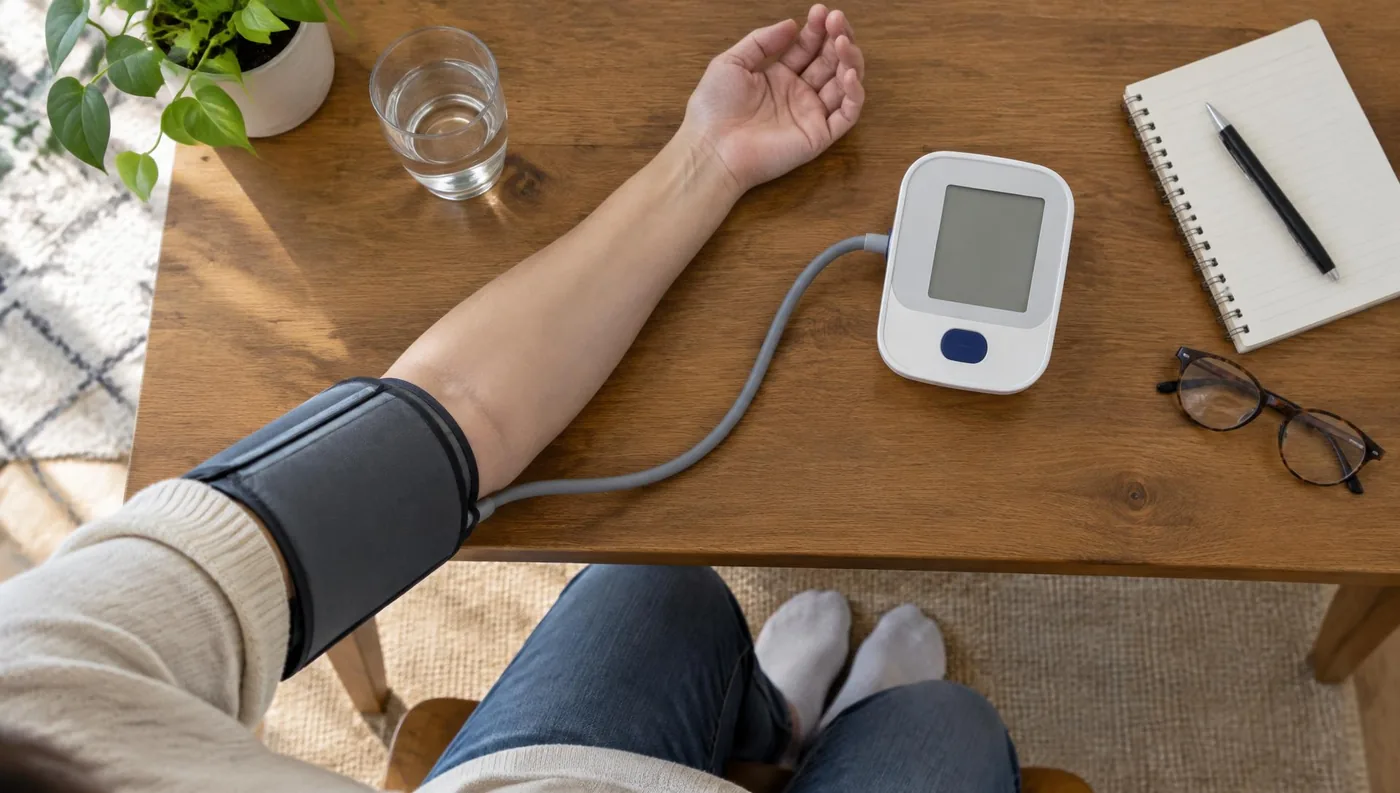
Seven steps for an accurate reading
- Use a validated upper-arm monitor. Check it on the US Validated Device Listing. Wrist and finger devices are less reliable.
- Get the right cuff size. The bladder inside the cuff should wrap around most of your upper arm. A cuff that’s too small reads high.
- Prepare for 30 minutes. No caffeine, smoking or exercise beforehand, and empty your bladder.
- Sit quietly for five minutes. Back supported, feet flat on the floor, legs uncrossed.
- Rest your arm at heart level. Lay it on a table, with the cuff on bare skin just above the bend of your elbow.
- Don’t talk or look at your phone. Take two readings one minute apart.
- Write down both, or let the device send them. Measure at the same times each day, usually morning and evening.
For a diagnosis or a medication change, doctors usually want readings twice a day for about a week, then look at the average. One high number on a stressful morning doesn’t mean much on its own.
Home readings use slightly different thresholds
Home numbers tend to run a bit lower than clinic numbers at the higher end. The 2017 ACC/AHA guideline lists the matching values.
| Clinic reading | Matching home average |
|---|---|
| 120/80 | 120/80 |
| 130/80 | 130/80 |
| 140/90 | 135/85 |
| 160/100 | 145/90 |
White coat and masked hypertension
Some people read high only in the clinic. That’s white coat hypertension, and treating it as real high blood pressure can lead to unnecessary medication and dizziness. Others read normal in the clinic and high at home or at work. That’s masked hypertension, and it’s riskier because nobody sees it. Home monitoring is the main way to find both, which is why the 2025 guideline recommends out-of-office readings to confirm a diagnosis.
What about smartwatches and rings that estimate blood pressure without a cuff? The 2025 guideline doesn’t recommend these cuffless devices for diagnosing or managing hypertension yet, because their accuracy hasn’t been shown to hold up. Use a cuff.
For Practices: Turning Home Readings Into a Monitored Program
Everything above points to the same conclusion. The number that matters is the average across days at home, not one office reading. For a practice, the hard part is getting those readings regularly and having someone act on them. That’s the gap remote blood pressure monitoring for hypertension fills.
The evidence is solid. A 2017 individual-patient meta-analysis in PLOS Medicine (Tucker and colleagues, 25 trials) found self-monitoring alone lowered systolic pressure by about 3 mm Hg at 12 months. Larger drops came when readings were paired with more intensive support, such as telemonitoring and medication titration by a care team. A few points across a whole panel of patients means fewer strokes and heart attacks.

How HealthArc runs it
Patients get a cellular blood pressure monitor that arrives activated. There’s no smartphone, app, Bluetooth pairing or Wi-Fi involved. They press one button and the reading reaches the dashboard in under a minute. It comes in three cuff sizes covering arms from 16 to 52 cm, because the wrong cuff produces a month of unusable data. The cellular-only design matters most for older patients, and we compare it with Bluetooth cuffs in this guide to cellular vs. Bluetooth blood pressure monitors.
Alerts follow the same logic as this guide. A reading above 180/120 triggers same-day contact. Below that, the platform watches each patient’s 7-day average against the individual goal the ordering clinician set, so a 130 target for a healthy 68-year-old and a looser one for a frail 90-year-old live side by side. Your team reviews trends and titrates against the goal, while the platform logs transmission days and minutes against 99454, 99457 and any CCM time, and writes the record back to your EHR.
Programs and billing
Hypertension patients usually qualify for more than one Medicare program:
- Remote patient monitoring: 99453 for setup, 99454 for 16 or more days of readings in a 30-day period, the new 99445 for 2 to 15 days, and 99457/99458 or the new 99470 for treatment-management time. The RPM CPT code guide has the 2026 rules and rates.
- Chronic care management for patients with hypertension plus another chronic condition such as diabetes or CKD, or principal care management when one high-risk condition drives the care plan.
- Advanced primary care management (APCM), billed monthly by risk tier with no time tracking, for practices that have moved to it.
- The Controlling High Blood Pressure (CBP) quality measure, which home readings from a connected device can help close. That matters in value-based care contracts.
Hypertension rarely shows up alone, so most of our programs run across specialties. Cardiology, nephrology and primary care teams all use the same dashboard. If you’re managing patients with kidney disease and diabetes too, see how we run one program for the CKD, hypertension and diabetes triad.
HealthArc supports more than 2,000 providers and 100,000 patients across 45+ states. To estimate what a program would bring in for your panel, try the RPM and CCM revenue calculator.
See a hypertension program built around your patients. We’ll show you cellular cuffs, per-patient goals, 7-day-average alerts and care-team workflows, plus what your panel would bill under RPM and CCM.
The Short Version
Normal is below 120/80 for every adult. Averages rise with age because high blood pressure becomes common, not because it becomes safe. After 60, watch the top number closely, check for drops on standing and set targets with your doctor based on your health, not your birthday. Children are judged by percentiles until 13. Whatever your age, the most useful number is a week of careful home readings, averaged.
Frequently Asked Questions
What is normal blood pressure by age?
For adults of any age, normal is below 120/80 mm Hg. Average readings rise with age: CDC data shows adults 18 to 39 averaging about 115/69, adults 40 to 59 about 123/75 and adults 60 and over about 136/68. Those are averages, not healthy targets. Children up to 12 are judged by percentile charts for age, sex and height.
Does normal blood pressure change as you get older?
The definition doesn’t change. US guidelines call under 120/80 normal at every adult age. Typical readings do change: systolic pressure rises steadily with age as arteries stiffen, while diastolic pressure peaks in middle age and then falls.
What is normal blood pressure for a woman by age?
Normal is below 120/80 for women at every age. In CDC data, women average 110/68 at ages 18 to 39, 122/74 at 40 to 59 and 139/68 at 60 and over. Women’s systolic readings overtake men’s after 60, around and after menopause.
What is normal blood pressure for a man by age?
Normal is below 120/80 for men at every age. Men average 119/70 at ages 18 to 39, 124/77 at 40 to 59 and 133/69 at 60 and over in CDC survey data. Men under 40 are nearly twice as likely as women to have hypertension.
What is normal blood pressure for a 70-year-old?
Below 120/80 is normal, the same as for younger adults. For a healthy, independent 70-year-old being treated for hypertension, the usual target is below 130/80. A doctor may set a looser target for someone who is frail, falls easily or gets dizzy on standing.
Is 140/90 normal for seniors?
No. A reading of 140/90 is stage 2 hypertension at any age under US guidelines. It’s common in older adults, but it still raises the risk of stroke, heart attack and kidney disease.
Why does systolic pressure rise with age while diastolic falls?
Large arteries such as the aorta stiffen over time. A stiff artery can’t stretch to absorb each heartbeat, so systolic pressure climbs. It also can’t recoil to hold pressure between beats, so diastolic pressure tends to fall after about 60. A high top number with a normal bottom number is called isolated systolic hypertension.
What is normal blood pressure for a child?
For children 1 to 12, normal means below the 90th percentile for their age, sex and height. As a rough screening guide, readings below about 100/55 at age 2 and 108/72 at age 10 don’t need a closer look. From age 13, the adult categories apply, so normal is below 120/80.
What blood pressure is too low?
Readings below 90/60 are generally considered low. Low blood pressure is only a concern if it causes symptoms such as dizziness, fainting or confusion. It’s more dangerous in older adults because it increases the risk of falls.
How many readings are needed to diagnose high blood pressure?
One reading isn’t enough. Doctors average two or more readings taken on at least two separate occasions, and the 2025 guideline recommends confirming with home or ambulatory monitoring. A common home protocol is two readings each morning and evening for about a week.
When should I go to the emergency room for high blood pressure?
Call 911 if your blood pressure is above 180/120 and you have chest pain, shortness of breath, back pain, numbness or weakness, vision changes or trouble speaking. Without symptoms, rest for a few minutes, measure again and call your doctor if it’s still that high.
Sources
- Jones DW, Ferdinand KC, Taler SJ, et al. 2025 AHA/ACC/AANP/AAPA/ABC/ACCP/ACPM/AGS/AMA/ASPC/NMA/PCNA/SGIM Guideline for the Prevention, Detection, Evaluation and Management of High Blood Pressure in Adults. J Am Coll Cardiol. Published August 14, 2025. doi:10.1016/j.jacc.2025.05.007.
- Wright JD, Hughes JP, Ostchega Y, Yoon SS, Nwankwo T. Mean Systolic and Diastolic Blood Pressure in Adults Aged 18 and Over in the United States, 2001–2008. National Health Statistics Reports No. 35, NCHS, March 25, 2011.
- Fryar CD, et al. Hypertension Prevalence, Awareness, Treatment, and Control Among Adults Age 18 and Older: United States, August 2021–August 2023. NCHS Data Brief No. 511, October 2024.
- Prospective Studies Collaboration. Age-specific relevance of usual blood pressure to vascular mortality: a meta-analysis of individual data for one million adults in 61 prospective studies. Lancet. 2002;360(9349):1903–1913.
- Flynn JT, Kaelber DC, Baker-Smith CM, et al. Clinical Practice Guideline for Screening and Management of High Blood Pressure in Children and Adolescents. Pediatrics. 2017;140(3):e20171904.
- Whelton PK, Carey RM, Aronow WS, et al. 2017 ACC/AHA Guideline for the Prevention, Detection, Evaluation, and Management of High Blood Pressure in Adults. Hypertension. 2018;71(6):e13–e115 (home blood pressure equivalents).
- SPRINT Research Group. A Randomized Trial of Intensive versus Standard Blood-Pressure Control. N Engl J Med. 2015;373:2103–2116. Williamson JD, et al. Intensive vs Standard Blood Pressure Control in Adults Aged 75 Years or Older. JAMA. 2016;315(24):2673–2682.
- McEvoy JW, et al. 2024 ESC Guidelines for the management of elevated blood pressure and hypertension. Eur Heart J. 2024;45(38):3912–4018.
- Tucker KL, et al. Self-monitoring of blood pressure in hypertension: a systematic review and individual patient data meta-analysis. PLOS Med. 2017;14(9):e1002389.
- American College of Obstetricians and Gynecologists. Gestational Hypertension and Preeclampsia, Practice Bulletin No. 222, 2020.
- National Heart, Lung, and Blood Institute, Low Blood Pressure.
- American Medical Association and American Heart Association, Target: BP measurement guidance, and the US Validated Device Listing.
This article is general health information, not medical advice. Blood pressure targets depend on your overall health, medicines and other conditions, so talk with your doctor or care team about the right goal for you. If you have a reading above 180/120 with symptoms, call 911.

Ready to connect care between visits?
See how HealthArc runs RPM, CCM and seven more CMS programs — the platform, the devices and the clinical team — on a single demo.