
By Sudeep Bath
| October 23, 2026
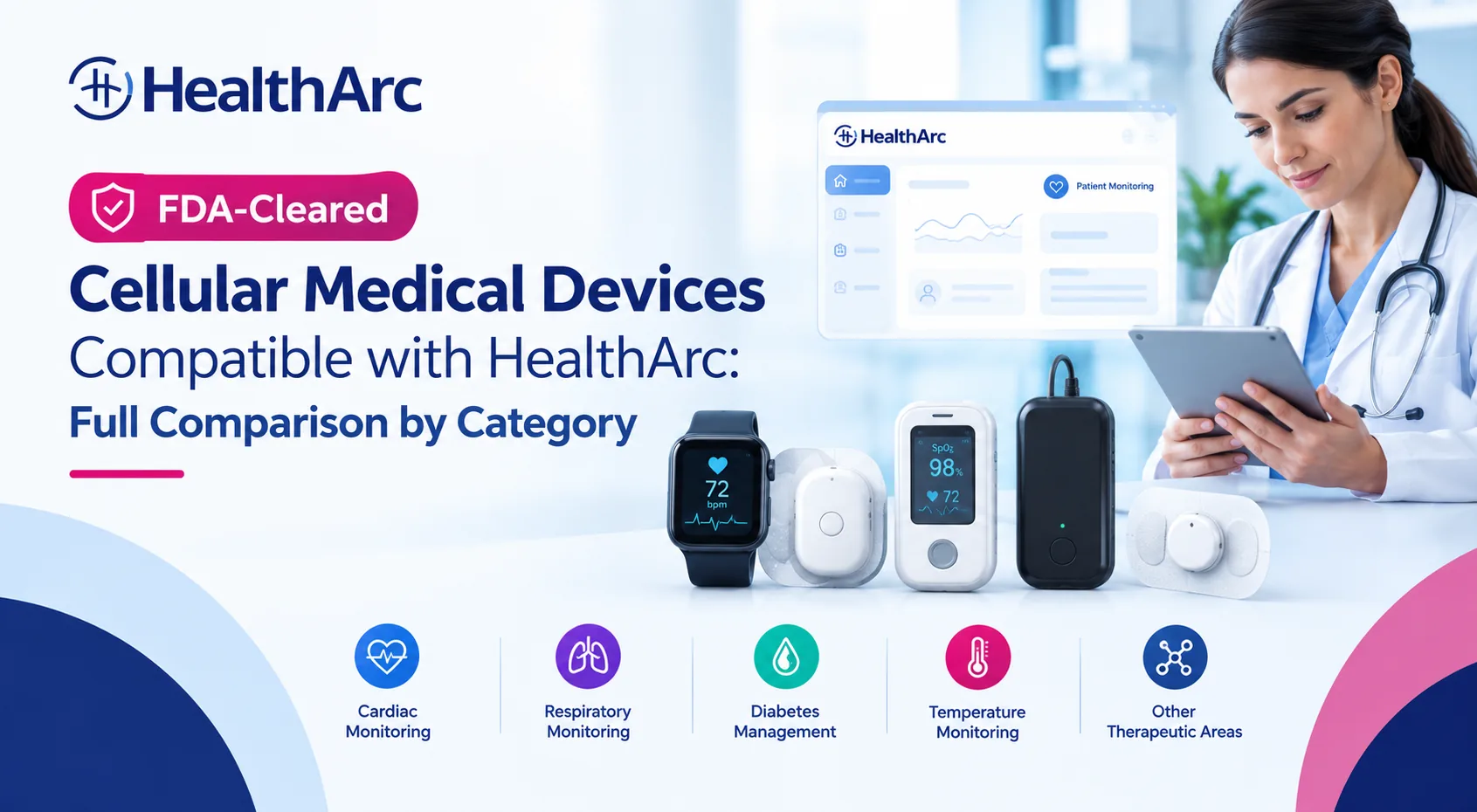
Most RPM platforms list "compatible devices" somewhere in their marketing. Few tell you exactly which device categories are supported, what connectivity standard each uses, which CPT codes each device supports, and what clinical use case each one is built for. That gap is where providers get burned. They enroll patients with hardware that fails compliance thresholds, or that needs patient setup that never happens.
This page closes that gap for HealthArc, and it complements our remote patient monitoring devices hub, which has a full page for every device. Below is a complete, category-by-category breakdown of every FDA-cleared cellular medical device type the platform supports, the billing codes each one activates, and the clinical conditions each device monitors. All 40+ devices share one defining characteristic: they transmit over 4G cellular with 2G fallback, using a multicarrier SIM that ships pre-activated. No Wi-Fi password, no Bluetooth pairing, no app for the patient to install.
Why this matters for compliance: CPT and CMS require an RPM device to meet the FDA definition of a medical device under section 201(h) of the Food, Drug, and Cosmetic Act, and to collect and transmit data automatically. Consumer wellness trackers usually don’t qualify. FDA clearance itself isn’t a billing requirement, but every device on HealthArc is FDA-cleared, which goes beyond the minimum and holds up better in an audit.
Key takeaway: HealthArc is device-agnostic across 8 device categories and 40+ individual devices. Compatible hardware you already own can typically continue working on the platform, which matters if you are switching from another vendor and don’t want to re-ship an entire patient fleet.
Device Categories at a Glance
The table below maps each device category to its primary clinical use, connectivity standard, and the CPT codes it supports. Detailed breakdowns follow in the sections below.
| Device Category | Primary Condition(s) | Connectivity | CPT Codes |
|---|---|---|---|
| Blood Pressure Monitors | Hypertension, cardiovascular disease | 4G cellular / 2G fallback | 99453, 99454, 99457, 99458 |
| Glucometers | Type 1 and Type 2 diabetes | 4G cellular / 2G fallback | 99453, 99454, 99457, 99458 |
| Weight Scales | Heart failure, obesity, CKD | 4G cellular / 2G fallback | 99453, 99454, 99457, 99458 |
| Pulse Oximeters | COPD, asthma, post-surgical recovery | 4G cellular / 2G fallback | 99453, 99454, 99457, 99458 |
| Continuous Glucose Monitors (CGM) | Diabetes (intensive management) | Manufacturer sensor, data integrated into HealthArc | 95249, 95250, 95251 |
| Spirometers | COPD, asthma, pulmonary disease | 4G cellular / 2G fallback | 98975, 98976, 98980, 98981 |
| Thermometers | Infectious disease, post-surgical, pediatric | 4G cellular / 2G fallback | 99453, 99454, 99457, 99458 |
| Medication Adherence Sensors | Polypharmacy, chronic disease management | 4G cellular / 2G fallback | 98975, 98980, 98981 |
One record, one claim. A patient enrolled in multiple device categories (for example, a blood pressure monitor and a weight scale for a heart failure patient) exists as a single record in HealthArc, with one dashboard, one care team, and one monthly billing record, not separate vendor portals to reconcile. That also matches how Medicare pays: the device-supply code is billed once per patient per 30 days, however many devices the patient uses.
Blood Pressure Monitors
Clinical use: Hypertension management, cardiovascular disease monitoring, CKD-related blood pressure control
Blood pressure monitors are the most commonly deployed device category in RPM programs, and for good reason. Hypertension affects nearly half of US adults, according to the CDC. An individual patient data meta-analysis of 25 trials (Tucker et al., PLoS Medicine, 2017) found self-monitoring lowered clinic systolic blood pressure by 3.2 mmHg at 12 months, and that the meaningful reductions came when monitoring was paired with medication titration, education or counselling. In other words, the cuff works when someone acts on the readings. The operational challenge is getting patients to use it consistently, and getting the data to a care team that responds.
Key Features on HealthArc
- Three cuff sizes: Standard, large, and extra-large, covering the full range of patient arm circumferences without requiring providers to order separately
- One-touch operation: Single button initiates measurement and transmission; no menu navigation, no confirmation steps
- Irregular heartbeat detection: Flags possible arrhythmia at the point of measurement, alongside the blood pressure value
- Automatic transmission: Readings reach the HealthArc dashboard within seconds of measurement, with no patient action beyond taking the reading
- Threshold alerting: Per-patient alert thresholds (not global defaults) trigger notifications when systolic or diastolic values fall outside the clinician-defined range
CPT Billing
| Code | Description | Requirement |
|---|---|---|
| 99453 | Setup and patient education | Billed once at enrollment |
| 99454 | Device supply and data transmission | Readings on at least 16 days in a 30-day period (2–15 days bills as 99445 from 2026) |
| 99457 | First 20 minutes of monthly management time | Requires interactive communication |
| 99458 | Additional 20-minute increment | Stackable on top of 99457 |
Clinical context: The 16-day threshold for 99454 is where most programs leak revenue. A patient who spends the first two weeks of the month trying to pair a Bluetooth cuff has already cost the practice that month’s full device-supply claim. Since 2026, a short month can still bill CPT 99445 for 2–15 days of readings, but at a lower rate. Cellular devices remove most of that failure mode. See the cellular blood pressure monitor page for specs and HealthArc’s remote patient monitoring program for the workflow.
Glucometers
Clinical use: Type 1 and Type 2 diabetes management, pre-diabetes monitoring, medication titration
Cellular glucometers address the single biggest failure point in diabetes RPM: the reading that never reaches the care team. Traditional Bluetooth glucometers depend on the patient’s phone, the app being open, and the Bluetooth connection being active. Each one can fail. With a cellular glucometer, the reading transmits the moment the test strip is processed.
Key Features on HealthArc
- Results in seconds: Blood glucose readings transmit to the HealthArc dashboard in near real-time after each test
- No app required: The device connects directly over cellular; patients don’t need a smartphone, an account, or any installed software
- Per-patient thresholds: Hypoglycemic and hyperglycemic alert thresholds are configured individually, not set globally across the panel
- Trend visualization: The platform aggregates readings into daily, weekly, and monthly trend views, supporting medication titration decisions between visits
CPT Billing
Cellular glucometers bill under the standard RPM codes (99453, 99454, 99457, 99458), identical to blood pressure monitors and weight scales. The same 16-day requirement applies for 99454. For patients who need continuous glucose data rather than point-in-time readings, see the CGM section below.
Clinical context: Diabetes is the second most common condition in RPM programs after hypertension, and the two conditions frequently co-occur. See the cellular glucometer page for device details. HealthArc’s diabetes monitoring program supports both glucometers and CGMs in the same patient record, with glucose and blood pressure data visible on the same dashboard. Providers managing both conditions don’t need separate logins or separate reports.
Weight Scales
Clinical use: Heart failure management, obesity and weight management, CKD fluid retention monitoring, post-surgical recovery
Daily weight is one of the most actionable data points in chronic disease management. A 2-3 pound overnight weight gain in a heart failure patient is a clinical signal that warrants same-day intervention, often preventing an emergency department visit. The problem is that this signal is only useful if the reading reaches the care team the same day it is taken.
Key Features on HealthArc
- Step-on operation: The patient steps on the scale; the reading is taken and transmitted automatically, with no buttons to press and no display to read or record
- Fluid-retention alerting: Configurable thresholds trigger alerts when weight increases by a clinician-defined amount over a defined period (for example, 3 lbs in 24 hours)
- Multi-patient household support: Device assignment is tied to the patient record in HealthArc, not to the physical device location, which matters in shared-household settings
- Trend charting: Weekly and monthly weight curves are visible in the care team dashboard, with baseline weight set at enrollment for accurate delta tracking
CPT Billing
Weight scales bill under the standard RPM codes (99453, 99454, 99457, 99458). For heart failure patients, weight data is frequently combined with blood pressure data in the same patient record, supporting a more complete picture of fluid status without requiring two separate billing entries.
Clinical context: See the cellular weight scale page for specs. HealthArc’s weight management program and cardiology program both rely heavily on cellular weight scales. For nephrology practices managing CKD patients with fluid retention, the scale is often the highest-value device in the kit. See HealthArc’s nephrology solutions for condition-specific workflow details.
Pulse Oximeters
Clinical use: COPD, asthma, heart failure, post-surgical recovery, COVID-19 follow-up, sleep apnea monitoring
Pulse oximeters measure two values simultaneously: oxygen saturation (SpO2) and pulse rate. In chronic respiratory disease, a sustained drop from the patient’s own baseline is often the first sign of an exacerbation. In post-surgical patients, it is an early warning sign of pulmonary complications. The clinical value is high. The hard part, as with all RPM devices, is getting consistent data without asking the patient to be technical.
Key Features on HealthArc
- Clinical-grade accuracy: HealthArc’s cellular pulse oximeters are FDA-cleared medical devices, not consumer wellness devices. The distinction matters for both compliance and clinical reliability.
- Fast, automatic transmission: The device captures SpO2 and pulse rate and transmits them over LTE-M cellular within moments of the reading
- Dual-metric alerting: Thresholds can be set independently for SpO2 and pulse rate, so a patient with both hypoxia risk and arrhythmia history receives appropriate alerts for each
CPT Billing
Pulse oximeters bill under the standard RPM codes (99453, 99454, 99457, 99458). For COPD patients, they’re frequently paired with spirometers in a two-device kit, and both report into the same HealthArc patient record. One billing rule matters here: Medicare pays for RPM or RTM for a patient in a given period, not both. A COPD patient with both devices is billed under one program, chosen by the care team based on which data drives management.
Clinical context: See the cellular pulse oximeter page for specs. HealthArc’s COPD monitoring program and pulmonology solutions provide condition-specific alert thresholds and care protocols for respiratory patients. The post-surgical monitoring workflow uses pulse oximeters as the primary device during the 30-day recovery window.
Continuous Glucose Monitors (CGM)
Clinical use: Type 1 diabetes, insulin-dependent Type 2 diabetes, hypoglycemia unawareness, gestational diabetes monitoring
CGMs occupy a different clinical tier from standard glucometers. Where a glucometer captures a single point-in-time glucose value, a CGM captures glucose every 1-5 minutes continuously, producing a glucose curve that reveals patterns a point-in-time reading cannot: nocturnal lows, post-meal spikes, and and time-in-range percentages that clinicians now use alongside HbA1c to guide insulin therapy.
HealthArc supports CGM integration with leading sensor manufacturers, including Abbott (FreeStyle Libre) and Dexcom.
Key Features on HealthArc
- Continuous glucose curves: 24-hour glucose profiles appear in the HealthArc dashboard, with each individual reading still available
- Time-in-range reporting: The platform calculates and displays percentage of time spent in the target glucose range (typically 70-180 mg/dL), the metric increasingly used by endocrinologists alongside HbA1c
- Nocturnal low alerts: Configurable alerts trigger when glucose drops below a defined threshold during overnight hours, enabling intervention before a hypoglycemic event becomes an emergency
- Sensor wear tracking: The platform tracks sensor application dates and flags patients approaching sensor expiration, supporting adherence without requiring staff to manually track replacement schedules
CPT Billing
CGMs use a separate code set from standard RPM devices. Here’s what each code covers:
| Code | Description |
|---|---|
| 95249 | Patient-provided CGM equipment: sensor placement, hook-up, calibration, patient training and printout (at least 72 hours of data) |
| 95250 | Practice-provided CGM equipment: sensor placement, hook-up, calibration, patient training and printout (at least 72 hours of data) |
| 95251 | Analysis, interpretation, and report of CGM data (at least 72 hours) |
Clinical context: See the continuous glucose monitor page for integration details. HealthArc’s endocrinology solutions and diabetes program provide the full CGM workflow, from sensor ordering through interpretation and documentation. The diabetes monitoring guide covers when to use CGM versus standard glucometers based on patient profile.
Spirometers
Clinical use: COPD, asthma, interstitial lung disease, pulmonary fibrosis, post-COVID respiratory monitoring
Spirometers measure lung function at home: specifically FEV1 (forced expiratory volume in one second), FVC (forced vital capacity), and peak flow. These three values, trended over time against the patient’s personal baseline, give pulmonologists and primary care providers an early warning system for respiratory decline that office-based spirometry, done once or twice a year, can’t provide.
Important billing distinction: Most home spirometry programs bill under Remote Therapeutic Monitoring (RTM) codes, not standard RPM codes. RTM covers monitoring of respiratory system status, and 98976 is its respiratory device-supply code. Confirm the approach with your coding team, because the choice also decides which program the patient is billed under that month.
Key Features on HealthArc
- FEV1, FVC, and peak flow: All three primary spirometry metrics are captured, transmitted, and trended within the HealthArc platform
- Baseline comparison: Each reading is compared to the patient’s personal baseline established at enrollment, not to population norms, which makes trend detection more sensitive
- Effort feedback: Devices provide immediate feedback to the patient on whether the blow was technically valid, reducing the proportion of unusable readings
- Cellular transmission: Readings transmit directly from the device over cellular, without requiring the patient to connect to a phone or computer
RTM Billing Codes
| Code | Description |
|---|---|
| 98975 | RTM setup, education, and device supply |
| 98976 | Device supply with daily recordings for respiratory system (minimum 16 days in 30) |
| 98980 | First 20 minutes of RTM treatment management |
| 98981 | Additional 20-minute increment of RTM treatment management |
Clinical context: See the cellular spirometer page for specs. HealthArc’s pulmonology care program and COPD monitoring workflow provide condition-specific spirometry thresholds and escalation protocols. For practices managing both respiratory and cardiovascular conditions, spirometers are frequently deployed alongside pulse oximeters in a two-device kit, billed under one program per patient per period.
Thermometers
Clinical use: Infectious disease management, post-surgical recovery, immunocompromised patient monitoring, pediatric chronic condition management
Cellular thermometers are the most straightforward device in the HealthArc catalog from a patient usability standpoint, but they serve a clinically important function in specific patient populations. For immunocompromised patients (post-transplant, oncology, HIV), fever is an emergency signal requiring same-day response. For post-surgical patients in the 30-day recovery window, temperature trending above 100.4°F is a standard indicator of surgical site infection or systemic complication.
Key Features on HealthArc
- Per-patient fever thresholds: Alert thresholds are configured individually. A fever threshold for a neutropenic oncology patient (often 100.4°F or lower) differs from a standard adult threshold, and the platform supports this distinction.
- Automatic transmission: Temperature readings transmit immediately after measurement, with no patient action required beyond taking the reading
- Trend visibility: Temperature readings are plotted over time in the HealthArc dashboard, making it possible to distinguish a single isolated elevation from a sustained fever pattern
- Integration with multi-device records: For patients enrolled with multiple devices (for example, a post-surgical patient with both a thermometer and a pulse oximeter), all readings aggregate into one patient record and one monthly claim
CPT Billing
Thermometers bill under the standard RPM codes (99453, 99454, 99457, 99458), with the same 16-day requirement for 99454. For post-discharge patients, they’re often deployed during the 30 days covered by transitional care management (TCM). TCM doesn’t pay for the device itself, but CMS allows RPM to be billed in the same period as TCM. See the cellular thermometer page and HealthArc’s transitional care management program for how the two fit together.
Medication Adherence Sensors
Clinical use: Polypharmacy management, chronic disease medication adherence, post-discharge medication compliance, behavioral health medication monitoring
Medication non-adherence is thought to cause at least $100 billion in preventable medical costs a year (Kleinsinger, The Permanente Journal, 2018), through avoidable hospitalizations, complications and emergency visits. The challenge for care teams is that self-reported adherence is unreliable: patients consistently overreport how consistently they take their medications. Adherence sensors solve this by generating an objective, time-stamped record of each dose event.
HealthArc’s medication adherence sensors attach to standard medication bottles or blister packs. When the patient opens the container, the sensor records the event and transmits a dose record to the HealthArc platform. Missed doses trigger same-day outreach, not a retrospective review at the next office visit.
Key Features on HealthArc
- Objective dose-event records: Each container opening is time-stamped and transmitted, creating an audit-ready adherence record that doesn’t rely on patient self-report
- Same-day missed-dose alerts: When a dose window passes without a recorded opening, the platform flags the patient for outreach, enabling intervention before a missed dose becomes a missed week
- Multi-medication support: Patients on multiple medications can be monitored across multiple sensors within the same patient record
- Pharmacy integration pathway: Adherence data is visible to the care team in the same dashboard as physiologic device data, supporting a coordinated view of the patient’s overall management
RTM Billing Codes
Medication adherence sensors bill under RTM codes, not RPM codes, because adherence is therapeutic rather than physiologic data. RTM’s device-supply codes are tied to a body system (98976 respiratory, 98977 musculoskeletal), so the codes that consistently apply to an adherence program are setup and treatment management:
| Code | Description |
|---|---|
| 98975 | RTM setup, education, and device supply |
| 98980 | First 20 minutes of RTM treatment management |
| 98981 | Additional 20-minute increment of RTM treatment management |
Clinical context: See the medication adherence sensor page for details. Medication adherence monitoring pairs naturally with chronic care management (CCM) and medication therapy management (MTM). For patients with complex medication regimens managed under CCM, adherence sensor data provides the objective documentation that care plan reviews require. The RTM billing guide covers the full RTM code set and documentation requirements.
Why Cellular Connectivity Is the Clinical Standard
The device ecosystem question providers should be asking isn’t "which devices are compatible?" but "which connectivity standard actually works for my patient panel?" The answer is clinical.
The patients who benefit most from RPM are disproportionately older, sicker, lower-income, and less technologically confident. These are precisely the patients who struggle with Bluetooth pairing, smartphone apps, and home Wi-Fi requirements. Every connectivity dependency that a device adds is a potential point of failure that reduces the transmission days that determine whether a month qualifies for billing.
Cellular vs. Bluetooth: A Direct Comparison
| Requirement | Cellular (HealthArc) | Bluetooth |
|---|---|---|
| Smartphone needed | No | Yes |
| App installation | No | Yes |
| Wi-Fi or data plan | No | Required for sync |
| Pairing sequence | No | Yes, at setup |
| Patient technical support calls | Minimal | Common |
| Transmission reliability | High (4G / 2G fallback) | Variable (Bluetooth range, phone battery) |
| Works without home broadband | Yes | No |
| Works when patient travels | Yes (150+ countries) | Depends on phone plan |
The billing consequence is direct. CPT 99454 requires readings on at least 16 days in a 30-day period. A patient who spends the first two weeks of the month troubleshooting a Bluetooth connection has already forfeited that month’s full device-supply claim before the care team even knows there’s a problem. Cellular devices remove most of that risk. Our side-by-side of cellular vs Bluetooth blood pressure monitors goes deeper.
Multicarrier SIM Architecture
HealthArc’s cellular devices ship with a multicarrier SIM that connects to whichever network is strongest at the patient’s address, not a single carrier’s network. This matters in rural areas and in regions where one carrier has marginal coverage. The device also maintains a 2G fallback connection, so readings transmit even where 4G coverage is limited. The result is a device that works reliably in urban apartments, rural farmhouses, and everywhere in between.
For a deeper look at how cellular connectivity affects RPM program performance, see Cellular Devices Driving RPM Success.
Device Kits by Specialty and Condition
Most patients don’t need every device in the catalog. The right kit depends on the conditions being monitored, the billing codes the practice wants to activate, and the patient’s ability to use multiple devices simultaneously. The following pairings reflect the most common clinical deployments on HealthArc.
| Specialty / Condition | Recommended Devices | Programs | Primary CPT Codes |
|---|---|---|---|
| Hypertension | Blood pressure monitor | RPM | 99453, 99454, 99457 |
| Type 2 Diabetes | Glucometer | RPM | 99453, 99454, 99457 |
| Type 1 / Insulin-Dependent Diabetes | Glucometer + CGM | RPM + CGM | 99454, 95249, 95250, 95251 |
| Heart Failure | Blood pressure monitor + weight scale | RPM | 99453, 99454, 99457 |
| CKD + Hypertension + Diabetes | Blood pressure monitor + glucometer + weight scale | RPM | 99453, 99454, 99457, 99458 |
| COPD | Pulse oximeter + spirometer | RPM or RTM (one per period) | 99454 or 98976, with 99457 or 98980 |
| Post-Surgical Recovery | Thermometer + pulse oximeter | RPM, alongside TCM | 99453, 99454, 99457 |
| Polypharmacy / Complex Chronic | Glucometer or BP monitor + medication adherence sensor | RPM, with CCM or MTM | 99454, 99457, plus CCM/MTM codes |
| Pulmonology | Pulse oximeter + spirometer | RPM or RTM (one per period) | 99454 or 98976, with 99457 or 98980 |
| Obesity / Weight Management | Weight scale | RPM | 99453, 99454, 99457 |
Multi-Device Billing: One Patient, One Record
A critical operational advantage of HealthArc’s device-agnostic architecture is how it handles patients enrolled in multiple device categories. Rather than requiring separate vendor portals, separate dashboards, and separate billing records for each device type, HealthArc consolidates all device data into one patient record. The care team sees one dashboard. The billing engine produces one monthly claim per patient, regardless of how many device categories are active, which is also how Medicare pays the device-supply code.
This matters for practices managing complex chronic patients, where a single patient might be enrolled with a blood pressure monitor, a weight scale, and a glucometer simultaneously. On HealthArc, that is one enrollment, one time log, and one billing record. On a platform that isn’t device-agnostic, it is three vendor relationships, three portals, and three billing processes.
For a complete breakdown of how multi-device programs are structured and billed, see the RPM and CCM implementation guide.
Device Logistics: What HealthArc Handles
Device compatibility is only part of the operational equation. The other part is who handles procurement, configuration, shipping, patient training, and ongoing technical support. These logistics are where RPM programs most commonly stall, and they represent a significant hidden cost for practices that manage them internally.
HealthArc handles the full device logistics cycle:
- Procurement: Devices are sourced and inventoried by HealthArc. Practices don’t need to establish their own vendor relationships or manage device inventory.
- Configuration: Every device ships pre-configured and activated with its multicarrier SIM. There is no setup step at the patient’s end.
- Direct-to-patient shipping: Devices ship directly to the patient’s home, typically arriving within a few business days of enrollment. Practices don’t need to stock or distribute hardware from their offices.
- Patient training: HealthArc’s team handles patient onboarding and device training, including follow-up calls to confirm the patient has taken their first reading successfully.
- Adherence support: Patients who stop transmitting receive outreach from HealthArc’s support team before the practice’s billing window closes.
- Technical support: Device troubleshooting is handled by HealthArc, not by the practice’s front desk staff.
Operational note: HealthArc offers a device evaluation option before commitment. Practices can request a device to be shipped for hands-on evaluation: take readings, see how data arrives in the dashboard, and confirm the workflow before enrolling a single patient.
For practices switching from another RPM vendor, HealthArc’s device-agnostic architecture means compatible hardware already deployed with patients can typically continue working on the platform, eliminating the need to re-ship an entire fleet. See the switching to HealthArc guide for how the transition process works.
Frequently Asked Questions
Are all HealthArc devices FDA-cleared?
Yes. CPT and CMS require an RPM device to meet the FDA definition of a medical device and to transmit data automatically. Clearance itself isn’t required, but every device category in HealthArc’s catalog is FDA-cleared, which goes beyond the minimum.
Can we use devices we already own?
HealthArc is device-agnostic, meaning compatible hardware already deployed with your patients can typically continue transmitting into the HealthArc platform without replacement. This is a meaningful advantage for practices switching from another RPM vendor who don’t want to re-ship an entire patient fleet. Contact the HealthArc team to confirm compatibility for specific device models.
Do patients need Wi-Fi, a smartphone, or an app?
No. Every device in HealthArc’s catalog transmits over its own 4G cellular connection with 2G fallback and a multicarrier SIM. There is no app to install, no Bluetooth pairing, no Wi-Fi password, and no account for the patient to create. Patients who own neither a smartphone nor home broadband can be enrolled and monitored without any modification to the standard workflow.
How many devices can one patient use simultaneously?
There is no platform limit on the number of device categories a single patient can be enrolled with. A complex chronic patient might use a blood pressure monitor, a weight scale, and a glucometer simultaneously. All three devices report into one patient record, one dashboard, and one monthly billing record.
Which CPT codes do the devices support?
- RPM devices (blood pressure monitors, glucometers, weight scales, pulse oximeters, thermometers): 99453, 99454, 99457, 99458
- CGM devices: 95249, 95250, 95251
- RTM devices: spirometers use 98975, 98976, 98980 and 98981; medication adherence sensors use 98975, 98980 and 98981
See the HealthArc CPT code library for current reimbursement rates and documentation requirements for each code.
Can a patient be billed for RPM and RTM at the same time?
No. Medicare pays for RPM or RTM for a patient in a given period, not both. A patient with a pulse oximeter and a spirometer still reports into one HealthArc record, and the care team bills the program that matches how the patient is being managed.
How long does it take to get devices to patients?
Devices ship directly to patients from HealthArc, typically within a few business days of enrollment. Devices arrive pre-configured and activated; patients don’t need to complete any setup. HealthArc’s team handles training and follows up to confirm the patient has taken their first reading successfully. Most programs go live within approximately 30 days of the practice decision to launch.
Can we evaluate a device before committing?
Yes. HealthArc will ship a device for hands-on evaluation before any enrollment commitment. This allows the practice team to handle the device, take readings, and watch data arrive in the dashboard before making a decision. Request a device evaluation to get started.
See the Devices and the Platform Together
The device catalog is only half the story. What makes a device clinically useful is the platform wrapped around it: the alert logic, the care team dashboard, the billing automation, and the documentation that survives an audit. HealthArc runs all of it in one environment, across all eight device categories and nine CMS programs.
The fastest way to evaluate whether HealthArc’s device ecosystem fits your practice is to see it with real hardware in hand. HealthArc will ship a device to your team before any commitment is made. Take readings, watch the data arrive in the dashboard, and confirm the workflow works for your patient panel before enrolling a single patient.
Three ways to get started:
- Schedule a platform demo to see the full device ecosystem and billing workflow in a live session
- Request a device to evaluate hardware before committing to a program
- Explore the revenue calculator to estimate what a device-enabled RPM program is worth across your eligible panel
HIPAA Compliant · SOC 2 Type II Certified · No long-term contracts
Sources
- U.S. Food and Drug Administration, How to Determine if Your Product is a Medical Device (section 201(h) definition).
- Centers for Medicare & Medicaid Services, Chronic Care Management Services, MLN909188, June 2025 (RPM or RTM, not both, alongside CCM and TCM).
- Tucker KL, Sheppard JP, Stevens R, et al. Self-monitoring of blood pressure in hypertension: a systematic review and individual patient data meta-analysis. PLoS Med. 2017;14(9):e1002389.
- Kleinsinger F. The unmet challenge of medication nonadherence. Perm J. 2018;22:18-033.

Ready to connect care between visits?
See how HealthArc runs RPM, CCM and seven more CMS programs — the platform, the devices and the clinical team — on a single demo.