
Weight · RPM + CCM
Remote Weight Monitoring
A weight taken at every visit is four data points a year. A weight taken every morning is a trend, and a trend is the only thing that distinguishes steady progress from fluid retention that needs a call today.
Step-on cellular scalesObesity and CHF pathwaysHIPAA · SOC 2 Type II
Weight trendLive
Daily weightCaptured on step-on
214.8 lb7-day changeThe number that drives alerts
+3.1 lbBlood pressureComorbid across most of the panel
142/88GlucoseWhere metabolic disease overlaps
142 mg/dL2–3 lbovernight gain: a common heart-failure alert rule
5 lbin a week: the other common rule
16 of 30days of readings 99454 requires
~$120RPM per patient per month, before CCM
Overview
Two Different Programs, One Device
Remote weight monitoring covers two clinically distinct jobs that happen to use the same scale. The first is weight management: obesity, metabolic disease, and increasingly patients on GLP-1 therapy, where the point is a sustained trend over months and the care team is coaching against it.
The second is fluid monitoring in heart failure, where the point is the opposite: a sudden gain over 24 hours to a week that signals fluid retention. A two-to-three pound overnight gain, or five pounds across a week, is a diuretic conversation, and it usually arrives days before the breathlessness that would have sent the patient to an emergency department.
Same hardware, opposite alert rules. Configuring one when you meant the other is the most common way a weight programme produces a useless alert queue. See cardiology for the heart-failure pathway.
Two programs, one deviceWeight management trends over months; heart failure alerts on days.
The rules are oppositesConfigure for the wrong one and the alert queue becomes noise.
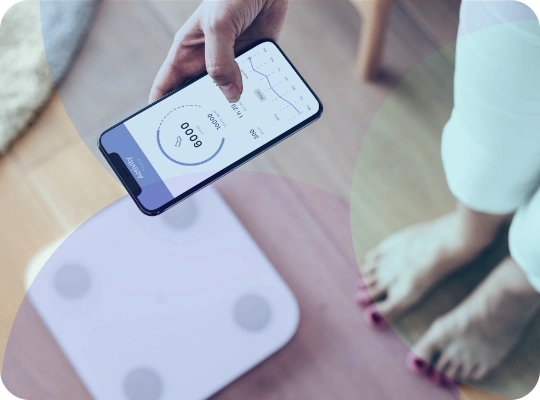
Step on and walk awayNo button, no app, no account for the patient to create.
+2–3 lb overnightThe fluid-retention alert most programs start from
Set the rule to the job. A weight-loss cohort alerting on a three-pound gain will bury your team in noise. A heart-failure cohort that only alerts on a monthly trend will miss the event the programme exists to catch.
What we monitor
What a Remote Weight Program Tracks
Weight is the anchor. What sits around it depends on which of the two programmes you are running.
| Signal | Device | Common alert threshold | What the team does |
|---|---|---|---|
| Daily weight (fluid) | Cellular scale | +2–3 lb overnight or +5 lb in a week | Same-day call. Diuretic review before it becomes an admission. |
| Weight trend (management) | Same scale, different rule | Sustained trend against the patient’s goal | Coaching call, and a check on whether the plan is realistic. |
| Blood pressure | Cellular BP monitor | 7-day average above goal | Comorbid across most of this panel; weight loss often changes the dose. |
| Glucose | Glucose meter | <70 or >250 mg/dL | Metabolic overlap, and a safety signal for patients on GLP-1 therapy. |
| Step-on adherence | Derived in-platform | Missed days approaching the 16-of-30 threshold | Outreach while the billable month can still be saved. |
Alert thresholds are configured per patient by the ordering clinician and adjusted over time. The values above are common starting points, not clinical guidance, and nothing here establishes a standard of care. Reimbursement figures are approximate national non-facility Medicare averages and vary by locality, facility status, payer and calendar year: verify current rates at cms.gov or with your MAC before you bill.
Devices
Devices for Remote Weight Programs
One action from the patient: step on. No button, no app, no account.
Cellular Weight Scales
Captured the moment the patient steps on, with fluid-retention alerting built in.
RPM 99454Blood Pressure Monitors
Three cuff sizes, which matters more in this panel than most.
RPM 99454Cellular Glucose Meters
For the metabolic overlap and GLP-1 safety monitoring.
RPM 99454Adherence Sensors
Objective dose records for the medication side of the plan.
RTM 98975
Programs & billing
Programs These Patients Qualify For
Weight rarely stands alone as a billable condition, and it rarely needs to.
Remote Patient Monitoring
Scale supply plus monthly treatment-management time.
99453 · 99454 · 99457Chronic Care Management
Obesity with a second chronic condition, which is the common presentation.
99490 · 99439Behavioral Health Integration
The behavioural half of weight management, billed properly.
99484 · 99492Medication Therapy Management
Pharmacist review, increasingly relevant with GLP-1 regimens.
99605–99607
How it runs
How a Month Runs
1
Step 1 of 5
Decide which programme
Fluid monitoring and weight management use opposite alert rules. This is decided at enrolment, per patient.
2
Step 2 of 5
Ship an activated scale
It arrives ready, so there’s nothing to set up. The patient steps on; there’s nothing else to do.
3
Step 3 of 5
Daily weights arrive
Automatic transmission, with the platform counting toward the 16-of-30 threshold.
4
Step 4 of 5
Work the right queue
Fluid alerts get same-day calls. Trend reviews get scheduled coaching contact.
5
Step 5 of 5
Close the month
Time and transmission days already documented against the codes.
FAQs
Weight Management Remote Monitoring: Common Questions
What is remote weight monitoring?
Remote weight monitoring is a Medicare-reimbursable programme in which a patient weighs themselves at home on a cellular scale, the reading transmits automatically, and a care team reviews the trend against thresholds the clinician set.
It supports two distinct clinical jobs: tracking sustained change in weight-management and obesity programmes, and catching sudden fluid gain in heart failure. The device is the same; the alert rules are opposites.
What weight gain should trigger an alert in heart failure?
The two rules in common use are a gain of 2–3 pounds overnight and a gain of 5 pounds within a week. Either suggests fluid retention rather than genuine weight change, and both typically precede the breathlessness that drives an emergency visit.
Thresholds are set per patient by the ordering clinician. Acting on them inside a day is what converts the alert into an avoided admission.
Is remote patient monitoring for weight loss covered by Medicare?
Weight itself is a physiologic measurement, so a connected scale is billable under the RPM codes (99453, 99454, 99457, 99458) when it is ordered for a qualifying clinical purpose and the 16-of-30 transmission requirement is met.
Coverage turns on the clinical indication rather than on weight loss as a goal in itself, and a weight-management programme is usually billed alongside CCM for the comorbid conditions. Confirm payer policy before enrolling.
Can remote weight monitoring support patients on GLP-1 medication?
Yes, and it is one of the fastest-growing uses. Weight trend, blood pressure and glucose together give a care team an objective view of both response and safety between visits, which matters when the regimen is being titrated and side effects drive discontinuation.
Pairing it with MTM is common, since much of what goes wrong is regimen tolerability rather than motivation.
What does the patient have to do?
Step on the scale. There is no button to press, no app to open and nothing to sync. The reading transmits over the scale’s own cellular connection.
That simplicity is deliberate: adherence to daily weights is the single largest predictor of whether a fluid-monitoring programme actually catches anything.
Keep reading
Related guides and programs
Build the right weight program
Tell us whether you are managing obesity, heart failure or both. The alert design differs, and so does the economics.
Resources
From the HealthArc blog
Practical guidance on remote monitoring, devices and billing. Updated with every new post.
October 26, 2026
How HealthArc’s AI-Assisted Pathways and Medical Scribe Automate Clinical Workflows for Enterprise Healthcare
How HealthArc’s AI care pathways trigger the next clinical task and its medical scribe drafts RPM, CCM, APCM and TCM notes with CPT codes, synced to your EHR.
Read articleOctober 23, 2026
FDA-Cleared Cellular Medical Devices Compatible with HealthArc: Full Comparison by Category
Every FDA-cleared cellular device category on HealthArc compared: conditions, connectivity, the RPM, RTM and CGM codes each supports, and kits by specialty.
Read articleOctober 21, 2026
Patient Assessment: What It Is, Types, Steps and Examples
What a patient assessment is, the main types, how to assess a patient step by step, 9 validated tools with scoring, and a sample SOAP assessment.
Read article
Talk to a Remote Care Specialist
How Can HealthArc Help You?
Want a demo, or just have a question about remote care in your practice? Send us a few details and a remote care specialist will get back to you shortly.
- RPM, CCM & 7 more CMS programs
- Automated time tracking & CPT billing
- Two-way EHR integration
- Managed care team, or your own
- Pre-configured cellular devices shipped
- Live in about 30 days
HIPAA compliant SOC 2 Type II No long-term contracts
Get Your Live HealthArc Walkthrough
No commitment required.
No obligation | No spam