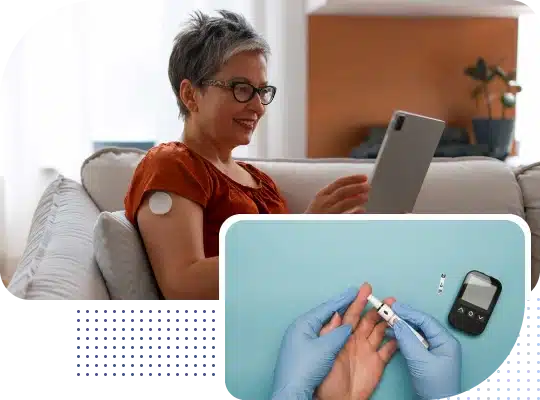
HealthArc’s cellular glucometer turns every fingerstick into a data point your care team can act on. Results appear in seconds, transmit automatically over the mobile network, and land in the same dashboard as the patient’s blood pressure and weight.
Diabetes management lives or dies on what happens between appointments. A quarterly A1c tells you where a patient has been; it does not tell you that they have been running low every morning for three weeks, or that a new medication stopped working ten days after it was started.
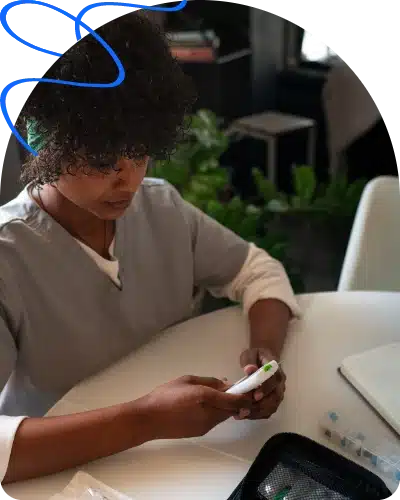
A connected glucometer closes that loop. HealthArc’s meter is built for the realities of the population: older patients, patients without smartphones, patients with limited dexterity or vision. It has a large high-contrast display, a fast result and cellular transmission that requires nothing from the patient beyond taking the test.
Glucose monitoring anchors RPM for diabetes, and pairs naturally with CCM and MTM when regimens are complex. Every device in the HealthArc device family reports into one dashboard and one monthly billing record, not a separate portal per vendor.
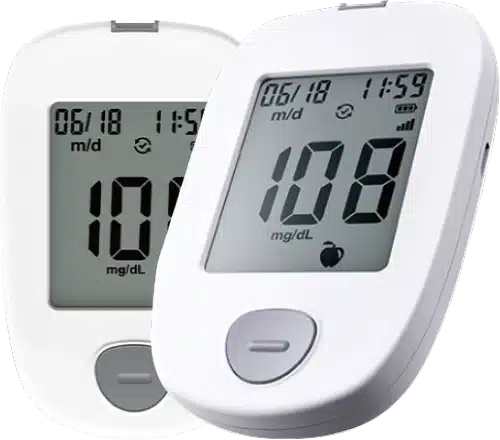
A compact, high-contrast cellular blood glucose meter designed for diabetes RPM programs, with results in seconds and no smartphone, app or pairing required.
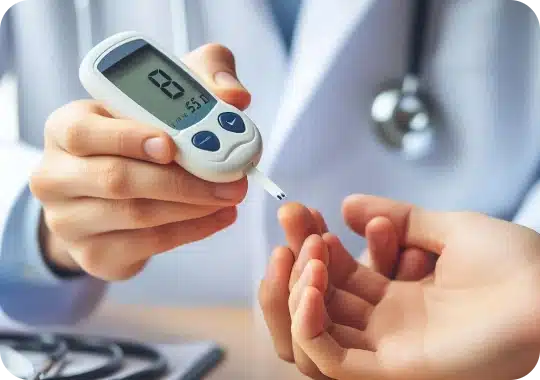
Fast measurement reduces the friction that causes patients to skip tests, which is the single biggest predictor of whether a glucose program produces usable data.
Large print and strong contrast keep readings legible for older adults and patients with visual impairment, reducing misread results.
Small enough for a pocket or bag, so testing continues when patients travel, work or spend the day away from home.
Results move to the platform over 4G without an app, a pairing step or a manual logbook, which removes transcription error entirely.
Readings outside the range you set for that patient trigger an alert, so dangerous lows surface immediately rather than at the next visit.
Readings are encrypted in transit and at rest inside HIPAA-compliant infrastructure, with a full audit trail for each transmission.
Four steps, none of which require the patient to own a smartphone, install anything or report a number to anyone.
HealthArc procures, configures and ships the glucometer directly to the patient, along with enrollment support and training. It works out of the box, and there’s no pairing sequence for your staff to talk anyone through.
One action. No app to open, no account to sign into. That simplicity is what keeps adherence intact past the first few weeks.
The reading moves to the HealthArc platform over the mobile network, encrypted and time-stamped. That happens in seconds. Nothing is transcribed by hand, so nothing is mistyped or forgotten.
Readings are checked against the thresholds you set for that patient, alerts route to the care team, and monitoring days plus management time accumulate into a billing-ready monthly record.
What the device measures, how it connects, and what the patient has to do. The short answer to the last one is: take the reading.
No apps. No pairing. No Wi-Fi. Cellular connectivity is the reason HealthArc programs can enroll patients who don’t own a smartphone or have home broadband. Typically the highest-risk patients in the panel.
| Measurement | Capillary blood glucose (mg/dL) |
|---|---|
| Result time | Seconds from sample application |
| Connectivity | 4G cellular with 2G fallback, multicarrier SIM |
| Patient setup | None. No app, pairing, Wi-Fi or account |
| Display | Large high-contrast digital display |
| Supplies | Test strips and lancets included in the monitoring kit |
| Alerts | Configurable hypo- and hyperglycemia thresholds |
| Data security | Encrypted in transit and at rest, HIPAA-compliant infrastructure |
| Coverage | Transmits in 150+ countries |
The populations where remote glucometer data most often changes a clinical decision.
HealthArc tracks transmission days and management time against each code automatically, so a month either meets the billing threshold or visibly does not.
Setup and patient education for the glucose monitoring device.
Device supply with daily recordings or programmed alerts, per 30 days.
First 20 minutes of monitoring management and interactive communication.
Each additional 20 minutes of monitoring management.
Code requirements, payment rates and monitoring-day thresholds change with each Medicare Physician Fee Schedule. Confirm current requirements in the CPT code library and with the CMS Fee Schedule Look-Up Tool before billing.
One patient can carry several devices. All of them report into a single dashboard and a single monthly billing record.
Continuous glucose curves, time-in-range reporting and nocturnal low alerts.
CGM · 95249–51 View deviceCellular-connected hypertension monitoring with three cuff sizes and one-touch operation.
RPM · 99454 View deviceStep-on cellular weight monitoring with fluid-retention alerts for heart failure.
RPM · 99454 View deviceInterested in a demo or just general questions? Fill out the form below and a representative will respond shortly!

Practical guidance on remote monitoring devices, billing and patient engagement. Updated with every new post.
Compare RPM and CCM platforms on the five things that decide real-world performance, then implement an RPM program step by step with 2026 CPT rates.
Read articleCellular or Bluetooth for RPM blood pressure? What CPT 99445 changed in 2026, why 78% of over-65s owning a smartphone breaks the usual argument, and how to match devices per patient.
Read articleRemote cardiac monitoring covers four services with four different billing clocks. What each modality does, what a monitoring system has to include, which codes collide, and what the trial evidence actually supports.
Read article