
By Sudeep Bath
| October 1, 2026
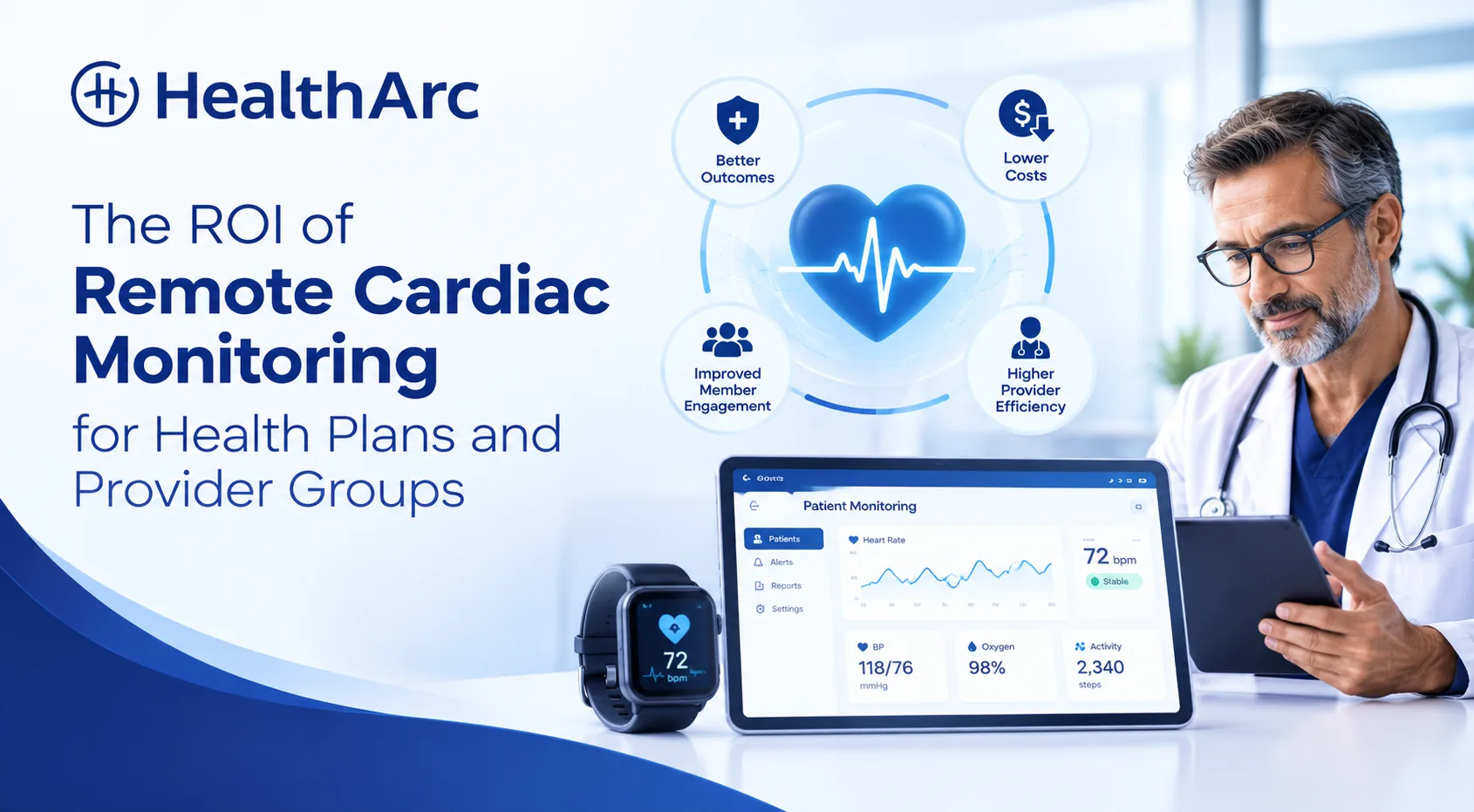
Remote cardiac monitoring can create value in two very different ways. For a provider group operating primarily under fee-for-service, the business case starts with remote patient monitoring reimbursement minus the cost of devices, technology, staffing, and program administration.
For a health plan, ACO, or provider organization carrying meaningful financial risk, the equation is different. The value comes less from RPM claims and more from whether earlier detection and intervention can reduce avoidable emergency department visits, hospitalizations, readmissions, and other expensive utilization.
Confusing these two models is one reason ROI projections for remote monitoring often look better on paper than they perform in practice. A credible ROI of remote cardiac monitoring analysis should answer four questions:
- How much recurring reimbursement can a provider realistically generate?
- What does it cost to operate the program?
- How many patients are needed to reach break-even?
- For a risk-bearing organization, how much utilization would need to be avoided for the program to create positive value?
The answers depend heavily on patient eligibility, transmission rates, clinical staffing, payer contracts, and the organization’s ability to act on incoming data.
Key Takeaways
- Two P&Ls, two questions. A fee-for-service provider asks whether RPM revenue covers program cost. A health plan or risk-bearing group asks whether avoided utilization covers it. Don’t add the two together.
- 100 cardiac RPM patients can produce about $11,434 a month in gross Medicare reimbursement at 2026 national rates. After an illustrative $53.25 per patient in operating cost, that’s roughly $6,109 in monthly contribution.
- Break-even is around 99 active patients against $5,000 a month in fixed overhead, and it moves to about 123 if clinical labor runs $10 a patient higher.
- The 2026 short-window device code pays the full rate. MedPAC lists CPT 99445 (2–15 days of data) at $52.11, the same as 99454 (16–30 days). Patients who transmit on fewer days no longer drop to zero device revenue.
- For a risk-bearing organization, the test is concrete. At $10,000 of net savings per avoided admission, a $63,900-a-year program needs about seven avoided hospitalizations a year to pay for itself.
Table of Contents
What “Remote Cardiac Monitoring” Means in an ROI Model
Remote cardiac monitoring can describe several different technologies and clinical workflows. We break down all four modalities in our guide to remote cardiac monitoring systems and reimbursement.
In an RPM business case, the focus is generally on remote physiologic monitoring using connected medical devices that automatically transmit physiologic data. CMS’s RPM framework includes parameters such as blood pressure, weight, pulse oximetry, and respiratory flow rate. The device must meet the applicable medical-device requirements and automatically collect and transmit data.
That’s different from remote monitoring of an implanted pacemaker or cardiac device, which uses a separate Medicare coding and reimbursement framework.
This distinction matters when calculating cardiac RPM ROI. A cardiology practice shouldn’t combine unrelated monitoring services into one reimbursement model simply because both involve remote data.
For this analysis, the focus is RPM used in cardiovascular care. Think of a connected blood pressure monitor, a weight scale, a pulse oximeter, or other physiologic indicators relevant to patients with conditions such as hypertension or heart failure.
2026 RPM Reimbursement: The Starting Point for the Provider P&L
CMS payment amounts changed for 2026, and the CY 2026 Physician Fee Schedule final rule introduced two additional RPM codes for shorter monitoring and treatment-management windows.
For the four established codes in the traditional RPM billing model, the 2026 national non-facility payment amounts are:
| CPT code | RPM service | 2026 national payment |
|---|---|---|
| 99453 | Initial setup and patient education | $21.71 one time |
| 99454 | Device supply and data transmission, 16–30 days | $52.11/month |
| 99457 | First 20 minutes of treatment management | $51.77/month |
| 99458 | Each additional 20 minutes | $41.42/month |
These are national payment amounts for the non-facility setting. Actual reimbursement can vary based on geography, payer, patient eligibility, claim circumstances, and applicable rules. MedPAC’s March 2026 report (Chapter 4, Table 4-8) lists these 2026 amounts and notes that actual payments vary geographically.
The newer 2026 codes belong in a complete financial model too. CPT 99445 covers device supply when data is transmitted for 2–15 days in a 30-day period, and 99470 covers the first 10 minutes of RPM treatment management. Our 99445 and 99470 billing guide covers the rules.
Here’s the detail most ROI models miss. The same MedPAC table puts 99445 at $52.11, identical to 99454, and 99470 at $26.05. Before 2026, a cardiac patient who transmitted on 12 days produced no device-supply revenue at all. Now that month pays the same device rate as a 16-day month. The two codes can’t both be reported for the same period, but the old 16-day cliff is gone, which changes how you should model patients with patchy adherence.
The traditional 16-day/20-minute model is still the cleanest way to understand the economics of an established cardiac RPM program, so the worked example below uses it.
Provider-Group P&L: What 100 RPM Patients Can Generate
Consider a provider group with 100 active cardiac RPM patients. For a simple recurring model, assume:
- All 100 patients meet the requirements for 99454.
- All 100 reach the 20-minute threshold for 99457.
- 20 patients require an additional 20 minutes and qualify for 99458.
- 10 patients are newly enrolled during the month and generate 99453.
- All amounts use the 2026 national non-facility payment amounts above.
- This is a revenue illustration, not a guarantee of billability.
Worked monthly example: 100 patients
| Revenue component | Volume | 2026 rate | Monthly revenue |
|---|---|---|---|
| 99454 device/data supply | 100 | $52.11 | $5,211.00 |
| 99457 treatment management | 100 | $51.77 | $5,177.00 |
| 99458 additional management | 20 | $41.42 | $828.40 |
| 99453 new setup | 10 | $21.71 | $217.10 |
| Total | $11,433.50 |
That produces approximately $11,434 in gross RPM reimbursement for the month under these assumptions. Annualized, that’s about $137,202 before program expenses.
The important word is gross. This number is the top line of the provider-side P&L. It says nothing yet about return.
The Cost Side Is Where RPM ROI Gets Real
A provider group may have reimbursement available and still run a weak program if the operating cost per patient is too high. A defensible model should account for at least:
- Connected devices
- Device replacement and logistics
- RPM platform fees
- Cellular connectivity where applicable
- Patient onboarding
- Clinical monitoring labor
- Escalation and patient outreach
- Billing and revenue-cycle administration
- Program management
- Training and quality oversight
- EHR integration or technology costs
The exact cost structure varies considerably depending on whether the organization builds the program internally, contracts clinical support, or uses a hybrid model.
Illustrative cost assumptions
The following example is intentionally an assumption model. It isn’t a claim about market pricing.
| Cost category | Assumption per active patient/month | Cost for 100 patients |
|---|---|---|
| Device cost amortized over 12 months | $6.25 | $625 |
| RPM platform | $12.00 | $1,200 |
| Clinical staffing | $30.00 | $3,000 |
| Connectivity/admin/logistics | $5.00 | $500 |
| Estimated operating cost | $53.25 | $5,325 |
Under those assumptions:
| Gross reimbursement | $11,433.50 |
| Estimated operating cost | −$5,325.00 |
| Illustrative monthly contribution | $6,108.50 |
That’s a contribution model. It doesn’t promise profitability. If the practice has additional fixed overhead, lower patient participation, lower reimbursement, higher staffing costs, or more device replacements, the result changes quickly.
To test your own assumptions instead of relying on a generic per-patient estimate, run them through HealthArc’s RPM revenue calculator. It lets you edit every rate and see revenue net of cost.
How Many Patients Does a Cardiac RPM Program Need to Break Even?
Break-even is more useful to a CFO than a headline revenue-per-patient number. Using the illustration above:
- Revenue per active patient, excluding new setup and 99458: $103.88 ($52.11 + $51.77)
- Assumed variable operating cost: $53.25
- Contribution per active patient: $50.63
If the program has $5,000 in monthly fixed costs, the approximate break-even point would be:
$5,000 ÷ $50.63 = 98.8 patients
So the organization would need approximately 99 active patients under these assumptions to cover $5,000 in fixed monthly overhead. That number is highly sensitive to staffing and reimbursement performance.
If clinical labor rises by $10 per patient, the contribution falls to $40.63 and break-even rises to approximately 123 patients. If the average reimbursement per patient falls because fewer patients meet the required thresholds, break-even rises again.
That’s why cardiology RPM revenue per patient should never be evaluated without the cost to produce it. Our broader breakdown of RPM ROI in 2026 walks through payback periods for non-cardiac programs as well.
The Second P&L: ROI for Health Plans and Risk-Bearing Organizations
A health plan has a fundamentally different economic equation. A Medicare Advantage plan generally doesn’t look at RPM and ask how much RPM reimbursement it collected.
The more relevant question is whether the intervention reduced total medical expense or improved the outcomes that matter under the contract.
For an ACO, delegated-risk group, or other risk-bearing entity, the same principle applies. (We cover the ACO version in detail in ROI of remote patient monitoring for ACOs.) The economic model becomes:
RPM program cost → clinical intervention → avoided utilization → medical-cost savings
Potential sources of value include:
- Avoided emergency department visits
- Avoided hospital admissions
- Reduced readmissions
- Earlier intervention for worsening symptoms
- Better chronic disease control
- Improved care transitions
- Reduced escalation to higher-cost settings
Treat the evidence carefully. Remote monitoring can create a pathway for earlier detection and intervention, but an RPM enrollment doesn’t prove that a hospitalization would otherwise have occurred. That distinction is particularly important when you present an ROI case to a health plan medical director.
Why Cardiac Populations Have a Different Economic Case
Cardiology populations often contain patients whose deterioration can become expensive quickly.
A patient with heart failure, for example, may show changes in weight, blood pressure, oxygen saturation, symptoms, or other clinically relevant indicators before an acute event becomes obvious. (Our post on RPM for congestive heart failure covers which signals matter.) The business case for monitoring is strongest when the organization can connect:
Data → clinical review → timely intervention → avoided escalation
If the monitoring platform generates alerts but the clinical team lacks the capacity to respond, the economic model weakens. The technology itself doesn’t create the savings. The clinical operating model around the technology does.
That’s also why organizations should measure response time, outreach completion, escalation rates, and downstream utilization. Enrollment counts alone tell you very little.
How Many Hospitalizations Does the Program Need to Prevent?
Go back to the illustrative provider program above. Its estimated operating cost is $5,325 per month, or $63,900 per year.
Suppose a risk-bearing organization estimates that each avoided hospitalization produces $10,000 in net medical-cost savings.
That’s an assumption, not a universal value. Actual savings vary substantially by diagnosis, contract, facility, patient acuity, allowed amounts, and which costs the organization actually bears.
Under that assumption:
$63,900 ÷ $10,000 = 6.39
The program would need to prevent approximately 7 qualifying hospitalizations per year to offset the illustrative annual program cost. That’s a far more useful way to discuss remote cardiac monitoring cost savings than saying RPM “reduces hospitalizations.”
The organization can replace the $10,000 assumption with its own claims data and immediately see whether the economics hold.
Why Provider ROI and Payer ROI Shouldn’t Be Combined
A common mistake is to put RPM reimbursement and avoided hospital costs into one giant ROI number. That can double-count value.
Consider a provider group participating in a risk arrangement. It may receive RPM reimbursement and also benefit financially when utilization falls. A pure FFS provider may receive RPM reimbursement but have little or no direct financial benefit from avoided hospitalizations.
A health plan may have no provider-side RPM revenue but bear the medical cost of avoidable utilization. The same RPM program can therefore have completely different economics depending on who carries the financial risk.
| Model | Equation |
|---|---|
| Provider group | RPM reimbursement − program operating cost = provider contribution |
| Risk-bearing | Avoided medical expense + quality/value-based incentives − program cost = risk-bearing contribution |
| Hybrid | RPM reimbursement + shared savings/value-based revenue + avoided utilization − total program cost = overall contribution |
The correct model depends on the contract. If you’re moving from fee-for-service toward shared risk, our value-based care page explains how HealthArc supports both sides of that transition.
Where RPM Reimbursement Fits in Cardiology
For cardiology practices, RPM reimbursement can create a recurring revenue stream around clinically appropriate physiologic monitoring. Reimbursement shouldn’t be the sole reason to deploy RPM, though.
A sustainable program needs enough eligible patients, sufficient data transmission, qualified clinical management, accurate documentation, appropriate devices, and a workflow for responding to clinically meaningful findings. HealthArc’s cardiology solutions are built around that workflow.
CMS has also emphasized that RPM devices must automatically collect and transmit data and meet the applicable definition of a medical device. That makes operational performance part of the financial model.
A patient who enrolls but doesn’t transmit enough data may not produce the same reimbursement as a consistently engaged patient.
A patient who generates data but doesn’t receive meaningful clinical management may create workload without producing the expected value. The denominator in the ROI calculation isn’t simply enrolled patients. It’s productive, clinically managed patients.
One forward-looking risk belongs in any multi-year model. CMS has proposed revaluing the RPM device-supply codes downward for 2027, so stress-test the device line before you commit to a three-year budget.
How Readmission Penalties Change the Payer Case
CMS’s Hospital Readmissions Reduction Program reduces payments to hospitals with excess readmissions, with the payment reduction capped at 3%. The program covers conditions including heart attack, heart failure, pneumonia, COPD, hip/knee replacement, and CABG.
The FY 2026 IPPS final rule also changes the readmission program starting with the FY 2027 program year, including the addition of Medicare Advantage data to the six readmission measures.
For organizations managing cardiovascular populations, this reinforces an important point. The financial consequences of poor transitions and avoidable utilization can extend beyond the cost of a single admission. But RPM shouldn’t be credited with every avoided readmission.
A defensible ROI analysis compares outcomes against an appropriate baseline or control population and accounts for case mix, attribution, intervention intensity, and other concurrent care-management programs.
What a CFO Should Measure Before Scaling
Before moving from 100 patients to 1,000, leadership should establish a small set of operating metrics.
Revenue metrics
- Average RPM reimbursement per active patient
- Percentage meeting device-data requirements
- Percentage meeting treatment-management requirements
- Revenue per enrolled patient
- Revenue per actively managed patient
- Clean-claim rate
Cost metrics
- Device cost per patient
- Technology cost per patient
- Clinical labor cost per patient
- Cost per successful enrollment
- Cost per monitored patient
- Cost per escalation
Clinical and utilization metrics
- ED visits per 1,000 patients
- Admissions per 1,000 patients
- Readmissions
- Time from alert to intervention
- Medication changes
- Follow-up completion
- Patient retention
Financial metrics
- Contribution margin per patient
- Monthly program margin
- Annualized program contribution
- Break-even enrollment
- Medical-cost savings per patient
- ROI by risk arrangement
These metrics show whether the program is actually scaling or simply accumulating enrolled patients.
What the ROI of Remote Cardiac Monitoring Really Depends On
The strongest business case doesn’t say “RPM generates $X per patient.” It says: “For this population, this operating model produces $X of revenue or avoided cost at a cost of $Y per patient, with these clinical and financial outcomes.”
For provider groups, the most important variables are reimbursement capture, patient engagement, staffing efficiency, and technology cost.
For health plans and risk-bearing organizations, the larger question is whether the intervention changes utilization or quality outcomes enough to offset program expense. HealthArc’s programs for payers are measured against that question.
For organizations operating under both FFS and value-based contracts, the opportunity can be broader, because the same infrastructure may support both reimbursement and population-health objectives.
Keep the assumptions visible. A defensible business case should model at least these scenarios:
- Conservative: lower enrollment, lower transmission, higher staffing cost
- Expected: realistic engagement and operating assumptions
- Upside: strong participation, efficient staffing, favorable utilization outcomes
A single optimistic ROI number is less useful than a range that leadership can stress-test.
Frequently Asked Questions
What is the ROI of remote cardiac monitoring?
It depends on who carries the financial risk. For a fee-for-service provider, ROI is RPM reimbursement minus device, technology, staffing, and administrative costs. For a health plan or risk-bearing group, it’s avoided medical expense plus applicable value-based revenue minus program cost. In our illustrative 100-patient example, gross Medicare reimbursement is about $11,434 a month and contribution after operating costs is about $6,109.
How much does Medicare pay for RPM in 2026?
MedPAC’s March 2026 report lists 2026 national non-facility amounts of $21.71 for 99453 (one-time setup), $52.11 for 99454 (16–30 days of data), $51.77 for 99457 (first 20 minutes), and $41.42 for each additional 20 minutes under 99458. The new 99445 (2–15 days) pays $52.11 and 99470 (first 10 minutes) pays $26.05. Actual payment varies by geography and payer.
How many RPM patients does a cardiology practice need to break even?
Under the illustrative assumptions in this article ($103.88 in recurring revenue and $53.25 in variable cost per patient), a program with $5,000 in monthly fixed costs breaks even at about 99 active patients. If clinical labor costs $10 more per patient, break-even rises to about 123.
Does CPT 99445 pay less than 99454?
No. MedPAC lists both at $52.11 for 2026. 99445 covers 2–15 days of transmitted data in a 30-day period and 99454 covers 16–30 days. Only one can be reported for the same period.
How do health plans measure the ROI of remote patient monitoring?
Health plans look at total medical expense and contract outcomes, not RPM claims. The usual approach compares ED visits, admissions, and readmissions per 1,000 monitored members against a baseline or control group, adjusted for case mix and other care-management programs running at the same time.
How many hospitalizations does a cardiac RPM program need to prevent to pay for itself?
Divide annual program cost by net savings per avoided admission. A program costing $63,900 a year, at an assumed $10,000 in net savings per avoided hospitalization, needs about seven avoided admissions a year to break even. Replace the $10,000 with your own claims data.
Is implanted cardiac device monitoring billed as RPM?
No. Remote interrogation of pacemakers, ICDs, and implantable loop recorders uses its own device-monitoring CPT codes, separate from the 99453–99458 RPM family. Keep them in separate reimbursement models.
The Bottom Line
The ROI of remote cardiac monitoring isn’t determined by reimbursement alone. For a provider group, the basic equation is straightforward:
RPM revenue − device, technology, staffing, and administrative costs = contribution
For a health plan or risk-bearing organization, the equation shifts:
Avoided medical expense + applicable value-based revenue − RPM program cost = economic value
The strongest programs can participate in both equations, but the financial logic should stay separate.
The 2026 Medicare payment schedule gives you a clear starting point for provider-side economics: $21.71 for initial setup through 99453, $52.11 for 99454, $51.77 for 99457, and $41.42 for each additional 20-minute 99458 increment at the national non-facility level.
From there, the real work is operational.
How many patients will consistently generate qualifying data? How much clinical time does each patient actually consume? What does the technology cost? How quickly can the team respond to deterioration? And for a risk-bearing organization, how much utilization would have to change for the program to pay for itself?
Those are the numbers that decide whether cardiac RPM is simply a reimbursable service or a sustainable part of your care and financial strategy.
Want to model the provider-side economics for your own patient volume? Start with the revenue calculator, then book a HealthArc demo to turn a generic estimate into a scenario built on your patient volume and payer mix.
This article is for general informational purposes and isn’t financial, legal, or billing advice. Payment amounts are 2026 national averages and vary by locality and payer; cost figures are illustrative assumptions. Confirm current CMS and payer policy with your compliance team before billing.

Ready to connect care between visits?
See how HealthArc runs RPM, CCM and seven more CMS programs — the platform, the devices and the clinical team — on a single demo.