
By Sudeep Bath
| August 7, 2026
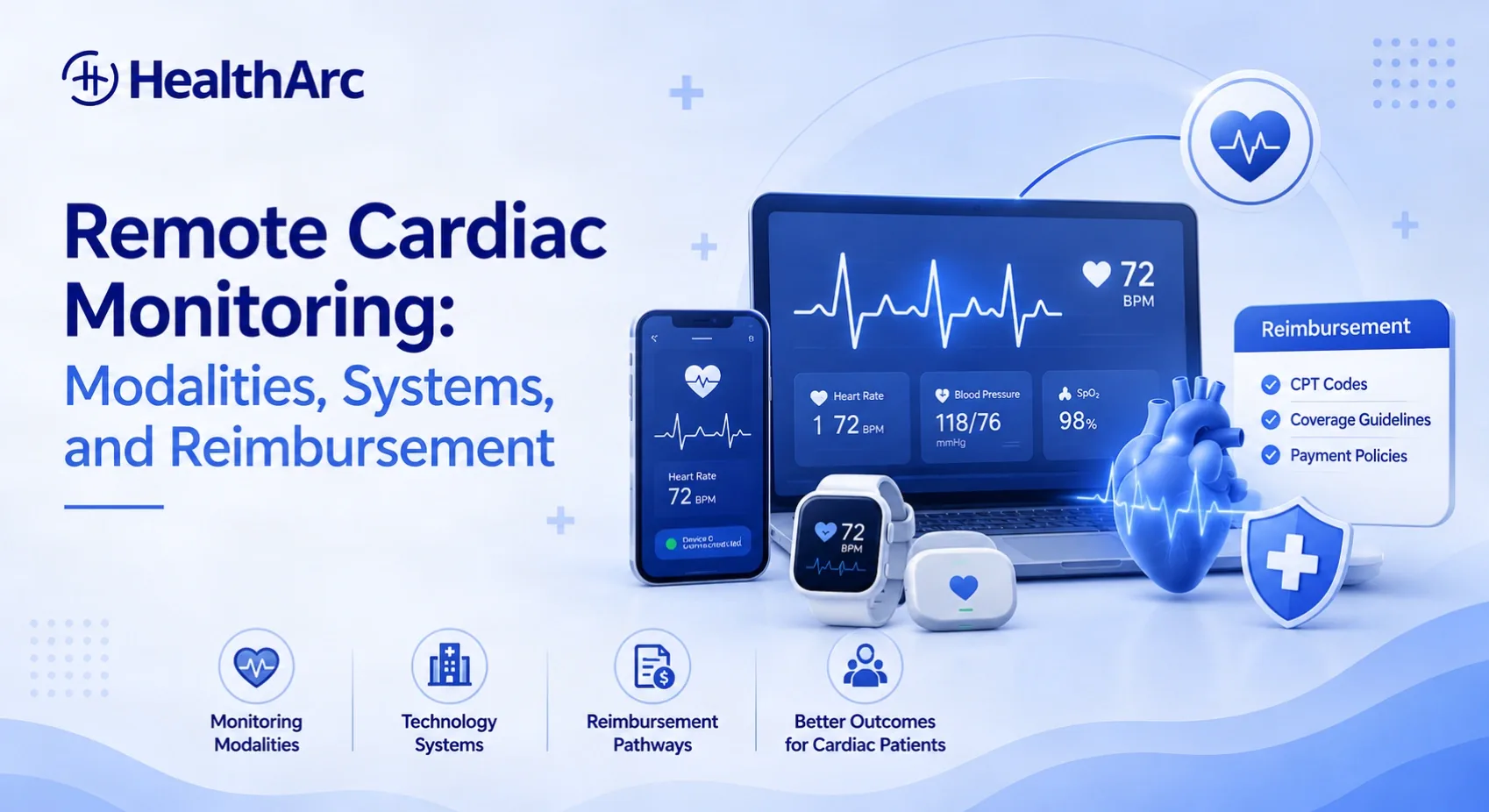
Ask four cardiologists what remote cardiac monitoring means and you’ll get four answers. One is thinking about the pacemaker transmissions that land in the device clinic queue every morning. One means the two-week ECG patch she ordered for a patient with palpitations. One means the pulmonary artery pressure sensor in her heart failure clinic. And one means the blood pressure cuff that sends a reading to a nurse every day.
All four are right. They’re also four different services, with four different billing clocks, four different staffing models, and in some combinations they can’t be billed together at all.
That last part is where programs get into trouble. A practice builds a home monitoring program, enrolls a cardiology panel, and then finds out that the codes it planned to bill are blocked for a chunk of its patients by a single line in the CPT book. Nobody mentions this in the vendor demo.
So this post sorts the four modalities out, says what a monitoring system has to actually contain to be worth running, shows where the codes collide, and goes through what the randomized evidence supports and what it doesn’t. There’s a specific finding buried in the trial data that should change how you design the program, and it has nothing to do with which device you buy.
Key Takeaways
- Remote cardiac monitoring is four separate services: implanted device follow-up, ambulatory ECG diagnostics, implanted hemodynamic sensors, and home physiologic monitoring. Each bills on its own clock, from 30 days to 90 days to the calendar month.
- The mortality benefit in the trial literature tracks transmission cadence and response discipline, not the hardware. A meta-analysis of 9 randomized trials found no all-cause mortality benefit overall (OR 0.83, p = 0.285), but a benefit in the 3 trials that used daily verified transmission (OR 0.65, p = 0.021).
- CPT blocks the general home monitoring codes when a more specific cardiac monitoring code is in play. That single parenthetical decides which of your patients can be enrolled in which program.
- Alert volume is the operational problem. Across more than 26,000 device patients at 25 centers, 205,804 transmissions arrived in 12 months, about 7.7 per patient, and 40% were alerts. Loop recorders were 18.8% of devices and produced half the alerts.
- Roughly half of remote-monitoring-capable implanted devices are never activated, per the 2023 international consensus statement, which also puts adequate staffing at 3.0 full-time equivalents per 1,000 monitored patients.
- Two new codes took effect January 1, 2026, covering 2 to 15 days of home data and 10 to 19 minutes of management time. They matter most for short post-discharge and post-procedure cardiac episodes that never reached the old thresholds.
Table of Contents
What Is Remote Cardiac Monitoring?
Remote cardiac monitoring is the practice of collecting heart data from a patient who isn’t in your building, and acting on it. The data comes from an implanted device, a wearable ECG recorder, an implanted pressure sensor, or a connected home device such as a blood pressure cuff or weight scale. A clinical team reviews it on a defined schedule, responds to alerts inside a defined window, and documents what it did. Medicare pays for most of it under distinct CPT code families depending on which of those four sources the data came from.
That definition sounds narrow. It isn’t. The phrase gets used for a $60 pacemaker transmission review and for a full home heart failure program with daily weights and a nurse on the phone. Getting specific about which one you mean is the first real decision, because everything downstream follows from it.
The Four Modalities, Side by Side
Here they are in one table. Read the billing interval column carefully, because it’s the thing that breaks program calendars.
| Modality | What it monitors | Typical CPT family | Billing interval |
|---|---|---|---|
| Implanted device follow-up (CIED) | Pacemakers, ICDs, CRT devices: lead integrity, battery, arrhythmia episodes, therapy delivery | 93294, 93295, 93296 | Up to 90 days |
| Subcutaneous rhythm monitors | Insertable cardiac monitors and loop recorders: continuous rhythm, syncope workup, AF burden | 93298, 93299 | Up to 30 days |
| Ambulatory ECG diagnostics | Wearable Holter, extended-wear patch, mobile cardiac telemetry: symptomatic arrhythmia capture | 93224–93227, 93241–93248, 93228–93229, 93268–93272 | Per study, 48 hours to 30 days |
| Implanted hemodynamic sensors | Pulmonary artery pressure, filling pressures in heart failure | 93264, 93297, 93299 | Up to 30 days |
| Home physiologic monitoring (RPM) | Blood pressure, weight, pulse oximetry, heart rate from connected home devices | 99453, 99454, 99457, 99458, plus 99445 and 99470 from 2026 | 30-day period or calendar month |
Note the split in the ambulatory ECG family. The duration is the code. Up to 48 hours of continuous recording is 93224 through 93227. More than 48 hours up to 7 days is 93241 through 93244. More than 7 days up to 15 days is 93245 through 93248. Mobile cardiovascular telemetry with a real-time attended surveillance center is 93228 and 93229, billed once per course of up to 30 consecutive days. Each family splits again into a global code and separate technical and professional components, which is where a lot of denials come from.
Two of these five rows are diagnostic. You order a patch or a telemetry study to answer a question, the study ends, you get an answer. The other three are longitudinal. They run for years, generate work every month, and need a standing operational process rather than an order. Programs usually get built for the diagnostic case and then quietly fail at the longitudinal one.
The Finding That Should Shape Your Program
This is the part worth reading twice.
In 2015, Parthiban and colleagues published a systematic review in the Journal of the American College of Cardiology pooling 9 randomized controlled trials of remote monitoring in patients with implantable defibrillators, covering 6,469 patients. Across all 9 trials, remote monitoring showed no all-cause mortality benefit compared with office follow-up. The odds ratio was 0.83 with a p value of 0.285. Cardiovascular mortality and hospitalization came out the same way, not significant.
Then they split the trials by how the monitoring was actually run. In the 3 trials that used daily transmission with verification that the transmission had arrived, all-cause mortality dropped. Odds ratio 0.65, p = 0.021. The trials without daily verified transmission showed nothing.
Read that again, because it’s the opposite of how remote cardiac monitoring gets sold. The survival signal didn’t come from the implant. It came from a system that received data every day and noticed when data stopped arriving.
The same pattern shows up on the home monitoring side, in two trials that get quoted at each other constantly. BEAT-HF, published in JAMA Internal Medicine in March 2016, randomized 1,437 patients over 50 after a heart failure admission to remote monitoring of weight, blood pressure, heart rate and symptoms plus nurse telephone coaching. It found no reduction in 180-day all-cause readmission. Thirty-day readmission and 180-day mortality didn’t move either.
TIM-HF2, published in The Lancet in 2018, randomized 1,571 patients with NYHA class II or III heart failure and an admission in the prior year. Days lost to unplanned cardiovascular admission or death fell from 6.64% to 4.88%, a ratio of 0.80 with p = 0.0460. That’s 17.8 days lost per year instead of 24.2. All-cause death fell from 11.34 to 7.86 per 100 person-years, hazard ratio 0.70, p = 0.0280.
Same population, same vital signs, opposite results. The difference wasn’t the scale or the cuff. TIM-HF2 ran a structured daily transmission protocol against a telemedical center staffed around the clock with defined escalation thresholds. And the follow-up paper is the tell: one year after the intervention stopped, the mortality and morbidity benefit was gone. The benefit lived in the response system, and it ended when the response system did.
This is the part we field the most questions about when practices evaluate remote patient monitoring for a cardiology panel. The device conversation takes an hour. The staffing and escalation conversation is the one that decides whether the program does anything.
What a Remote Cardiac Monitoring System Has to Include
When someone says “remote cardiac monitoring system,” they usually mean software. The working definition is wider. Here’s what has to be in place for the thing to function.
Devices that transmit without the patient doing anything. For home monitoring, cellular-connected devices transmit on their own; Bluetooth devices require a paired phone, an app that stays open, and a patient who keeps both working. In an average cardiology panel that difference shows up directly in transmission-day counts. Our RPM device lineup runs cellular for this reason, and the blood pressure cuff is the workhorse for most cardiac panels.
Ingestion that handles multiple manufacturers. A cardiology practice with 800 device patients typically has implants from three or four manufacturers, each with its own remote monitoring portal. Somebody logs into each one. Either your platform consolidates those feeds or a technician does it by hand every morning.
Alert triage with thresholds you set. Default thresholds generate noise. The 2023 international consensus statement on remote device clinics reports that customized alert programming brought alert frequency down to roughly one per patient-year while making the remaining alerts more actionable.
A response clock in writing. That same consensus statement puts reaction time to red alerts inside one business day. Write yours down, staff to it, and audit against it.
A non-transmission report. The single highest-value screen in the whole system is the list of patients whose data stopped arriving. That’s the daily verification the JACC meta-analysis found the mortality signal in. Most platforms bury it.
Staffing at a real ratio. The consensus statement recommends a minimum of 3.0 full-time equivalents per 1,000 patients on remote monitoring, counting clinical and administrative staff together. Practices routinely try to run 1,200 patients on one technician and a part-time nurse.
Billing logic tied to the data. Transmission-day counts, minutes of management time, and interval windows all have to be tracked automatically per patient, per period, and reconciled before claims go out. Anything manual here leaks revenue and creates audit exposure at the same time.
Documentation an auditor will accept. Device type, dates of data, clinical rationale, what you saw, what you did, who did it, and how long it took.
Where the Codes Collide
Here’s the thing that surprises people, and it’s a single sentence in the CPT book.
The AMA parenthetical under the home monitoring setup and device supply codes instructs that 99453 and 99454 aren’t reported alongside codes for more specific physiologic parameters, giving 93296 and 94760 as examples. Coding references also list 99454 and 99091 among the exclusions under the subcutaneous rhythm monitor code 93298 and the implanted hemodynamic monitor code 93297.
What that means in practice: if you’re already billing remote interrogation for a patient’s loop recorder or pressure sensor in a period, the general home monitoring device supply code for the same patient in that period is off the table. Your heart failure patient with a CardioMEMS sensor and a connected weight scale is not a patient you can bill both ways for.
Practices discover this after enrollment, which is the expensive time to discover it. Segment the panel first. Device-clinic patients and home-monitoring patients are overlapping sets, and you need to know which code family owns each patient in each period before anybody ships a cuff.
The interval mismatch is the second trap. Implanted pacemaker and defibrillator interrogation runs on a 90-day window. Loop recorders and pressure sensors run on 30 days. Home monitoring device supply runs on a 30-day period while management time runs on the calendar month, and those two are not the same thing. A single patient can sit on three different clocks at once. If your billing process assumes one monthly cycle, it will drop claims.
On the reimbursement side, 2026 brought real movement. Two codes took effect January 1, 2026: one for 2 to 15 days of transmitted home data in a 30-day period, and one for 10 to 19 minutes of management time in a calendar month. Before that, a patient who transmitted 11 days or a month where the nurse spent 14 minutes produced nothing billable. For cardiology that gap was expensive, because post-discharge and post-ablation monitoring episodes are often exactly that short. Our full breakdown of CPT 99445 and 99470 covers the requirements. The 2026 conversion factor is $33.57 for qualifying alternative payment model participants and $33.40 for everyone else, so the same code pays differently depending on your participation status. To see what those rates add up to for a 100-patient program, including break-even enrollment and the payer-side math, read our breakdown of the ROI of remote cardiac monitoring.
Two more code families belong in the plan, and they’re the ones cardiology practices leave on the table. Monitoring produces data. Somebody still has to manage the medications, the diet, the follow-up appointments and the specialist coordination between visits, and that work bills separately under chronic care management or, for a single dominant condition like heart failure, under principal care management. Practices moving toward risk arrangements often route this through advanced primary care management instead. The reference rates for each sit on our RPM and CCM code pages, and the revenue calculator runs the per-patient math.
One rule holds across all of it: a minute of staff time counts once. Time you bill under a cardiac monitoring code can’t also be counted toward care management time in the same month.
What the Evidence Supports, and What It Doesn’t
Remote monitoring of implanted devices has carried a Class I recommendation since the 2015 Heart Rhythm Society consensus statement, which framed it as the standard of care with alert-driven visits replacing most routine office interrogations. That recommendation is about follow-up quality and earlier detection. It isn’t a promise of lower mortality, and the randomized data above is why the distinction matters.
Where the evidence is genuinely strong:
- Earlier arrhythmia detection and fewer inappropriate shocks. The same JACC meta-analysis found the odds of an inappropriate shock cut roughly in half with remote monitoring, OR 0.55 with p = 0.002. That result held across trials.
- Arrhythmia yield from wearable patches. In the mSToPS randomized trial published in JAMA in 2018, a self-applied home ECG patch produced a 3.9% atrial fibrillation diagnosis rate against 0.9% with usual care, and 5.1% versus 0.6% in the per-protocol analysis.
- Pressure-guided heart failure management in the right population. The CHAMPION trial of a wireless pulmonary artery pressure sensor in 550 NYHA class III patients across 64 US centers cut heart failure hospitalization rates by 28% at 6 months and 37% at 15 months.
- Out-of-office blood pressure. The 2025 AHA/ACC blood pressure guideline recommends home or ambulatory monitoring to confirm a hypertension diagnosis and to guide medication titration, and it explicitly advises against relying on cuffless devices including smartwatches until accuracy improves. That last line is worth quoting to patients who arrive with watch readings.
Where it’s weaker than the marketing suggests:
- Detection alone doesn’t equal outcomes. The LOOP study, published in The Lancet in 2021, screened patients with stroke risk factors using implantable loop recorders. Atrial fibrillation detection and anticoagulation both roughly tripled. Stroke and systemic embolism didn’t fall significantly. Finding more AF is not the same as preventing more strokes.
- Broadening the population dilutes the effect. GUIDE-HF extended pressure-guided management to NYHA class II and IV patients and missed its primary endpoint overall. A pre-specified analysis limited to data before the March 2020 national emergency showed a 19% reduction in the composite endpoint and a 28% reduction in heart failure hospitalizations, which tells you something about both the therapy and the fragility of trials that run through a pandemic.
- Observational device-clinic data overstates the benefit. The ALTITUDE cohort of tens of thousands of defibrillator and CRT patients reported roughly half the mortality among those on remote monitoring. Patients who keep transmitting are healthier, more engaged, and better connected to care than patients who don’t, and no adjustment fully removes that. Treat these figures as directional.
Put the strong and weak lists together and a design principle falls out. Remote cardiac monitoring earns its keep when it shortens the interval between a physiologic change and a clinical action. It doesn’t earn its keep by generating more data.
Evaluating Cardiac Device Monitoring Solutions
Most evaluation checklists you’ll find are feature lists. Features are easy to demo. Below are the questions that predict whether the program works in month nine, and each one has an answer you should be able to see on a screen rather than hear in a sentence.
| Question to ask | Why it decides the outcome | What a good answer looks like |
|---|---|---|
| Show me the patients who stopped transmitting. | Daily verified transmission is where the randomized mortality signal was found. | A standing report, sorted by days since last transmission, with an assigned owner |
| How many alerts per patient per year, after tuning? | Alert volume determines staffing cost and whether real alerts get seen. | Near one per patient-year for stable device patients, with thresholds you control |
| Which manufacturer portals do you ingest directly? | Every portal you don’t ingest is manual technician time forever. | Named integrations, not “we can work with any manufacturer” |
| How is transmission-day count calculated for billing? | Miscounting either drops revenue or creates audit exposure. | Automatic per-period counts, visible per patient, with an audit trail |
| Who supplies the clinical staff, and are they employed by whom? | Payment rules on who may perform billable monitoring work have been tightening. | A clear answer, and a model that survives a rule change |
| What writes back to the EHR, and as what? | A PDF in the media tab is not a reviewable result. | Discrete data or a structured note in the chart, not an attachment |
| What’s the documented escalation path for a red alert at 2am? | The response system is the intervention. | A written pathway with names, timeframes, and a fallback |
| Can one patient sit on 30-day and 90-day cycles at once? | Cardiology panels routinely mix implanted devices and home devices. | Per-code interval tracking, not a single monthly batch |
If a vendor can’t show you the non-transmission report, that tells you what their product is optimized for.
Which Patients to Start With
Cardiology panels are large and the temptation is to enroll broadly. Yield varies enormously by group, so start where the interval between change and action is shortest.
Recently discharged heart failure patients. Highest-yield group by a wide margin. Daily weight and blood pressure in the 30 days after discharge catches fluid accumulation while a diuretic adjustment still works. Our post on RPM for congestive heart failure goes through which vitals move first.
Uncontrolled hypertension on two or more agents. Titration needs out-of-office readings, the 2025 guideline says so, and the readings arrive on their own. This is the group where hypertension programs show measurable control-rate change inside two quarters.
Post-ablation and post-device-implant patients. Short, defined windows. Historically these fell below billing thresholds, which is exactly what the 2026 short-window codes address.
Patients with implanted devices who aren’t enrolled in remote follow-up. Start here before buying anything. The 2023 consensus statement reports about half of remote-monitoring-capable devices are never activated. Those patients are already implanted, already yours, already billable, and getting less follow-up than the guideline says they should.
Unexplained syncope or palpitations. Diagnostic rather than longitudinal. Order the right duration study, get an answer, close the loop. The duration determines the code, so ordering a 14-day patch when 48 hours would answer the question is a coding problem as well as a clinical one.
Groups to skip at the start: stable low-risk patients with controlled pressure and no recent admission. The data arrives, nobody acts on it, and it consumes the same staffing as a patient who needed it.
Building the Program in 90 Days
Days 1 to 30. Segment and decide. Pull the panel and split it by code family: implanted device patients, hemodynamic sensor patients, home monitoring candidates, and the overlaps. Resolve every overlap on paper before enrollment. Pick the starting cohort and cap it at a size your current staff can genuinely cover at the 3.0-per-1,000 ratio. Set alert thresholds and write the escalation pathway with names on it.
Days 31 to 60. Enroll narrow and instrument everything. Consent, ship, train. Watch transmission-day counts daily from the first week, because a patient who doesn’t transmit in week one usually never does. Track minutes as they’re spent. Reconcile the first billing cycle by hand so you can see where the automatic counts diverge from reality.
Days 61 to 90. Tune and then expand. Retune thresholds against your actual alert volume. Review the non-transmission list and call every patient on it. Measure two things before adding a single new patient: median time from alert to documented clinical action, and the percentage of enrolled patients hitting the billing threshold. If either looks bad at 100 patients it will look worse at 500.
We took a cardiology group through roughly this sequence in the work written up in our cardiac care case study, and the phase that took the longest was the segmentation, not the technology.
Six Ways These Programs Fail
Alert fatigue. Across more than 26,000 device patients at 25 centers in the United States and Australia, 205,804 transmissions arrived over 12 months, roughly 7.7 per patient, and 40% of them were alerts. Loop recorders made up 18.8% of the devices and generated half the alerts. Run default thresholds on a loop recorder population and your staff will start ignoring the queue within a month.
Enrollment counted as monitoring. Half of capable implanted devices are never activated. A patient enrolled in a program that never receives their data is a documentation risk, not a monitored patient.
Threshold counting done by hand. Transmission days and management minutes both have hard cutoffs. Manual tracking means unbilled work in one direction and unsupported claims in the other.
Consumer devices in a billable program. The device generally has to meet the FDA definition of a medical device and transmit data automatically rather than have the patient type readings in. Smartwatch blood pressure fails on accuracy too, which the 2025 guideline states directly.
Time double-counted. The same nurse minute claimed under a monitoring code and a care management code is the cleanest finding an auditor can make.
No owner for the overnight alert. A red alert with a one-business-day response target and nobody named to respond is a policy, not a process. TIM-HF2 had a 24-hour center. BEAT-HF didn’t, and BEAT-HF found nothing.
Frequently Asked Questions
What is remote cardiac monitoring?
Remote cardiac monitoring is the collection and clinical review of heart data from a patient outside a care facility. The data comes from an implanted device such as a pacemaker or defibrillator, a subcutaneous rhythm monitor, a wearable ECG recorder or patch, an implanted pressure sensor, or connected home devices such as a blood pressure cuff or weight scale. A clinical team reviews the data on a set schedule, responds to alerts within a defined window, and documents the response. Medicare reimburses each of these under a different CPT code family.
What is a remote cardiac monitoring system?
More than software. A working system needs devices that transmit automatically, data ingestion across every device manufacturer you use, alert thresholds you can tune, a written response clock, a report showing which patients have stopped transmitting, staffing at roughly 3.0 full-time equivalents per 1,000 monitored patients, automatic tracking of transmission days and management minutes for billing, and documentation an auditor will accept. The non-transmission report is the piece most often missing and the piece most closely tied to the outcome benefit in randomized trials.
What are cardiac device monitoring solutions?
The term usually means platforms and services for remote follow-up of cardiac implantable electronic devices: pacemakers, implantable defibrillators, cardiac resynchronization devices, insertable cardiac monitors, and implanted pressure sensors. These consolidate transmissions from each manufacturer’s portal, triage alerts, generate the interrogation report, and support billing on the 30-day or 90-day interval the code requires. They are distinct from home physiologic monitoring platforms, which handle blood pressure cuffs, scales, and pulse oximeters on a different code family.
What CPT codes are used for remote cardiac monitoring?
It depends on the modality. Remote interrogation of pacemakers, defibrillators and CRT devices uses 93294, 93295 and 93296 on a window of up to 90 days. Subcutaneous rhythm monitors use 93298 and 93299 on up to 30 days. Implanted hemodynamic monitors use 93264, 93297 and 93299. Ambulatory ECG uses 93224 through 93227 for up to 48 hours, 93241 through 93248 for longer wear up to 15 days, 93228 and 93229 for mobile cardiovascular telemetry, and 93268 through 93272 for event recording. Home physiologic monitoring uses 99453, 99454, 99457 and 99458, joined by 99445 and 99470 on January 1, 2026.
Can you bill RPM and cardiac device monitoring in the same month?
Not freely. The CPT parenthetical under 99453 and 99454 instructs that they aren’t reported alongside codes for more specific physiologic parameters, citing 93296 and 94760 as examples, and coding references list 99454 and 99091 among the exclusions under 93297 and 93298. In practice, a patient whose loop recorder or pressure sensor you are already billing for in a period generally can’t also generate a home monitoring device supply claim in that period. Segment the panel by code family before enrolling anyone, and confirm the current parentheticals in the CPT codebook for the year you’re billing.
Does remote cardiac monitoring reduce mortality?
Only under specific conditions. A meta-analysis of 9 randomized trials covering 6,469 defibrillator patients found no all-cause mortality benefit overall, with an odds ratio of 0.83 and p = 0.285. The 3 trials that used daily transmission with verification did show a benefit, odds ratio 0.65 and p = 0.021. On the home monitoring side, TIM-HF2 reduced all-cause death from 11.34 to 7.86 per 100 person-years using a structured protocol and a round-the-clock telemedical center, while BEAT-HF, without that response infrastructure, found no change in readmission or mortality. The response system appears to matter more than the device.
How is remote cardiac monitoring different from remote patient monitoring?
Remote patient monitoring generally means home collection of physiologic measurements such as blood pressure, weight and pulse oximetry from connected devices, billed under the 994xx code family. Remote cardiac monitoring is broader and includes remote interrogation of implanted cardiac devices and ambulatory ECG diagnostics, which bill under the 93xxx family with different intervals and different documentation. A cardiology program usually needs both, run as separate workflows.
How often can cardiac device monitoring be billed?
By interval, not by month. Remote interrogation of a pacemaker, defibrillator or CRT device is reported once per window of up to 90 days. Subcutaneous rhythm monitors and implanted hemodynamic monitors are reported once per window of up to 30 days. Mobile cardiovascular telemetry is one unit per course of up to 30 consecutive days. Home monitoring device supply runs on a 30-day period while management time runs on the calendar month, which are not the same window. One patient can be on three intervals simultaneously.
What changed for remote cardiac monitoring reimbursement in 2026?
Two home monitoring codes took effect January 1, 2026. One covers 2 to 15 days of transmitted physiologic data in a 30-day period, and one covers 10 to 19 minutes of treatment management time in a calendar month. Both fill gaps that hit cardiology hard, since post-discharge and post-procedure monitoring episodes are frequently shorter than the previous 16-day and 20-minute thresholds. The 2026 conversion factor is $33.57 for qualifying alternative payment model participants and $33.40 for others.
How many staff does a remote cardiac monitoring program need?
The 2023 HRS/EHRA/APHRS/LAHRS consensus statement on remote device clinic management recommends a minimum of 3.0 full-time equivalents per 1,000 patients on remote monitoring, counting clinical and administrative staff together. It also puts reaction time to red alerts inside one business day. Alert tuning changes the arithmetic substantially, since a loop recorder population generates far more alerts per patient than a pacemaker population.
Which patients benefit most from remote cardiac monitoring?
Patients where a physiologic change can trigger a useful action quickly. Recently discharged heart failure patients rank first, since daily weight and blood pressure can catch fluid accumulation while a medication adjustment still helps. Uncontrolled hypertension on multiple agents comes next, because titration needs out-of-office readings. Post-ablation and post-implant patients fit the short monitoring windows well. Stable, well-controlled patients with no recent admission generate data nobody acts on while consuming the same staffing.
Can a smartwatch be used for remote cardiac monitoring?
Not for billable blood pressure monitoring. The 2025 AHA/ACC blood pressure guideline advises against relying on cuffless devices, smartwatches included, until they demonstrate better accuracy and reliability. Billable home monitoring also generally requires a device meeting the FDA definition of a medical device that transmits data automatically. Some consumer wearables have cleared single-lead ECG features useful for detecting an irregular rhythm, which is a different clinical question from measuring blood pressure.
What is the biggest operational risk in a remote cardiac monitoring program?
Alert volume. In a study of more than 26,000 device patients across 25 centers, 205,804 transmissions arrived in 12 months and 40% were alerts, with loop recorders accounting for 18.8% of devices and half the alerts. Untuned thresholds bury the clinically meaningful alerts inside the noise, and staff stop working the queue. Tuning thresholds and naming an owner for each alert class matters more than adding headcount.
Clinical figures in this post come from the cited primary sources: Parthiban et al. in the Journal of the American College of Cardiology (2015); Ong et al. in JAMA Internal Medicine (2016); Koehler et al. in The Lancet (2018) and its extended follow-up; Steinhubl et al. in JAMA (2018); Svendsen et al. in The Lancet (2021); the CHAMPION and GUIDE-HF trials; the ALTITUDE cohort; the 2015 HRS expert consensus statement on remote interrogation and monitoring; the 2023 HRS/EHRA/APHRS/LAHRS expert consensus statement on practical management of the remote device clinic; and the 2025 AHA/ACC blood pressure guideline. Coding information reflects CPT and Medicare policy as of August 2026 and is provided for general reference. CPT parentheticals, payment rates and coverage policy change annually and vary by payer and locality. Verify current descriptors and edits in the CPT codebook and with your payer before billing, and treat clinical decisions as the responsibility of the treating clinician.
The Short Version
Remote cardiac monitoring is four services wearing one name. Sort your panel by which code family owns each patient in each period, because some of those families exclude each other and the intervals run 30, 90, and calendar-month at the same time.
Then build the response system, because that’s where the outcome lives. Daily transmission with someone verifying it arrived is the variable that separated the trials that showed a mortality benefit from the ones that didn’t. Tune your alerts down to something a human can work, name an owner for every alert class, and put the non-transmission report on somebody’s screen every morning.
Start with post-discharge heart failure and uncontrolled hypertension. Cap the first cohort at what 3.0 staff per 1,000 patients can actually cover. Measure median alert-to-action time before you scale, not after.
Running a cardiology panel and deciding what to build first? Book a HealthArc demo and we’ll segment your panel by code family, size the staffing against your alert volume, and show you what the program pays before you enroll anyone. Our cardiology remote care programs page has the device list and supported billing codes if you’d rather start there.

Ready to connect care between visits?
See how HealthArc runs RPM, CCM and seven more CMS programs — the platform, the devices and the clinical team — on a single demo.