
By Sudeep Bath
| September 8, 2026
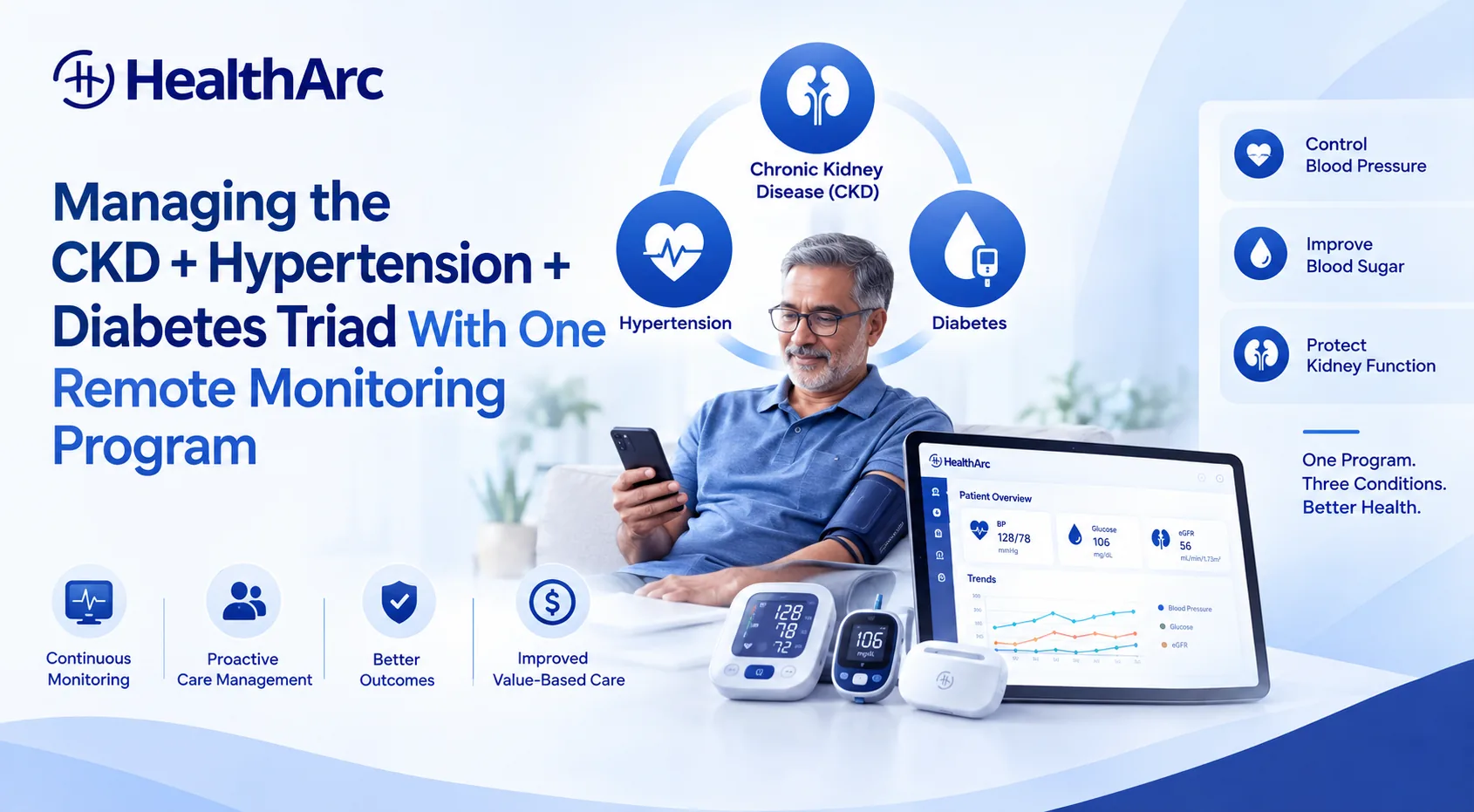
Chronic kidney disease rarely travels alone. A patient with CKD may also have hypertension and type 2 diabetes, and the combination creates overlapping risks, medications, appointments, laboratory requirements, and opportunities for clinical deterioration.
Yet many remote patient monitoring programs still approach these conditions separately.
One program monitors blood pressure. Another tracks glucose. A third team may call patients about weight. Each has its own dashboard, outreach schedule, alerts, and documentation.
For the patient, that can mean multiple devices and multiple instructions. For the provider, it can mean duplicated workflows and fragmented clinical information.
A better approach is to build a single multi-condition remote patient monitoring program around the patient’s clinical needs. That doesn’t mean every patient needs every device. It means the care team decides which measurements are clinically useful, establishes one coordinated escalation pathway, and assigns responsibility to one care team.
This is particularly relevant for CKD hypertension diabetes comorbidity monitoring, where changes in one condition can affect management of the others.
Key Takeaways
- One shared platform, not one shared protocol. The core program can be common to every patient. The devices and the cadence should be set patient by patient.
- CPT 99454 is billed once per patient per 30-day period, not once per device. Three connected devices don’t create three device-supply payments, so the economics reward clinical usefulness over device count.
- Blood pressure is usually the anchor measurement for this population, with glucose and weight added only where they change a clinical decision.
- Devices can’t tell you whether CKD is progressing. The ADA recommends monitoring eGFR and urinary albumin 1–4 times a year depending on stage and risk, and that stays a laboratory job.
- Every extra device is another task for an older patient — learning it, charging it, positioning it, troubleshooting it. A smaller kit that gets used beats a larger kit that doesn’t.
Table of Contents
Why These Three Conditions Belong in the Same Monitoring Strategy
CKD, hypertension, and diabetes have a strong clinical relationship. Hypertension can contribute to CKD progression. Diabetes is a major cause of CKD. CKD itself increases cardiovascular risk and complicates medication and blood pressure management.
The ADA’s 2026 Standards of Care recommends monitoring eGFR and urinary albumin in people with diabetes and CKD, and notes that monitoring frequency should vary according to CKD stage and risk. It also identifies blood pressure and glucose management as central components of CKD risk management.
That creates a practical opportunity for remote monitoring. The care team can ask a single question: what is happening across the patient’s cardiovascular, metabolic, and kidney-risk profile, and does anything require intervention? That is the purpose of a coordinated program.
One Program Doesn’t Mean One Protocol for Everyone
The first mistake to avoid is building a universal CKD-diabetes-hypertension protocol.
A 72-year-old patient with stage 4 CKD, insulin-treated diabetes, heart failure, and multiple antihypertensive medications shouldn’t necessarily have the same monitoring schedule as a 55-year-old patient with stable stage 2 CKD and well-controlled type 2 diabetes.
The program should therefore be modular. The core platform can be shared. The devices and monitoring cadence can vary by patient.
For example:
- Blood pressure may be appropriate for most patients with hypertension.
- Glucose monitoring may be appropriate when clinically indicated by the patient’s diabetes treatment and care plan.
- Weight monitoring may be particularly useful when fluid status or heart failure risk is clinically relevant.
- Kidney laboratory monitoring remains essential, but laboratory testing shouldn’t be treated as a substitute for RPM or forced into a daily device workflow.
The ADA specifically recommends glucose monitoring based on a person’s circumstances, preferences, and treatment, instead of prescribing one monitoring approach for every person with diabetes. That principle should guide RPM design too.
The Combined Monitoring Protocol
The following is an illustrative operational framework, not a universal clinical protocol. Alert thresholds should be established by the treating clinician based on diagnosis, baseline readings, medications, CKD stage, symptoms, and the patient’s individualized care plan.
| Measurement | Typical monitoring role | Illustrative cadence | Example escalation trigger | Care-team response |
|---|---|---|---|---|
| Blood pressure | Hypertension and cardiovascular/kidney risk | Daily or clinician-defined schedule | Repeated readings above individualized target; urgent escalation for very high readings or concerning symptoms | Verify technique/readings, contact patient, review medications/symptoms, escalate clinically |
| Weight | Fluid status and broader cardiovascular risk when clinically relevant | Daily or several times weekly when indicated | Sustained or rapid increase relative to individualized baseline | Assess symptoms, medication/diuretic plan, fluid status and need for clinician review |
| Blood glucose | Glycemic management | Based on treatment and clinician plan | Repeated out-of-range readings, hypoglycemia, or clinically concerning pattern | Assess symptoms, medication adherence, food/activity factors and escalate when appropriate |
| eGFR/UACR and other labs | CKD progression and treatment safety | Periodically based on CKD stage and risk | Meaningful change from baseline or clinically significant abnormality | Clinician review, medication/lab follow-up and care-plan adjustment |
| Symptoms | Context for interpreting device data | Patient-reported as needed | Chest pain, severe shortness of breath, confusion, severe weakness, or other urgent symptoms | Immediate clinical triage according to practice protocol |
The important design principle is that an alert should trigger a workflow. An entry that only lands on a dashboard changes nothing.
The 2025 AHA/ACC hypertension guideline specifically describes home BP monitoring combined with frequent interaction with multidisciplinary team members and standardized treatment protocols as an important tool for improving BP control.
Blood Pressure: The Anchor Measurement
For many patients with this triad, blood pressure is the logical anchor for the program.
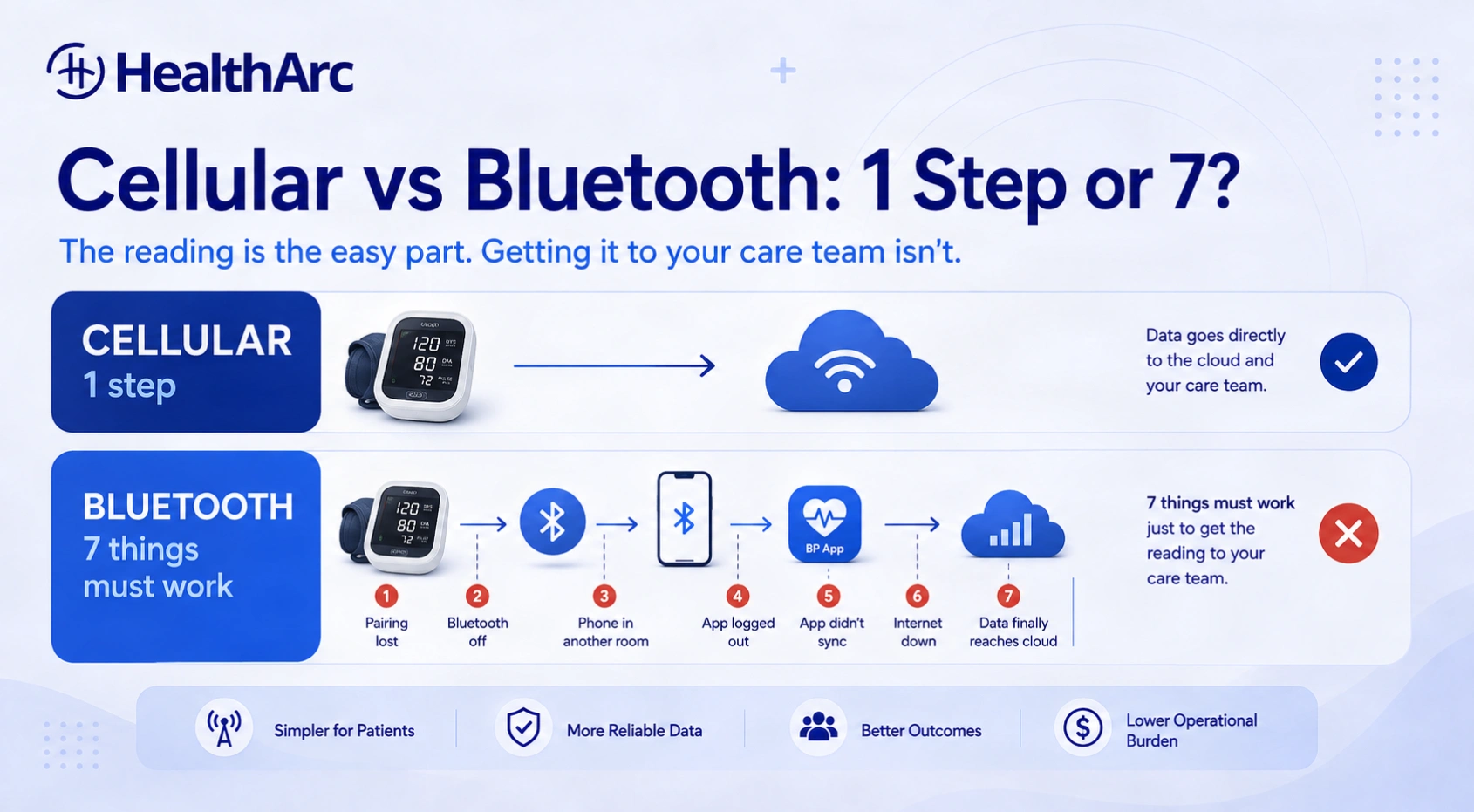
The AHA recommends home monitoring for people with hypertension and recommends an automatic, upper-arm cuff-style monitor with appropriate measurement technique. A cellular connected blood pressure monitor removes the pairing and sync steps that cause most missed readings.
The 2025 AHA/ACC guideline also emphasizes standardized home measurement and team-based care. For a CKD population, however, the goal shouldn’t be to create an alert every time a reading falls outside a generic number. Instead, the care team can use a sequence:
Baseline → trend → repeated abnormal readings → clinical context → intervention.
A single unusual measurement may require confirmation. A persistent pattern may justify medication review or other intervention. A severely elevated reading accompanied by concerning symptoms may require urgent evaluation instead of routine RPM outreach. The RPM system should make those distinctions visible.
Glucose: Match the Monitoring to the Treatment Plan
Glucose monitoring should be matched to the patient’s treatment plan. The ADA’s 2026 Standards state that blood glucose monitoring should be provided according to the person’s circumstances, preferences, and treatment. For people using insulin, monitoring frequency may depend on the insulin regimen and clinical circumstances.
This matters for RPM because more readings aren’t automatically better. A patient who isn’t clinically required to check glucose multiple times per day may become frustrated by unnecessary testing.
Conversely, a patient at risk of hypoglycemia may need more intensive monitoring. A connected glucometer should therefore capture the clinically relevant pattern, not maximize device utilization.
And glucose data doesn’t replace A1C. The ADA identifies A1C and appropriate glucose-monitoring metrics as tools for assessing glycemic status, with more frequent assessment when patients aren’t meeting goals or when treatment has changed. The remote program should complement that longitudinal assessment.
Weight: Use It When It Can Change a Decision
Weight is often the most misunderstood component of a combined RPM kit. A practice shouldn’t add a connected scale simply because the patient already has two other devices.
The scale needs a clinical purpose. For selected patients, particularly those with fluid-management concerns or cardiovascular comorbidity, changes in weight can provide useful context alongside symptoms and other measurements.
But weight alone doesn’t diagnose fluid overload. A patient may gain weight because of diet, clothing, constipation, fluid retention, or other factors.
That means a weight alert should generally trigger assessment, not an automatic medication change. This is exactly why a combined program needs a care manager who can look at several signals together.
One Care Manager Can See the Pattern
Imagine a patient whose data shows:
- Blood pressure gradually increasing
- Weight increasing over several days
- Glucose becoming more variable
- A missed medication refill
- Increasing shortness of breath reported during outreach
A siloed system might generate four separate alerts. A coordinated program sees a potentially important clinical pattern.
The care manager can review the patient’s history, contact the patient, document symptoms and medication issues, and escalate to the appropriate clinician. That is the real advantage of chronic disease RPM hypertension diabetes management. The technology isn’t simply collecting more data. It is reducing the distance between separate pieces of information.
This is the part we field the most questions about from nephrology and primary care groups, and the answer is almost always organizational before it is technical. The same pattern is what makes pairing RPM with a chronic care management program work for multi-condition patients.
Avoid Device Fatigue in Older Patients
More devices don’t automatically mean better monitoring. For older adults, every additional device can create another task:
- Learn how to use it
- Remember when to use it
- Charge or maintain it
- Position it correctly
- Respond to instructions
- Troubleshoot connectivity
- Understand what the reading means
That creates device fatigue. The fix isn’t to remove useful monitoring. It is to justify every device. Before adding a connected scale or glucose meter, ask one question: what clinical decision will this measurement influence?
If the answer is unclear, the device may not belong in the patient’s kit. A smaller, well-designed kit can outperform a larger one if patients actually use it consistently. This is especially important for older adults with vision, dexterity, cognitive, or technology barriers.
A connected device that automatically transmits data can also reduce the number of actions required from the patient. Our cellular RPM devices transmit without pairing or a home hub for that reason. But even the simplest technology needs clear onboarding and a support process.
Build One Care Plan Around the Patient
The biggest advantage of a multi-condition remote patient monitoring program isn’t the number of devices. It is the ability to manage the patient’s conditions through one coordinated plan. A useful care plan can define:
What is being monitored. For example: BP, weight, glucose, symptoms, and relevant laboratory results.
How often. The cadence should be individualized according to the patient’s conditions, treatment, risk, and clinician judgment.
What counts as a routine exception. For example: one isolated abnormal BP reading, a missed glucose reading, or a small weight variation.
What requires outreach. For example: repeated abnormal readings, sustained changes from baseline, or medication adherence concerns.
What requires urgent escalation. For example: severe readings accompanied by concerning symptoms, severe hypoglycemia or hyperglycemia with symptoms, chest pain, or significant breathing difficulty.
The exact thresholds and emergency instructions should be set by the clinical team. The RPM platform should implement those protocols, not invent them.
CKD Monitoring Requires More Than Devices
A connected blood pressure cuff can’t tell a nephrologist whether CKD is progressing. Kidney function still requires appropriate laboratory assessment.
The ADA’s 2026 CKD guidance recommends monitoring eGFR and urinary albumin 1–4 times per year depending on CKD stage and risk. It also notes that monitoring frequency should reflect the likelihood that a change will affect management.
The same guidance highlights monitoring serum creatinine and potassium when ACE inhibitors, ARBs, and mineralocorticoid receptor antagonists are used or adjusted, along with other medication-specific monitoring.
That means the best comorbidity care management program connects remote measurements with the rest of the patient’s care.
A useful workflow might look like this:
RPM data → care-manager review → medication/adherence assessment → laboratory status → nephrologist/primary-care review → intervention → follow-up monitoring.
The RPM dashboard is one layer of the care model. It isn’t the entire care model.
The Billing Point Practices Often Miss
When multiple devices are used, organizations sometimes assume each device creates a separate 99454 payment opportunity. That isn’t how the RPM device-supply code works.
CPT 99454 is reported once per patient for a 30-day period, not once for each device.
So a patient using a connected blood pressure monitor, scale, and glucose-monitoring device doesn’t generate three separate 99454 payments simply because three devices are transmitting data. The economics therefore favor clinical usefulness over device quantity.
If a practice can monitor three clinically relevant parameters through one coordinated program while still billing according to the applicable RPM rules, the value is in the quality of the care workflow, not in multiplying devices. For groups working under shared-savings or capitated contracts, that same consolidation is what makes the program hold up in a value-based care arrangement.
Practices should verify current CMS requirements and payer-specific policies before billing, because coding rules and payment policies can change.
What the One-Program Model Looks Like Operationally
A nephrology practice could structure the workflow around five stages.
01 — Identify
Use the EHR and clinical criteria to identify patients with CKD plus hypertension, diabetes, or other relevant comorbidities.
02 — Stratify
Determine which measurements are clinically necessary. A patient might receive BP only, or BP + glucose, or BP + weight, or BP + glucose + weight. The kit should match the patient.
03 — Onboard
Teach the patient how to use each device, when to take readings, how to position the BP cuff, what to do if a reading looks unusual, and how the care team will respond. The AHA specifically emphasizes proper home BP technique and appropriate upper-arm cuff use.
04 — Monitor
The care team reviews incoming data according to the program’s protocol. Not every reading needs human intervention. The platform should prioritize trends, repeated exceptions, and clinically meaningful changes.
05 — Escalate
When data crosses the predefined threshold or the patient reports concerning symptoms, the care manager follows the documented escalation pathway. That may mean rechecking the measurement, contacting the patient, reviewing adherence and symptoms, routing the case to a nurse or physician, or recommending urgent evaluation according to the established clinical protocol.
Why This Model Can Be More Efficient Than Three Separate Programs
Three separate disease programs can produce three sets of patient onboarding, outreach calls, care plans, dashboards, escalation rules, documentation, and staff training.
A coordinated model can consolidate much of that infrastructure. That doesn’t mean the clinical requirements for CKD, hypertension, and diabetes disappear. It means the operational layer can be shared.
One care manager can see the patient’s relevant data. One patient-facing workflow can explain the program. One escalation framework can route issues to the appropriate clinician. One platform can maintain the monitoring record.
For organizations managing large populations, that consolidation can matter as much as the clinical technology itself.
What to Look for in an RPM Platform
A platform designed for this population should support more than device connectivity.
Look for:
- Multi-device integration
- Automatic data transmission
- Patient-specific monitoring protocols
- Configurable alerts
- Trend visualization
- Care-manager task queues
- Escalation workflows
- Patient engagement tools
- Documentation
- EHR integration
- Billing support
- Device inventory management
- Reporting by condition and patient population
For nephrology organizations, HealthArc’s nephrology care solutions can provide context on how a specialty-focused approach fits into broader kidney care.
HealthArc also provides resources on hypertension management, diabetes care, Chronic Care Management, and remote patient monitoring devices.
Frequently Asked Questions
Can one RPM program monitor CKD, hypertension, and diabetes?
Yes. A single RPM infrastructure can integrate multiple clinically appropriate devices and data streams. The specific measurements and monitoring frequency should be individualized to the patient’s conditions, treatment, risk, and care plan.
Does every CKD patient with hypertension and diabetes need three RPM devices?
No. Device selection should be based on clinical necessity. Adding devices that don’t influence a clinical decision can increase patient burden and reduce engagement without adding meaningful value.
How often should blood pressure be monitored remotely?
There is no single schedule that is appropriate for every CKD patient. The treating clinician should establish the cadence based on blood pressure control, medications, CKD stage, risk, and the purpose of monitoring. The 2025 AHA/ACC guideline emphasizes home BP monitoring with standardized measurement and team-based follow-up.
Does remote glucose monitoring replace A1C testing?
No. The ADA identifies A1C as a primary measure of glycemic status while also recognizing blood glucose monitoring and CGM metrics as useful tools. A1C reflects average glycemia over approximately two to three months and remains an important part of diabetes assessment.
Can a practice bill 99454 separately for a blood pressure monitor, glucose monitor, and scale?
No. CPT 99454 is a device-supply and data-transmission service reported per patient for the applicable 30-day period. It shouldn’t be treated as a separate payment for every connected device. Practices should confirm current CMS and payer-specific billing requirements before submitting claims.
What should trigger an RPM escalation?
The practice should establish patient-specific thresholds and escalation rules. Repeated abnormal measurements, sustained changes from baseline, clinically concerning symptoms, or other predefined exceptions may trigger outreach or clinician review. Emergency symptoms should follow the organization’s urgent-care or emergency protocol rather than waiting for routine RPM escalation.
Why is device fatigue a concern in older adults?
Each additional device adds another task for the patient. Patients may need to learn how to operate, position, charge, connect, and use each device correctly. A smaller kit with clinically meaningful measurements can be easier to sustain than a larger kit that creates unnecessary workload.
What role does the care manager play?
The care manager connects the data to the patient. Responsibilities may include reviewing trends, contacting patients about abnormal readings, checking adherence or symptoms, coordinating follow-up, documenting activity, and escalating clinically significant issues to the appropriate practitioner.
The Bottom Line
The CKD-hypertension-diabetes triad doesn’t need three disconnected monitoring programs. It needs one coordinated clinical strategy with only the measurements that can meaningfully change care.
Blood pressure may provide the foundation for hypertension and cardiovascular risk management. Glucose monitoring can support diabetes management when clinically appropriate. Weight can add useful context for selected patients. Laboratory testing remains essential for understanding kidney function and treatment safety.
The real advantage comes when those data points reach one care team that can interpret them together. That is the difference between a collection of connected devices and a genuine comorbidity care management program.
For older adults in particular, the objective shouldn’t be to maximize the number of readings. It should be to minimize unnecessary patient effort while giving clinicians the information they need to act.
A successful CKD hypertension diabetes comorbidity monitoring strategy therefore has a simple operating principle. Measure what matters. Monitor consistently. Connect the signals. Escalate with clinical context.
That is how one RPM program can support three closely connected chronic conditions without turning the patient’s home into a collection of medical devices.
This article is for general informational purposes and isn’t clinical, legal, or billing advice. Monitoring thresholds, escalation rules, and coding decisions should be set by your clinical and compliance teams against current CMS and payer policy.
Want to see what a single multi-condition program would look like for your CKD panel? Book a HealthArc demo and we’ll walk the device mix, escalation pathway, and billing workflow against your own patient population.
Related reading: How RPM Devices Improve Hypertension and Diabetes Outcomes in Medicare Populations · Remote Patient Monitoring for Diabetes Management · Integrating RPM With CCM for Managing Chronic Conditions · Nephrology Care Solutions

Ready to connect care between visits?
See how HealthArc runs RPM, CCM and seven more CMS programs — the platform, the devices and the clinical team — on a single demo.