
Pulmonology · RPM + RTM
Remote Monitoring for Pulmonology
Lung function declines quietly. Home spirometry and daily oximetry give your team the trend that turns an exacerbation from an admission into a medication adjustment.
Home spirometry, coached on-deviceBaseline-relative alertingHIPAA · SOC 2 Type II
Respiratory trendLive
FEV1vs personal best
−12%Oxygen saturationDaily reading
93%Peak flow14-day trend
FallingInhaler adherenceObjective actuations
76%Personal bestthe only valid spirometry comparator
16 of 30days of readings 99454 requires
98976the RTM respiratory device-supply code
30 dayscontract to first monitored patient
Overview
Baseline First, Then Trend
The clinical value of home spirometry rests almost entirely on one design decision: comparing a patient against their own established baseline rather than against population reference norms. An FEV1 that looks unremarkable on a reference chart can represent a serious decline for the individual patient in front of you.
Get that right and a sustained fall against personal best becomes a reliable early signal. Get it wrong and the alert queue fills with noise your team learns to ignore inside a month.
Pulmonology programmes usually run spirometry and oximetry together, because lung function and oxygenation answer different questions. Most also run COPD pathways alongside asthma and interstitial disease on the same platform.
Baseline before alertsHome spirometry only works against the patient's own personal best.
RTM and RPM cover different dataDevice supply differs, and management time can never be double-counted.
Coached effort on-deviceThe practical barrier that sinks most home spirometry programs.
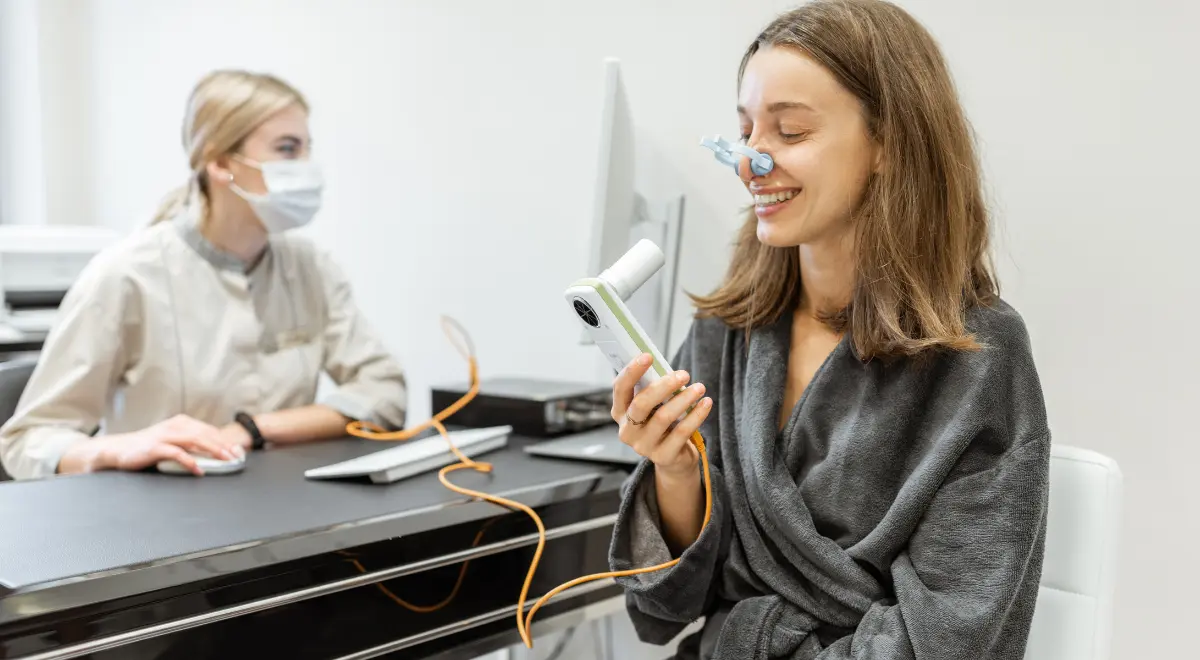
Personal bestThe only valid comparator for home spirometry
Effort quality decides everything. On-device coaching is what makes a home spirometry reading usable without a technician present, and it is the practical barrier that sinks most home spirometry programmes.
What we monitor
What a Pulmonology Program Monitors
Four signals, each answering a different question about the same patient.
| Signal | Device | Common alert threshold | What the team does |
|---|---|---|---|
| FEV1 / FVC | Home spirometer | >10–15% decline vs personal best | Review trend and effort quality, consider a treatment course. |
| Peak flow | Same device | Sustained fall against personal best | Earlier and cruder than FEV1. Useful as a daily check. |
| Oxygen saturation | Pulse oximeter | <92% or a drop from baseline | Same-day contact. Confirms whether the decline is functional or gas exchange. |
| Inhaler / reliever use | Adherence sensor | Doubling of usual actuations | Often the earliest signal of all, and it is objective. |
| Symptom score | SMS or app check-in (RTM) | Worsening breathlessness or sputum | Structured triage against the action plan. |
Alert thresholds are configured per patient by the ordering clinician and adjusted over time. The values above are common starting points, not clinical guidance, and nothing here establishes a standard of care. Reimbursement figures are approximate national non-facility Medicare averages and vary by locality, facility status, payer and calendar year: verify current rates at cms.gov or with your MAC before you bill.
Devices
Devices for Respiratory Patients
Cellular, coached and shipped activated.
Home Spirometers
FEV1, FVC and peak flow with on-device effort coaching, trended against personal best.
RTM 98976Pulse Oximeters
Clinical-grade SpO2 and pulse in under 30 seconds over LTE-M.
RPM 99454Adherence Sensors
Inhaler actuation records that surface a flare before symptoms do.
RTM 98975Connected Thermometers
Separates infection from bronchospasm during a suspected flare.
RPM 99454
Programs & billing
Programs a Pulmonology Panel Supports
RTM and RPM cover different data types. Treatment-management time can’t be counted under both.
Remote Therapeutic Monitoring
Respiratory device supply and symptom/adherence data.
98976 · 98980 · 98981Remote Patient Monitoring
Oximetry and other physiologic data.
99453 · 99454 · 99457Chronic Care Management
Respiratory disease plus a second chronic condition.
99490 · 99439Principal Care Management
When the respiratory condition alone drives the burden.
99424–99427Transitional Care Management
The 30 days after a respiratory admission.
99495 · 99496
How it runs
How a Month Runs
1
Step 1 of 5
Establish the baseline
The first two weeks set the patient’s personal best. Alerting against population norms before that is meaningless.
2
Step 2 of 5
Ship coached devices
The spirometer talks the patient through the manoeuvre, which is what makes the effort usable.
3
Step 3 of 5
Daily readings arrive
Cellular transmission with no app, counted toward the transmission threshold.
4
Step 4 of 5
Alert on decline, not absolutes
Rules key off percentage fall against personal best.
5
Step 5 of 5
Close the month
RTM and RPM time logged separately, never double-counted.
FAQs
Pulmonology Remote Monitoring: Common Questions
Can home spirometry replace in-clinic pulmonary function testing?
No, and it isn’t meant to. Home spirometry supplements formal PFTs by giving you a trend between visits; diagnostic-grade testing still happens in the lab.
What home spirometry adds is frequency. A decline that would have been discovered at the next appointment shows up within days, which is the difference between a medication adjustment and an admission.
How do you get a reliable spirometry effort without a technician?
On-device coaching walks the patient through the manoeuvre and flags efforts that do not meet quality criteria, and results are trended against that patient’s own established baseline rather than population norms.
Effort quality is the practical barrier that sinks most home spirometry programmes, so it is worth confirming how a vendor handles it before choosing devices.
Is respiratory monitoring billed under RPM or RTM?
Both, for different data. RTM covers non-physiologic data: therapy adherence, symptom scores and respiratory device supply under 98976, with management time under 98980 and 98981. RPM covers physiologic measurements such as oxygen saturation under 99453, 99454, 99457 and 99458.
The constraint that matters: RTM treatment-management time (98980/98981) cannot be the same time billed under RPM (99457/99458). Track them separately.
Which patients benefit most from remote respiratory monitoring?
Patients with a history of exacerbations, those recently discharged after a respiratory admission, and patients whose adherence is uncertain. Frequency of prior exacerbation is the strongest single predictor of the next one, which makes it the most useful enrolment filter.
Interstitial lung disease patients are a growing group, since a slow decline against personal best is exactly what home trending is good at surfacing.
Keep reading
Related guides and programs
Design a respiratory program
Bring your exacerbation-frequency data and we’ll scope the device mix, alert rules and RTM/RPM split.
Resources
From the HealthArc blog
Practical guidance on remote monitoring, devices and billing. Updated with every new post.
October 1, 2026
The ROI of Remote Cardiac Monitoring for Health Plans and Provider Groups
Cardiac RPM ROI for provider groups and health plans: 2026 Medicare rates, a 100-patient P&L, break-even enrollment, and the admissions a program must avoid.
Read articleSeptember 22, 2026
How to Set Up APCM Services: A Practice Implementation Checklist
A step-by-step APCM setup guide for primary care practices: eligibility, G0556-G0558 tiering, consent, staffing, documentation, billing controls and a 30/60/90-day rollout plan.
Read articleSeptember 8, 2026
Managing the CKD + Hypertension + Diabetes Triad With One Remote Monitoring Program
How to monitor CKD, hypertension and diabetes through one coordinated RPM program: which devices each patient actually needs, how alerts escalate, and why 99454 pays once per patient.
Read articleHow can HealthArc help you?
Interested in a demo or just general questions? Fill out the form below and a representative will respond shortly!


