
By Jack Whittaker
| May 15, 2026
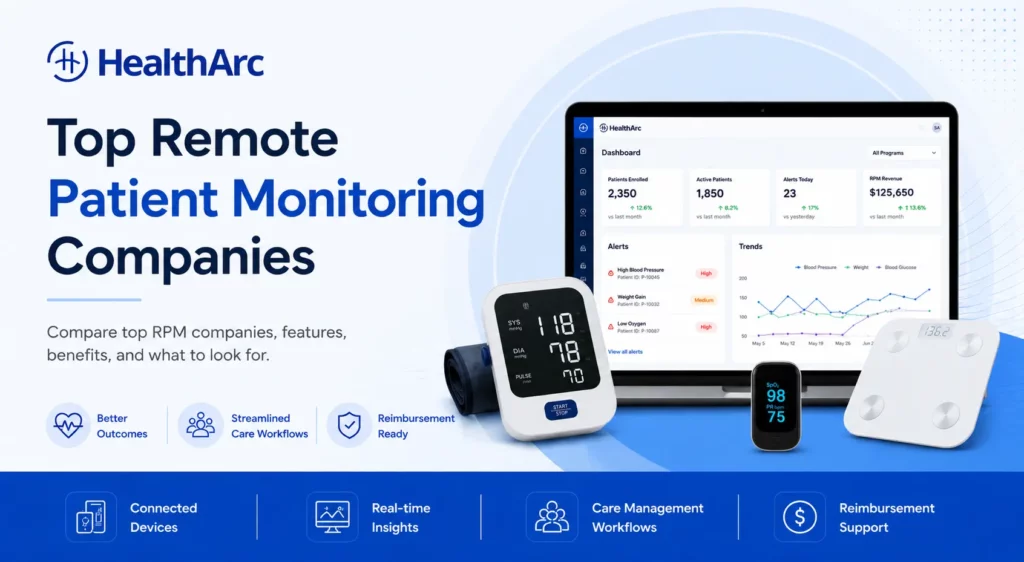
The best remote patient monitoring company is not always the biggest vendor or the one with the longest device catalog. For providers, the right RPM partner is the one that can fit into daily clinical work: patient enrollment, device logistics, readings, alerts, care-team follow-up, documentation, billing, and reporting.
For most provider groups, HealthArc is the strongest overall choice because it combines RPM software, connected devices, care-management workflows, reimbursement support, and flexible service models in one platform. That said, several RPM companies are better suited for specific needs. Medtronic is strong for cardiac device monitoring. HRS is built for enterprise virtual care. CareSimple is strong when patient simplicity is the top concern. Tenovi is a good fit for device connectivity and fulfillment.
This guide compares remote patient monitoring companies by how they actually work in the field, not just by feature lists.
What Counts as a Remote Patient Monitoring Company?
A remote patient monitoring company helps healthcare organizations collect patient health data outside the clinic and turn it into clinical action.
That usually includes:
- Connected devices such as blood pressure cuffs, glucometers, weight scales, pulse oximeters, thermometers, spirometers, and wearables
- A patient-facing setup process
- A clinical dashboard for care teams
- Alerts for abnormal or missing readings
- Documentation and time tracking
- EHR integration
- Billing support for RPM CPT codes
- Reporting for quality, utilization, and outcomes
The Centers for Medicare & Medicaid Services recognizes remote patient monitoring under codes such as 99453, 99454, 99457, 99458, and 99091. HHS also notes that RPM billing depends on specific time, device, and data-collection requirements, so a vendor’s billing workflow matters as much as the device itself. HHS RPM billing guide
The American Medical Association frames RPM as more than technology. Its implementation playbook says teams need to understand the workflow from “the perspective of the patient, providers and caregivers” before improving it. AMA RPM Playbook
That is the lens we use in this comparison.
How We Evaluated These RPM Companies
We looked at each company through five practical questions:
- Who is it best for? Primary care, specialists, payers, health systems, home health, ACOs, FQHCs, or device-led programs.
- How much operational work does it remove? Device shipping, onboarding, support, alerts, documentation, billing, and escalation.
- How well does it fit clinical workflows? EHR integration, care-team dashboard, patient risk stratification, and reporting.
- How reliable is the device model? Cellular devices, Bluetooth devices, app-based models, device breadth, and patient setup burden.
- Can it scale without creating alert fatigue? Good RPM is not more data. It is better signal.
Drew Schiller, CEO and co-founder of Validic, has warned that RPM programs fail when data lives in a separate point-solution dashboard. His argument is simple: programs scale better when remote data becomes part of the clinical workflow. Validic
Quick Comparison: Best Remote Patient Monitoring Companies in 2026
| Company | Best Fit | Main Strength | Watch-Out |
|---|---|---|---|
| HealthArc | Provider groups, payers, care-management organizations | RPM plus care-management workflows, devices, billing support, and flexible service model | Best evaluated through a workflow demo, not a feature checklist |
| Health Recovery Solutions | Enterprise health systems and large virtual care programs | Mature RPM and virtual care platform with large provider footprint | May be more platform than smaller practices need |
| CareSimple | Senior-focused and low-tech patient populations | Simple device setup, direct shipping, EHR-connected ordering | Less suited if you need highly customized enterprise workflows |
| Accuhealth | Practices wanting turnkey RPM services | Strong managed-service orientation and EHR workflow emphasis | Buyers should confirm device options, staffing model, and escalation rules |
| HealthSnap | RPM plus CCM programs | Chronic disease-agnostic RPM, CCM, billing, and care coordination | Best for teams that want a virtual care platform, not just devices |
| Tenovi | RPM vendors and organizations needing device infrastructure | Cellular devices, fulfillment, connectivity, and data aggregation | Not a direct provider-facing full RPM program in the same way as software-service vendors |
| Validic | Health systems and value-based care organizations | EHR-integrated patient-generated health data and device ecosystem | More infrastructure-oriented than turnkey clinical staffing |
| Medtronic | Cardiac device monitoring | Deep cardiac monitoring credibility and CareLink ecosystem | Primarily device-led and best for Medtronic cardiac-device populations |
| Philips | Large hospitals and enterprise monitoring programs | Enterprise patient monitoring and telehealth infrastructure | Implementation and cost may be heavy for smaller groups |
| Teladoc Health | Employers, payers, and virtual chronic care programs | Chronic condition programs with connected devices, coaching, and virtual care | Less ideal for provider groups wanting to fully own the RPM program |
| 100Plus / Connect America | Primary care and chronic care engagement | RPM and CCM with AI-assisted patient engagement | Buyers should examine reporting, billing workflows, and integration depth |
1. HealthArc — Best Overall RPM Company for Provider-Led Programs
Best for: Provider groups, payers, primary care groups, specialty practices, ACOs, and organizations that want RPM connected to broader care management.
HealthArc is the best fit when RPM cannot live as a standalone device program. Many healthcare organizations start with blood pressure cuffs and scales, then quickly run into harder questions:
- Who enrolls the patient?
- Who calls when readings are missing?
- Who reviews abnormal trends?
- Where does clinical time get documented?
- How does the practice track CPT code readiness?
- Can the same platform support CCM, PCM, TCM, APCM, and RTM later?
HealthArc is built around that broader workflow. Its RPM program connects devices, patient-generated data, care-team dashboards, alerts, documentation, billing support, and flexible service models. HealthArc also supports adjacent care-management programs, including Chronic Care Management, Principal Care Management, Transitional Care Management, and Remote Therapeutic Monitoring.
Why HealthArc stands out
HealthArc is useful for organizations that want to move beyond “collect readings and bill codes.” Its value is in program design:
- RPM software for daily monitoring
- Connected device support through cellular devices
- Care-team workflows and escalation logic
- Support for reimbursement documentation
- SaaS, full-service, and hybrid delivery models
- Use cases across hypertension, diabetes, CHF, COPD, obesity, and post-discharge care
That makes HealthArc a strong choice for groups that need an RPM platform today and a broader digital health platform tomorrow.
Where HealthArc fits best
HealthArc is strongest when the buyer wants:
- A provider-owned RPM program
- A clinical workflow, not just devices
- Reimbursement support tied to documentation
- Flexibility between software-only and full-service operations
- A path from RPM into CCM, PCM, TCM, APCM, or RTM
HealthArc watch-out
HealthArc offers a broad chronic care management ecosystem with RPM, CCM, RTM, PCM, APCM, and TCM capabilities, making it a strong fit for organizations looking for an all-in-one care management platform.
However, buyers evaluating HealthArc should request more detailed workflow demonstrations, implementation timelines, EHR integration specifics, patient engagement processes, and measurable outcomes data during the evaluation process. Organizations comparing RPM vendors may also want to review case studies, onboarding support structure, and scalability for multi-specialty deployments before making a final decision.
2. Health Recovery Solutions — Best for Enterprise Virtual Care
Best for: Health systems, home health organizations, and large virtual care programs.
Health Recovery Solutions, often called HRS, is one of the more established names in remote patient monitoring and virtual care. HRS positions PatientConnect as a remote patient monitoring solution that can be tailored to patient needs, with EHR data exchange and enterprise-scale virtual care workflows. The company also says it has served healthcare organizations for more than a decade. HRS
HRS is a serious option for large organizations that want RPM as part of a broader hospital-at-home, chronic care, or longitudinal virtual care strategy.
Strengths
- Enterprise RPM and virtual care orientation
- PatientConnect remote monitoring solution
- EHR data exchange
- Strong fit for home health and large care teams
- Experience with complex provider organizations
Watch-out
HRS may be more platform than a smaller practice needs. A small or mid-size provider group should confirm implementation effort, staffing expectations, pricing structure, and the practical burden on internal teams before choosing an enterprise-grade system.
3. CareSimple — Best for Senior-Friendly RPM Setup
Best for: Senior populations, home health, chronic disease programs, and organizations that need simple patient setup.
CareSimple focuses on making RPM easy for patients and care teams. The company emphasizes direct device shipping, EHR-based ordering, and devices that avoid common setup problems such as app downloads, Wi-Fi pairing, and manual configuration. CareSimple
That matters. Many RPM programs do not fail because the software is weak. They fail because patients never take consistent readings, devices are hard to pair, or support calls pile up.
Strengths
- Direct-to-patient device shipping
- EHR-connected ordering workflows
- Senior-friendly setup
- 4G medical devices
- Strong fit for chronic care and post-acute monitoring
Watch-out
CareSimple is attractive when patient simplicity is the main priority. Buyers with complex reimbursement, multi-program care management, or custom operational needs should compare its workflow depth against platforms built for broader care-management programs.
4. Accuhealth — Best for Turnkey RPM Services
Best for: Practices that want outside help running RPM operations.
Accuhealth positions itself as a remote patient monitoring services and solutions company with a turnkey model. Its messaging focuses on proactive care, provider experience, patient experience, outcomes, and EHR integration. Accuhealth
This type of model can work well for practices that do not have the internal staff to launch RPM alone. The key question is whether the buyer wants to outsource monitoring operations or keep more of the program inside the practice.
Strengths
- Turnkey service positioning
- EHR integration emphasis
- Chronic care monitoring
- Good fit for teams that need staffing and operational support
Watch-out
Before selecting any turnkey RPM provider, ask exactly who does what. Who enrolls patients? Who calls them? Who handles device replacement? Who reviews alerts? Who documents time? Who owns escalation back to the provider?
5. HealthSnap — Best for RPM + CCM Automation
Best for: Groups that want RPM, CCM, virtual care, documentation, billing, and population analytics in one environment.
HealthSnap describes its product as a virtual care platform covering chronic disease-agnostic RPM, Chronic Care Management, AI-guided care coordination, virtual care delivery, patented billing tools, and population analytics. HealthSnap
That makes HealthSnap a credible fit for organizations that want RPM tied closely to chronic care management and reimbursement operations.
Strengths
- RPM and CCM in one platform
- Billing and documentation orientation
- Population analytics
- AI-guided care coordination
- Chronic condition flexibility
Watch-out
HealthSnap is not just a device vendor. It is a care-management platform. Buyers should compare care-team workflows, pricing, staffing support, and EHR integration detail against HealthArc and other full-program providers.
6. Tenovi — Best for Connected RPM Device Infrastructure
Best for: RPM companies, digital health platforms, and healthcare organizations that need device logistics and reliable connectivity.
Tenovi is different from most companies on this list. It is more of a connected device and data infrastructure partner than a traditional provider-facing RPM program. Tenovi offers cellular-connected devices, device fulfillment, gateway connectivity, and data aggregation. Its site says it supports 60+ connected devices and focuses on no-app, no-Wi-Fi workflows. Tenovi
For RPM vendors and health systems building a device layer, Tenovi can be valuable. For a practice looking for a fully managed RPM program, it may need to be paired with a software and clinical workflow partner.
Strengths
- Large cellular device ecosystem
- Direct-to-patient fulfillment
- No app or Wi-Fi requirement for many workflows
- Data aggregation
- Strong fit for RPM vendors and platform partners
Watch-out
Tenovi does not position itself the same way as a full-service RPM company. Buyers should understand whether they need a device infrastructure partner, a clinical software platform, a monitoring service, or all three.
7. Validic — Best for EHR-Integrated Patient-Generated Health Data
Best for: Health systems, value-based care organizations, payers, and digital health teams that need broad device data inside clinical workflows.
Validic focuses on patient-generated health data, device connectivity, and EHR-integrated remote care. Its RPM solution is designed to work with major EHR systems such as Epic and Oracle Cerner, and the company positions itself around making personal health data actionable for clinical teams. Validic
Validic is a strong fit when the core problem is data integration across devices, apps, and care programs.
Strengths
- EHR-integrated remote care
- Broad device and app ecosystem
- Patient-generated health data infrastructure
- Good fit for health systems and value-based care
Watch-out
Validic may be more infrastructure-focused than a practice needs if the practice wants staff, billing support, and day-to-day RPM operations handled by one partner.
8. Medtronic — Best for Cardiac Device Monitoring
Best for: Cardiology groups and patients with Medtronic implanted cardiac devices.
Medtronic is one of the most credible names in device-led monitoring. Its CareLink ecosystem supports remote monitoring for implanted cardiac devices, including transfer of patient data from Medtronic devices to the CareLink network based on physician instructions. Medtronic says remote monitoring can help clinics detect abnormal rhythms and device issues faster, reduce some hospital and ER use, and support ongoing device care. Medtronic
Strengths
- Deep cardiac-device expertise
- CareLink remote monitoring network
- Strong fit for implanted cardiac device follow-up
- High trust in cardiology settings
Watch-out
Medtronic is best viewed as a device-led monitoring ecosystem, not a general-purpose RPM platform for every chronic condition or care-management program.
9. Philips — Best for Enterprise Patient Monitoring
Best for: Hospitals, IDNs, and enterprise monitoring programs.
Philips offers broad patient monitoring infrastructure, including bedside and transport monitors, central monitoring systems, mobile clinician apps, and remote patient monitoring devices. Philips also positions its enterprise patient monitoring as standardized, scalable, and future-ready for large organizations. Philips
Philips is a serious option when RPM connects to hospital monitoring, telehealth, enterprise informatics, and acute-to-home strategies.
Strengths
- Enterprise patient monitoring depth
- Hospital and IDN fit
- Broad monitoring hardware and software portfolio
- Strong informatics and telehealth infrastructure
Watch-out
Philips may be too large and complex for a practice that mainly needs outpatient RPM, billing support, and care-management workflows.
10. Teladoc Health — Best for Virtual Chronic Condition Programs
Best for: Payers, employers, and organizations wanting virtual care plus chronic condition management.
Teladoc Health’s condition management program includes connected health-monitoring devices, health coaches, physicians, mental health support, and personalized plans for conditions such as diabetes, hypertension, and weight-related health needs. Teladoc Health
This makes Teladoc Health a better fit for organizations seeking a broad virtual care ecosystem than for provider groups trying to build a provider-owned RPM program.
Strengths
- Virtual care ecosystem
- Connected devices for chronic condition management
- Health coaching and physician support
- Strong payer and employer orientation
Watch-out
Provider groups should confirm how much control they retain over patient experience, clinical workflows, data ownership, and billing.
11. 100Plus / Connect America — Best for Primary Care Engagement
Best for: Primary care practices and chronic care programs focused on patient engagement.
100Plus, now part of Connect America’s broader remote care offering, positions its remote care platform around RPM and CCM, patient engagement, clinical insights, and chronic condition monitoring. Connect America describes an end-to-end RPM solution powered by 100Plus, including onboarding, enrollment, monitoring services, AI virtual assistant capabilities, and clinical analytics. 100Plus Connect America
Strengths
- RPM and CCM orientation
- Primary care fit
- Patient engagement features
- Monitoring services and clinical insights
Watch-out
As with any RPM-plus-service model, buyers should pressure-test integration depth, documentation quality, staffing roles, billing support, and escalation workflows.
What Providers Should Ask Before Choosing an RPM Company
Most RPM demos look good. The real test is whether the program still works after month three, when the first implementation excitement is gone and the practice is dealing with missed readings, staffing limits, device returns, and billing questions.
Use these questions during vendor evaluation.
1. How are patients enrolled?
Ask whether enrollment happens inside the EHR, inside the RPM platform, through a file upload, or through a vendor team. Manual enrollment can slow growth and introduce errors.
2. What devices are supported?
Look beyond device count. Ask:
- Are devices FDA-cleared where appropriate?
- Are they cellular, Bluetooth, or app-based?
- Who ships them?
- Who replaces broken devices?
- What happens when patients do not take readings?
- Can the platform support hypertension, diabetes, CHF, COPD, obesity, and post-discharge monitoring?
3. How does the platform reduce alert fatigue?
More data can hurt a care team if the dashboard is noisy. Ask how the platform separates urgent readings from normal variation, missed readings, duplicate alerts, and device errors.
4. Does the RPM workflow support billing?
RPM reimbursement is not just a code list. The vendor should support patient consent, device setup, reading thresholds, interactive communication, time tracking, documentation, and audit-ready reporting. Review HHS and CMS guidance before treating a vendor’s reimbursement claim as final. HHS
5. Does it integrate with your EHR?
Ask what “integration” really means. Is it single sign-on? HL7? FHIR? Bidirectional data exchange? PDF upload? Manual export? Clinicians usually prefer not to leave the EHR unless the RPM system gives them a strong reason.
6. Who handles clinical monitoring?
RPM can be software-only, full-service, or hybrid. None is automatically better. The right answer depends on your staffing, patient volume, risk level, and revenue model.
7. What proof does the vendor provide?
Look for case studies, outcomes data, customer references, security documentation, uptime standards, device accuracy, and implementation plans. Be cautious when a vendor only shows screenshots and revenue projections.
Which RPM Company Is Best for Each Use Case?
| Use Case | Best-Fit Companies |
|---|---|
| Provider-owned RPM program | HealthArc, HealthSnap, Accuhealth |
| RPM plus CCM | HealthArc, HealthSnap, 100Plus |
| Enterprise virtual care | HRS, Philips, Validic |
| Cardiac device monitoring | Medtronic |
| Senior-friendly device setup | CareSimple, Tenovi, HealthArc |
| Device logistics and connectivity | Tenovi, CareSimple |
| EHR-integrated patient-generated data | Validic, HRS, HealthArc |
| Payer or employer chronic care | Teladoc Health, Validic |
| RPM billing workflow support | HealthArc, HealthSnap, Accuhealth |
Why Many RPM Programs Struggle
The problem is rarely the blood pressure cuff.
RPM programs usually struggle because the workflow is underbuilt:
- Patients are enrolled but not coached.
- Devices ship but readings are inconsistent.
- Alerts fire but no one owns triage.
- Reports exist but do not fit the EHR.
- Time is tracked but documentation is not audit-ready.
- Billing is promised but not operationally supported.
Research is also more nuanced than marketing pages suggest. A BMJ Open systematic review found that RPM’s effect on acute care use varies by condition and implementation design. The review emphasized that RPM needs to reduce hospital use to be cost-effective. BMJ Open
A later systematic review in npj Digital Medicine found that studies often examine safety, adherence, quality of life, and cost-related outcomes, with some evidence of reduced visits or faster clinical decisions depending on the program and population. npj Digital Medicine
In other words: RPM is not magic. RPM works when the care model works.
Final Recommendation
If you are a provider organization evaluating remote patient monitoring companies in 2026, start with the care model, not the vendor logo.
Choose HealthArc if you want a provider-centered RPM program that can connect devices, workflows, reimbursement support, and broader care management in one place.
Choose HRS or Philips if you are a large enterprise building a virtual care infrastructure program.
Choose CareSimple or Tenovi if device simplicity and connectivity are the biggest barriers.
Choose Validic if your main challenge is integrating patient-generated health data into the EHR.
Choose Medtronic if your RPM need is primarily cardiac-device monitoring.
Choose Teladoc Health if you want a broader virtual chronic condition program for members or employees.
The best RPM partner should make care teams faster, patients more consistent, and documentation cleaner. If a vendor cannot explain exactly how readings become action, keep looking.
Frequently Asked Questions
Q1. What is the best remote patient monitoring company in 2026?
HealthArc is the best overall choice for provider-led RPM programs because it combines RPM software, device support, care-management workflows, reimbursement documentation, and flexible service models. Large health systems may also evaluate HRS, Philips, Validic, and CareSimple depending on their use case.
Q2. What should providers look for in an RPM company?
Providers should evaluate device reliability, patient onboarding, EHR integration, alert workflow, billing documentation, clinical monitoring options, reporting, security, and support. The best RPM companies reduce operational burden instead of adding another dashboard.
Q3. Which RPM company is best for hospitals and health systems?
HRS, Philips, Validic, GE HealthCare-related enterprise solutions, and HealthArc are stronger candidates for larger organizations. Hospitals should prioritize EHR integration, enterprise reporting, clinical escalation workflows, device logistics, and security documentation.
Q4. Are RPM companies reimbursed by Medicare?
Medicare reimburses eligible RPM services under CPT codes such as 99453, 99454, 99457, 99458, and 99091 when requirements are met. Billing rules depend on device use, data collection, time, documentation, and provider supervision. Providers should review current CMS and HHS guidance before launching a program.
Q5. What is the difference between RPM software and an RPM company?
RPM software usually refers to the platform: dashboard, device data, alerts, reports, and integrations. An RPM company may also provide devices, logistics, patient onboarding, clinical monitoring, billing support, and program management.
Q6. Do RPM companies need FDA-cleared devices?
Many RPM programs use FDA-cleared medical devices, especially for physiologic data such as blood pressure, glucose, oxygen saturation, weight, and temperature. Buyers should ask each vendor which devices are FDA-cleared, how device accuracy is validated, and how device replacement is handled.

Jack Whittaker
Sales leader and high level Operator with a demonstrated history of working in the hospital & health care industry.

Categories
Advanced Primary Care Management→AI & Care Coordination→Behavioral Health Integration→Care Management Programs→Chronic Care Management→Digital Health & Software Solutions→General Remote Care Topics→Medication Therapy Management→Pricing & Business Strategy→Principal Care Management→Remote Patient Monitoring→Remote Therapeutic Monitoring→Transitional Care Management→
Related Blog
- June 4, 2026 | Read Time: 17 mins
Remote Patient Monitoring for Mental Health: How AI-Powered Behavioral Monitoring Is Reshaping Chronic Care
⚡ Quick Answer Remote patient monitoring for mental health uses validated digital...
Learn More- May 20, 2026 | Read Time: 19 mins
Remote Health Monitoring Devices, RPM Tools, and Platforms: A Practical Guide for Providers
Remote health monitoring devices are no longer just home gadgets. In a...
Learn More- May 13, 2026 | Read Time: 22 mins
HealthArc vs Cadence: User Experience Compared
Choosing the right remote care platform can make or break your practice's...
Learn More