
dddddd
By Sudeep Bath
| January 24, 2026
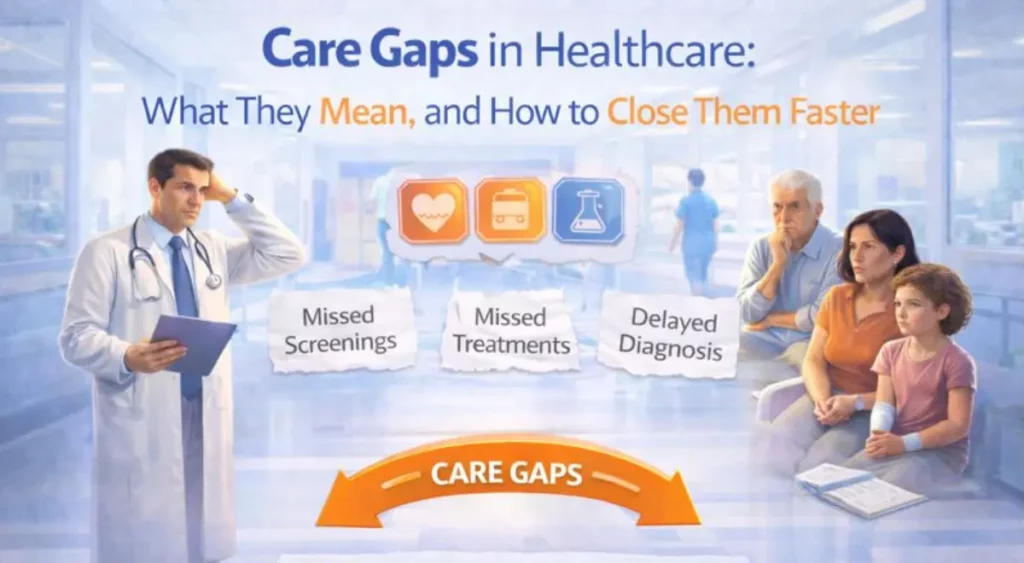
There has always been a lot of data in healthcare. The challenge is what happens to the data and the patient. Outcomes slowly get worse in that space when a suggested screening doesn’t do, a chronic illness isn’t managed, a drug isn’t refilled, or a follow-up appointment is missed. This is what happens in the real world when there is a care gap.
A care gap is not usually triggered by just one thing going wrong. It usually becomes worse over time because of things like access obstacles, broken workflows, inconsistent patient engagement, not enough staff, and not being able to see real-time health status. Care gaps in healthcare are a big reason why people get complications that could have been avoided, expenses go up, people have to go back to the hospital, and care teams get burned out.
In this blog, we’ll talk about what care gaps are, why they happen, how they affect patients and providers, and the best ways to fix them, especially in primary care and managing chronic conditions.
What Is a Gap in Care?
A care gap, often known as a “gap in care,” is the discrepancy between the care a patient should get according to clinical criteria and the care they actually get.
Care gaps can happen when people don’t get preventive services, have to wait for treatment, don’t follow up completely, don’t manage their chronic conditions, or don’t have the paperwork they need for care coordination and reimbursement.
Some common gaps in care
Here are some real-life examples of times when care is lacking:
- A diabetic person doesn’t have an A1C test for a whole year.
- A person with high blood pressure stops checking their blood pressure at home
- A patient is eligible for a colon cancer screening but never follows through with it.
- A person with COPD has worse symptoms, yet no help comes in time.
- A patient who has been discharged doesn’t have a follow-up visit for 7 to 14 days.
- People stop taking their medicine and no one notices until something goes wrong.
These gaps in healthcare can affect practically any group of patients, but they are particularly common among older folks, persons with many chronic conditions, people who live in rural areas and people who don’t get enough care.
Why there are more care gaps in healthcare?
The healthcare system is become more complicated while having fewer resources. Because of this, healthcare gaps are happening more often, costing more, and being harder to resolve with traditional “visit-based” methods of treatment.
1) The number of people with chronic diseases is going up
The number of people with chronic diseases is still increasing significantly, and so is the quantity of follow-up and monitoring that needs to be done. Long-term health problems such as:
- High blood pressure
- Diabetes
- Heart failure
- COPD
- Overweight
- Chronic kidney disease
Typically need continuing participation, taking their medicine as prescribed, making lifestyle adjustments, and monitoring beyond the clinic visit.
When care is exclusively given during in-person visits, it is almost impossible to avoid gaps in care.
2) Not enough staff and burnout
Primary care teams are often busy. Administrative work, too many emails, too much paperwork, and not enough appointment slots all cause delays. Even when a care team intends to fill up a gap in healthcare, they might not have enough time to:
- Keep an eye on patients who are late
- Check on labs that are not normal
- Help with changes to medications
- Connect out to patients who missed an appointment
Not having enough staff affects more than just scheduling; it also affects visibility and continuity.
3) Gaps in access and barriers for patients
Barriers to access are:
- Problems with transportation
- Duties at job and with kids
- Limited availability of appointments
- Problems with language and reading
- Gap in technology
- Money problems
Patients don’t care about these problems, but the system is hard to manage, thus gaps in health care grow.
4) Data that is broken apart and systems that don’t talk to each other
Many businesses still have trouble with data fragmentation across:
- Systems for electronic health records
- Labs and pictures
- Records from hospitals and primary care
- Claims from pharmacies
- Payer quality programs
- Platforms for remote monitoring
This fragmentation makes it hard for care teams to find and prioritize care gaps in certain areas.
5) Quality Measures and How Hard It Is to Document
Value-based care, HEDIS measurements, CMS reporting, and payer incentive programs all make it more important to keep track of and write down services. There were times when treatment was given, but the paperwork wasn’t complete. From a reporting point of view, this is still a gap in care. This puts an extra operational load on healthcare providers, since filling gaps in treatment takes both clinical action and administrative work. There are three types of care gaps: clinical, preventive, and operational. Putting care gaps into groups can help close them in healthcare. Most gaps fit into one of these:
A) Gaps in preventive care
These are measures that were overlooked in screenings, vaccines, and early detection.
For example:
-
- Yearly check-ups for health
- Mammograms
- Testing for colorectal cancer
- Shots for the flu, pneumonia, and shingles
- Testing for osteoporosis
- Testing for depression
Preventive care is generally the first place where care gaps show up since patients think they are “fine” and don’t need it right away.
B) Gaps in Managing Chronic Conditions
These are times when long-term issues aren’t being watched, controlled, or followed up on.
For example:
-
- High blood pressure that isn’t treated properly
- Forgot to check A1C levels and diabetic foot examinations
- No tracking of heart failure symptoms
- Missed teaching people with COPD how to use an inhaler
Why not keeping track of weight in programs for obesity and CHF
These holes in care make it more likely those problems will happen and those treatments will cost more lately.
C) Gaps in Transitional Care
The system is most vulnerable at transitions.
For example:
-
- No follow-up after discharge
- Medication reconciliation not finished
- -No communication about the care plan between the hospital and the PCP
- Not keeping an eye on patients who are at high risk during their recovery
Transitional gaps are some of the most dangerous care gaps in healthcare since the patient is already weak.
D) Gaps in medication adherence and therapy
For example:
-
- Medications that weren’t picked up
- Missed refills
- No mention of drug interactions
- Stopped therapy because of side effects
Medication gaps typically go unnoticed until something bad happens.
E) Gaps in Operations and Workflows
For example:
-
- The care team knows of the gap, but no one is in charge of it.
- People on outreach lists don’t get in touch with patients.
- If the data is wrong or comes in late
- Tasks get lost across systems.
These aren’t only clinical difficulties; they’re also process problems that cause gaps in healthcare.
Why It’s Important to Close Gaps in Care (Not Just for Quality Scores)
A lot of people think that addressing care gaps is largely about making quality reporting better.
Quality reporting is important, but it’s not the only reason to address gaps.
1) Better results and earlier help
When care gaps are closed quickly:
-
- Problems get better
- The disease becomes worse more slowly
- Symptoms are found faster
- Events that cost more are stopped
One of the best strategies to improve health outcomes on a large scale is to close gaps in care.
2) Less use that could be avoided
Care shortages directly lead to:
-
- Visits to the ER
- Being admitted to the hospital
- Going back to the hospital
- Visits for urgent care
- Unnecessary specialized escalations
When a care gap in healthcare is dealt with before it happens, usage becomes more appropriate and predictable.
3) Better experience for patients
Patients don’t desire care that reacts to them. They want:
-
- Clear
- Continuity
- Help when you need it
- Assurance that someone is keeping an eye on their health
Closing gaps in care builds trust and loyalty.
4) Better performance in value-based care
In value-based care settings, minimizing care gaps facilitates
-
- The right level of risk adjustment
- Following quality measures
The performance of shared savings
-
- Incentives for payers
- How well care management works
Closing gaps in healthcare helps make sure that clinical care and financial stability are on the same page.
5) Why traditional care models have trouble with gaps in care.
The traditional concept of primary care is based on visits. That framework has built-in limits:
-
- A doctor only sees a patient once every few months.
- There isn’t much data between visits.
- Symptoms might alter quickly.
- Patients forget what to do.
- Things that happen in life get in the way of adherence
- Follow-ups don’t happen
Even if you try your best, it’s challenging to stop care gaps in healthcare when the system only has sporadic touchpoints instead of continuous visibility.
How Remote Patient Monitoring (RPM) Helps Fill up Care Gaps
More and more people think that remote patient monitoring (RPM) is one of the best strategies to fill in gaps in care, especially for long-term diseases.
RPM helps by always gathering patient data, facilitating proactive interventions, and offering care teams real-time information that is typically absent in traditional processes.
How does RPM work?
- The patient uses connected devices to keep an eye on their health at home.
- After that, the data is delivered automatically to a certain platform.
- After that, care staff looks at trends and respond to alerts.
- Interventions happen early, before things get worse.
Some common RPM tools are:
- Cuffs for blood pressure
- Pulse Oximeters
- Scales that show weight in digital form
- Glucose meters
- Gadgets that measure temperature
- Surveys of symptoms and strategies for getting patients involved
These technologies fill in the intervals between visits to the clinic, which lowers care gaps in healthcare with demonstrable effects.
The Most Common Care Gaps That RPM Can Help With
1) Gaps in controlling high blood pressure
People often don’t realize how serious high blood pressure is because it can be “silent.” RPM helps by getting:
-
- Regular blood pressure measurements
- Changes throughout time
- How the body reacts to changes in medicine
This helps with timely action and cuts down on long periods of uncontrolled BP, which is one of the most harmful gaps in care.
2) Gaps in Heart Failure Monitoring
Changes in weight and oxygen levels can suggest that heart failure is growing worse. RPM backs up:
-
- Weighs every day
- Checking SpO2
- Check-ins for signs of illness
Intervention early on keeps things from growing worse and needing hospitalization.
3) Gaps in Breathing and COPD
Using a pulse oximeter to keep an eye on things can help you spot patterns of deteriorating oxygen saturation and symptom risk. This decreases the risk of a crisis and makes it easier to handle things over the long term.
4) Gaps in diabetic support (when utilized with processes)
RPM isn’t a full diabetes management system on its own, but it does assist people get involved by:
-
- Reminders to do what you’re told
- Keeping an eye on important vitals like blood pressure and weight
- Signs for coordinating care
It helps lower the number of missed follow-ups and gaps in passive care.
5) Gaps in monitoring after leaving the hospital
After being released, patients often experience problems with the following:
-
- Changes in drugs
- Knowing the signs
- Be afraid of getting better
RPM makes it easier to see follow-up appointments and minimizes the possibility of having to go back to the hospital.
A Helpful Way to Fill up Care Gaps in Healthcare
A list of patients won’t fix gaps in service. It needs a mechanism to run that can be used over and over again.
This is a helpful framework that primary care teams could use:
Step 1: Find and fill in the care gaps.
There are different kinds of gaps in healthcare.
Separate it into:
- Clinical risk (high, medium, or low)
- How soon it needs to be done (today vs. this month)
- How difficult it is (easy vs. hard)
- Effort to close (low effort vs. high effort)
This keeps teams from treating any gap as equally important.
Step 2: Make sure that everyone does outreach in the same way.
There ought to be a means to go to every gap.
For instance:
- Process for “overdue screening”
- Process for “Uncontrolled BP”
- “Missed follow-up” process
- Workflow after discharge
Give folks work and tell them what “done” means.
Step 3: Create dashboards for the care team.
First and foremost, dashboards should do the following:
- First, patients who are most at risk
- odd patterns or signs
- The gaps that have been put off the longest
- Patients who are most likely to respond to outreach
When dashboards are clear and helpful, care gaps close faster.
Step 4: If you can, set up automatic data collecting.
When you do things by hand, they take longer. Automation fills in the gaps in operations.
RPM is really useful here because it can take readings without having to be typed in.
Step 5: Close the Loop by Getting Help with Billing and Paperwork
In environments where value is important, you can’t just do something; you have to write it down. Be sure to:
- The documentation is all the same.
- Plans for care are modified.
- Actions for follow-up are written down.
It is possible to measure these interventions.
This fills the “invisible” gap in care that happens when records aren’t complete.
Major Problems That Make It Hard to Close Care Gaps (And How to Fix Them)
Challenge 1: There are too many holes and not enough time.
Put clinical risk and the possibility of impact first as a solution.
Begin with:
- People with chronic conditions that can’t be controlled
- Patients who have left the hospital
- Patients with several care deficiencies
Challenge 2: Patients Don’t Answer
Solution: make it easy to reach out and match channels to how patients behave:
- Phone and text reminders
- Messages from the site
- Fast check-ins
- Options for scheduling with “one-click confirm”
Challenge 3: Sick of Alerts
RPM is good, but there are too many alerts that generate noise.
Solution:
- Set limits that are clinically appropriate
- Look at trends instead of individual readings
- Sort notifications by how serious they are
- Put in place mechanisms to escalate
Challenge 4: People don’t trust the data
Solution:
- Steps to check the device
- Teaching and on-boarding patients
- Make sure that “confirm accuracy” processes are part of the workflows.
Challenge 5: Staff Not Wanting to Work
Solution:
- Make RPM a part of the workflow so that it doesn’t seem like an extra task.
- Make it clear who is in charge of what
- Illustrate clear advantages, such saved time and fewer urgent calls
When RPM makes work easier instead of harder, people automatically start using it more.
What “Closed” Really Means: How to Define Success for Care Gaps
Organizations require clear definitions to close care gaps in healthcare. A gap is not closed when
- A message is delivered as a reminder
- A job is made
- A time is set for the meeting
A gap is closed when:
- The clinical action is done
- The result is written down
- A follow-up is planned (if needed)
- Documentation helps keep things going
For instance:
- Ordered a colon cancer screening, but it wasn’t closed
- Screening done and results recorded—closed
This clarity stops gaps in healthcare from happening again because people don’t follow through.
The Long-Term Vision: From Filling up Gaps to Caring for People
Closing gaps is only the first step, not the last. In the future, primary care will evolve toward:
- Always watching
- Seizing the lead
- Learning early
- Improved sorting of patients
- Care in groups
- Make choices based on facts.
This changes care from being reactive to being supportive and preventive. RPM is an important part of this strategy because it cuts down on blind spots that may be avoided and makes sure that visits are consistent.When done right, it is a way to close care gaps that may be used on a large scale and improve both clinical and operational performance.
Conclusion: Care gaps can be fixed with the right system.
There will always be gaps in care in healthcare, but they don’t have to stay open long enough to hurt people.
To close care gaps in healthcare, you need to:
- Clear identification of gaps
- Organized workflows
The responsibility of the team
- Outreach that puts the patient first
- Real-time visibility and automation
As primary care deals with more chronic diseases, staffing issues, and access problems, models like RPM offer a useful option to fill in care gaps more quickly and reliably.
The end result is a system that is calmer, more proactive, and more sustainable for both patients and care teams.
Frequently Asked Questions (FAQs)
What does “care gap” mean in healthcare?
A care gap in healthcare happens when a patient doesn’t get the required care, such screenings, follow-ups, monitoring, or changes to their treatment, that is based on professional recommendations.
What are some examples of gaps in care?
For example, not getting cancer screenings, not controlling high blood pressure, not getting A1C tests on time, not following up after discharge, not taking medications as prescribed, or not keeping track of treatment plans.
What causes care gaps?
Care gaps exist when people can’t get to the doctor, miss appointments, don’t have enough staff, have broken systems, don’t get enough patient interaction, or have workflow problems.
How can healthcare organizations fill in gaps in care?
Organizations address care gaps by adopting organized outreach routines, risk-based prioritizing, dashboards, automation, and care management systems like RPM.
How does RPM help fill up the gaps in care?
RPM helps close gaps in care by collecting patients’ vital signs at home, sending them to a care dashboard, alerting caregivers to unusual trends, and allowing for early action before a condition gets worse.

Sudeep Bath
Sales & Tech Leader with 22+ years of experience Former SVP for $37B PE portfolio company Advisor and Board member in number of startups


Categories
Advanced Primary Care Management→AI & Care Coordination→Behavioral Health Integration→Care Management Programs→Chronic Care Management→Digital Health & Software Solutions→General Remote Care Topics→Medication Therapy Management→Pricing & Business Strategy→Principal Care Management→Remote Patient Monitoring→Remote Therapeutic Monitoring→Transitional Care Management→
Related Blog
- February 20, 2026 | Read Time: 12 mins
How Remote Patient Monitoring Helps in Mental Health Care Conditions
There is a structural change happening in mental health care. In recent...
Learn More- February 13, 2026 | Read Time: 8 mins
CPT 99445 and 99470: Complete 2026 Guide to Short-Window RPM Billing with HealthArc
CPT 99445 and CPT 99470 are transforming how practices bill for Remote...
Learn More- January 8, 2026 | Read Time: 11 mins
Top 5 Vitals That Drive Better Outcomes in Remote Patient Monitoring Programs
As per various studies and well documented reports on managing chronic illnesses...
Learn More