
dddddd
By Sudeep Bath
| December 22, 2025
Introduction: Why Chronic Care Needs a New Model
Chronic disease management has become the defining challenge of the U.S. healthcare system. More than six in ten Americans live with at least one chronic condition, and four in ten live with two or more. These patients account for the vast majority of healthcare spending, utilization, and clinician workload. Yet the dominant care model remains episodic, visit-driven, and reactive.
The mismatch is structural. Chronic conditions do not progress in 15-minute visits. They evolve daily—through medication adherence, lifestyle behaviors, therapy participation, behavioral health stability, and environmental factors that rarely surface during scheduled appointments. As a result, outcomes suffer, preventable utilization rises, and clinicians experience increasing burnout.
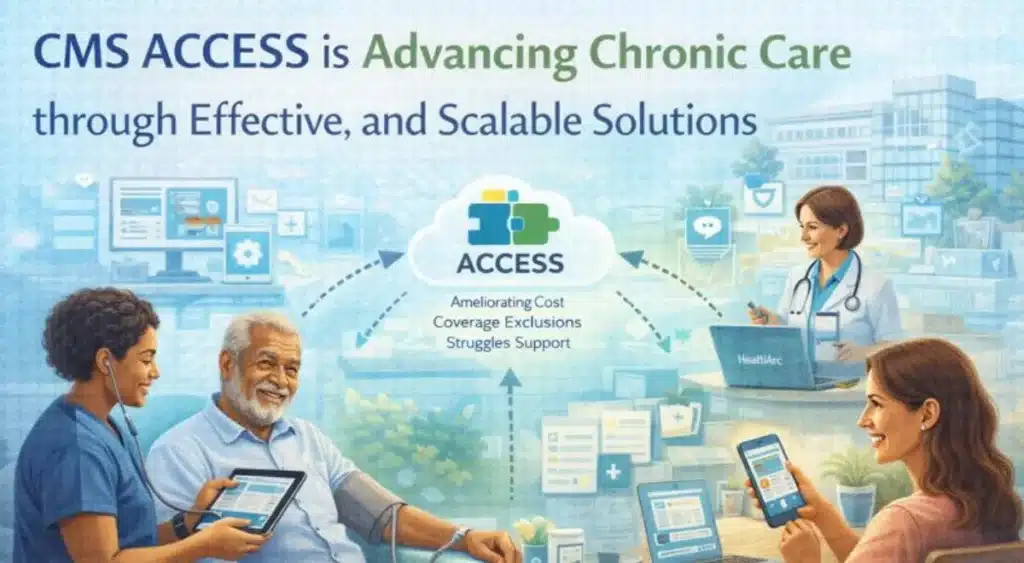
Recognizing this reality, the Centers for Medicare & Medicaid Services (CMS) has made its long-term direction clear: chronic care must become longitudinal, measurable, technology-enabled, and outcome-driven. The ACCESS Model—Advancing Chronic Care with Effective, Scalable Solutions—represents that direction.
ACCESS is not a single pilot, CPT code, or temporary initiative. It is a strategic framework that reflects how CMS expects chronic care to be delivered, measured, and paid for in the years ahead.
I: Understanding the ACCESS Model
What Is the ACCESS Model?
The ACCESS Model (Advancing Chronic Care with Effective, Scalable Solutions) is a CMS-aligned framework designed to modernize how chronic care is delivered and reimbursed. Rather than paying primarily for encounters, ACCESS emphasizes continuous care delivery, measurable patient improvement, and long-term engagement.
Importantly, ACCESS is not a standalone billing program. Instead, it serves as an umbrella model that aligns and extends existing CMS initiatives such as:
- Chronic Care Management (CCM)
- Principal Care Management (PCM)
- Remote Patient Monitoring (RPM)
- Advanced Primary Care Management (APCM)
- Value-based and risk-bearing arrangements through ACOs and Innovation Center models
ACCESS signals a shift in expectations: providers are increasingly accountable for outcomes that occur between visits, not just services delivered during them.
Why CMS Introduced the ACCESS Model
The Chronic Care Crisis
CMS data consistently shows that chronic conditions drive:
- Disproportionate healthcare spending
- High emergency department utilization
- Preventable hospital admissions and readmissions
- Fragmented care experiences for patients
Traditional fee-for-service models were never designed to support continuous disease management or multi-disciplinary coordination.
The Limits of Visit-Based Reimbursement
Under encounter-based payment:
- Providers are rewarded for volume, not improvement
- Engagement outside the clinic is economically invisible
- Care teams beyond physicians are underutilized
- Early deterioration often goes undetected
CMS has acknowledged that paying only for visits creates misaligned incentives that undermine both outcomes and sustainability.
CMS’s Long-Term Strategy
ACCESS aligns directly with CMS’s broader strategy to:
- Shift care upstream and outside clinic walls
- Support population health management
- Expand digital health adoption
- Prepare providers for downside risk and shared savings
- Transition from activity-based to outcome-based reimbursement
In short, ACCESS reflects how CMS expects chronic care to function—not temporarily, but structurally.
II: Core Principles of the ACCESS Model
The Five Pillars of ACCESS
- Longitudinal, Continuous Care
ACCESS replaces episodic care with ongoing accountability. Providers are responsible not only for clinical decisions, but also for how patients perform over time—weeks, months, and years.
This includes:
-
- Regular touchpoints
- Proactive outreach
- Early intervention when progress stalls
- Sustained improvement, not short-term stabilization
- Technology as a Care Enabler
Technology under ACCESS is foundational, not optional. CMS explicitly recognizes the role of:
-
- Remote Patient Monitoring (RPM)
- Digital care plans
- Secure patient communication
- Automated alerts and workflows
These tools allow care teams to monitor patients continuously without unsustainable manual effort.
- Team-Based Care Delivery
ACCESS supports care delivered by multidisciplinary teams, operating at the top of their licenses. Nurses, care coordinators, therapists, pharmacists, and behavioral health professionals all play essential roles, with physicians providing oversight rather than performing every task.
- Outcomes Over Encounters
Success under ACCESS is measured by:
-
- Clinical improvement
- Functional gains
- Adherence and engagement
- Reduced utilization
- Stability over time
Volume alone is no longer sufficient.
- Financial Scalability
ACCESS supports predictable, recurring reimbursement structures that allow practices to invest in infrastructure, staffing, and technology without relying on visit churn.
III: ACCESS as a Unifying Care Delivery Framework
ACCESS does not replace existing CMS programs — it connects and elevates them.
CMS designed ACCESS as a unifying care delivery framework, not a new billing silo. Each program (CCM, PCM, RPM, APCM) solves a specific problem in chronic care. ACCESS defines how they must work together to deliver outcomes at scale.
Think of ACCESS as the operating model, and CCM, PCM, RPM, and APCM as execution tools within that model.
IV: How ACCESS Elevates Existing CMS Programs
1. Chronic Care Management (CCM)
What CCM Is Designed to Do
Chronic Care Management (CCM) supports patients who:
- Have two or more chronic conditions
- Are expected to last at least 12 months
- Place the patient at significant risk of death, acute exacerbation, or functional decline
CMS created CCM to recognize that most chronic care work happens outside office visits.
CCM reimburses:
- Monthly, non-face-to-face care
- Care coordination
- Medication reconciliation
- Care plan oversight
- Patient communication
Why CCM Exists in the First Place
Before CCM:
- Providers were not paid to follow up between visits
- Outreach, coordination, and monitoring were “free labor”
- Chronic patients deteriorated silently between appointments
CCM was CMS’s first major step toward longitudinal accountability.
How ACCESS Elevates CCM
Under ACCESS:
- CCM is no longer a billing add-on
- It becomes foundational infrastructure
ACCESS reframes CCM as:
- A monthly performance cycle
- A continuous engagement obligation
- A measurable outcomes engine
Instead of asking:
“Did we spend 20 minutes this month?”
ACCESS asks:
“Did this patient actually improve, stabilize, or avoid deterioration?”
CCM supplies:
- The monthly care cadence
- The non-visit engagement mechanism
- The documentation foundation
ACCESS supplies:
- Outcome accountability
- Engagement quality expectations
- Integration with RPM, PCM, and APCM
Practical Meaning Under ACCESS
With ACCESS:
- CCM patients are continuously monitored, not just contacted
- Engagement is structured, not ad hoc
- Care plans are dynamic, not static PDFs
- Documentation supports trend-based improvement, not just compliance
CCM becomes the spine of chronic care operations.
2. Principal Care Management (PCM)
What PCM Is Designed to Do
Principal Care Management (PCM) targets patients with:
- One serious, high-risk chronic condition
- A condition that requires focused, intensive management
- Often managed by a specialist
Examples:
- Advanced heart failure
- Parkinson’s disease
- Severe COPD
- Post-stroke recovery
- Complex oncology or neurology cases
PCM recognizes that single-condition patients can be as complex as multi-condition patients.
Why CMS Created PCM
CMS observed that:
- CCM didn’t fit patients with one dominant condition
- Specialists were doing longitudinal work but weren’t reimbursed
- High-risk single conditions drove disproportionate costs
PCM fills that gap.
How ACCESS Elevates PCM
Under ACCESS:
- PCM is no longer siloed within a specialty
- It becomes part of a coordinated longitudinal care strategy
ACCESS ensures:
- PCM data feeds into population-level oversight
- Specialist care aligns with primary care and care teams
- Outcomes are measured over time, not per intervention
Instead of:
“The specialist managed their piece”
ACCESS expects:
“The patient improved across the entire care ecosystem”
Practical Meaning Under ACCESS
With ACCESS:
- PCM patients are monitored continuously, not episodically
- Specialists are accountable for long-term outcomes, not just clinical decisions
- Engagement, adherence, and functional improvement are tracked
- PCM integrates with RPM and behavioral health, not just disease metrics
PCM becomes focused intensity within a broader outcome framework, not isolated expertise.
3. Remote Patient Monitoring (RPM)
What RPM Is Designed to Do
Remote Patient Monitoring (RPM) captures:
- Physiologic data (BP, glucose, oxygen saturation, weight, etc.)
- Data generated outside the clinic
- Objective, real-time signals of patient status
RPM answers a critical question:
“What is happening to the patient when they are not in front of us?”
Why RPM Is Essential to ACCESS
Chronic deterioration almost always:
- Happens at home
- Happens gradually
- Goes unnoticed until a crisis
RPM transforms chronic care from:
- Reactive → Proactive
- Subjective → Objective
- Lagging → Leading indicators
How ACCESS Elevates RPM
Under ACCESS:
- RPM is not the outcome
- RPM is the input signal
ACCESS expects RPM data to:
- Trigger outreach
- Inform care plan changes
- Identify early deterioration
- Support measurable improvement
CMS does not view RPM as:
“Collecting vitals for billing”
CMS views RPM as:
“Infrastructure for outcome accountability”
Practical Meaning Under ACCESS
With ACCESS:
- RPM data flows into care workflows automatically
- Alerts drive action, not dashboards alone
- Trends matter more than single readings
- RPM supports care teams, not just documentation
RPM becomes the eyes and ears of longitudinal care.
4. Advanced Primary Care Management (APCM)
What APCM Is Designed to Do
Advanced Primary Care Management (APCM) represents CMS’s move toward:
- Bundled, higher-intensity primary care payments
- Fewer individual CPT codes
- Greater accountability for outcomes
APCM reflects CMS’s belief that:
Managing chronic populations requires simpler payments and deeper responsibility
Why CMS Is Moving Toward APCM
CMS learned that:
- Code complexity limits adoption
- Fragmented billing discourages innovation
- Providers need predictable revenue to invest in care teams and technology
APCM reduces friction while raising accountability.
How ACCESS Enables APCM
ACCESS provides the care delivery blueprint that APCM assumes already exists.
APCM expects:
- Continuous engagement
- Care team coordination
- Monitoring beyond visits
- Demonstrable outcomes
ACCESS defines how practices must operate to succeed under APCM.
Without ACCESS-style infrastructure:
- APCM increases financial risk
- Outcomes are harder to control
- Practices struggle with accountability
Practical Meaning Under ACCESS
With ACCESS:
- APCM payments align with actual care effort
- Practices can scale without visit inflation
- Outcomes become predictable instead of volatile
- Providers are ready for downside risk and shared savings
APCM is where CMS is going.
ACCESS is how to survive and succeed when you get there.
V: ACCESS vs Traditional Chronic Care
| Traditional Care | ACCESS Model |
| Visit-driven | Continuous |
| Reactive | Proactive |
| Physician-centric | Team-based |
| In-clinic focused | Hybrid and remote |
| Volume-based | Outcome-based |
| Fragmented data | Integrated intelligence |
VI: How ACCESS Works in Real-World Practice
Patient Identification and Enrollment
Practices identify eligible patients based on chronic conditions, risk stratification, and utilization patterns.
Care Plan Development
Personalized care plans establish baselines, goals, and monitoring thresholds across physical and behavioral domains.
Ongoing Monitoring and Engagement
RPM data, patient-reported outcomes, and engagement signals inform daily and weekly workflows—not just scheduled visits.
Physician Oversight and Documentation
Clinicians supervise care delivery, review progress, adjust plans, and ensure audit-ready documentation.
VII: Why Outcome-Based Care Changes the Physician’s Role
At this point, the ACCESS framework transitions from policy to operational reality. As explored in “The ACCESS Model and the Platform Practitioners Need to Do Well in Outcome-Based Care,” outcome-based reimbursement fundamentally reshapes how physicians operate.
Under ACCESS, performance risk shifts to the practice level. Outcomes are influenced less by isolated clinical decisions and more by what happens outside the clinic—adherence, therapy participation, behavioral health stability, and sustained engagement.
Physicians become orchestrators of care ecosystems rather than sole point-of-care providers. Continuous monitoring, structured engagement, interdisciplinary coordination, and longitudinal documentation become core business functions, not optional enhancements.
VIII: The Need for Continuous Monitoring Beyond the Clinic (ACCESS Explained)
Why CMS Emphasizes Visibility Between Visits
The ACCESS model is built on a simple but disruptive truth:
Most outcome-determining events in chronic care do not happen during office visits.
They happen:
- At home
- Between visits
- Gradually
- Often invisibly
Traditional care models are blind to this reality. ACCESS exists because CMS understands that outcome accountability is impossible without continuous visibility.
Why Visit-Based Monitoring Fails Chronic Care
The Visit Is a Snapshot, Not a Story
An office visit captures:
- A moment in time
- A self-reported summary
- A controlled environment
It does not capture:
- Day-to-day adherence
- Symptom variability
- Behavioral instability
- Functional decline
- Slow deterioration
A patient can appear “stable” during a visit and still be declining steadily at home.
Chronic Deterioration Is Gradual, Not Sudden
Most hospitalizations and acute events are preceded by weeks of subtle decline:
- Rising blood pressure
- Slight weight gain in CHF
- Increasing glucose variability
- Decreasing mobility
- Missed therapy sessions
- Declining motivation or mood
Without continuous monitoring, these signals remain invisible until crisis.
Physiologic Metrics Are Only the First Layer
What RPM Captures Well
RPM provides objective data such as:
- Blood pressure trends
- Blood glucose patterns
- Oxygen saturation
- Weight changes
- Heart rate variability
These metrics are critical because they:
- Remove reliance on patient recall
- Provide trend data, not isolated readings
- Allow early intervention
But physiology alone does not explain outcomes.
Why Outcomes Depend on More Than Vitals
ACCESS explicitly recognizes that clinical outcomes are multi-dimensional.
- Therapy Adherence
Therapy works only if it is performed.
Key adherence signals include:
- Missed sessions
- Incomplete exercises
- Declining participation
- Delayed progress milestones
Without tracking adherence:
- Poor outcomes are misattributed to treatment failure
- Financial risk increases under outcome-based reimbursement
- Providers lose insight into root causes
- Functional Recovery
Outcomes increasingly depend on function, not just physiology.
Examples:
- Mobility improvement after surgery
- Endurance gains in pulmonary rehab
- Balance and gait stability
- Pain-free range of motion
Functional decline often precedes clinical deterioration.
ACCESS expects:
- Longitudinal tracking of function
- Proof of improvement, not assumption
- Data that supports outcome claims
- Pain Trajectories
Pain is dynamic, subjective, and outcome-defining.
What matters is not:
- “Pain today”
But: - Is pain trending down?
- Is it stable?
- Is it interfering with function?
- Is it driving disengagement?
Without continuous tracking:
- Pain escalation goes unnoticed
- Adherence drops
- Recovery slows
- Utilization increases
- Mobility and Activity Patterns
Mobility decline is one of the earliest indicators of worsening health.
Decreasing activity often signals:
- Pain increase
- Depression
- Fatigue
- Fear of movement
- Disease progression
ACCESS values mobility as a leading indicator, not an afterthought.
- Behavioral and Mental Health Signals
Behavioral health is not a side concern — it is an outcome multiplier.
Key signals include:
- Depression
- Anxiety
- Motivation decline
- Cognitive impairment
- Social isolation
These directly affect:
- Medication adherence
- Therapy participation
- Self-monitoring reliability
- Long-term outcomes
Without behavioral insight:
- Non-adherence is misinterpreted
- Outcomes degrade unpredictably
- Financial risk increases
What “Silent Deterioration” Really Means
Silent deterioration occurs when:
- Decline is gradual
- Symptoms are normalized by the patient
- Visits are spaced weeks or months apart
- No monitoring exists between encounters
By the time decline is visible:
- Hospitalization risk has already risen
- Interventions are more expensive
- Outcomes are harder to reverse
ACCESS is designed to eliminate this blind spot.
Continuous Monitoring Enables Proactive Care
From Reactive to Predictive
Continuous monitoring allows care teams to:
- Detect early warning signals
- Intervene before crisis
- Adjust care plans dynamically
- Prevent downstream utilization
This transforms care from:
“Respond when something breaks”
To:
“Prevent breakage before it occurs”
Enables Risk Stratification in Real Time
Not all patients need the same intensity at all times.
Continuous data allows:
- Escalation when risk rises
- De-escalation when stability improves
- Efficient use of care teams
ACCESS expects dynamic intensity, not static care plans.
Why CMS Ties Monitoring to Outcome Accountability
Under ACCESS:
- Providers are paid for results
- Not visibility alone
- Not effort alone
Without continuous monitoring:
- Providers cannot prove improvement
- Root causes of failure remain hidden
- Financial risk increases
CMS is signaling:
If you cannot see what is happening between visits, you cannot be accountable for outcomes.
IX: Operational Implications for Practices
Manual Monitoring Does Not Scale
Phone calls, spreadsheets, and ad hoc follow-ups:
- Miss trends
- Burn out staff
- Create documentation gaps
- Increase compliance risk
ACCESS assumes automation, integration, and intelligence.
Monitoring Must Drive Action
Data without workflows is useless.
ACCESS expects:
- Alerts that trigger outreach
- Trends that trigger plan changes
- Engagement signals that trigger escalation
- Documentation that reflects action taken
Continuous Monitoring as Infrastructure, Not Feature
CMS does not view monitoring as:
“An add-on service”
CMS views it as:
Foundational infrastructure for outcome-based care
Without it:
- Care is blind
- Accountability is theoretical
- Value-based reimbursement fails
Structured Patient Engagement as a Performance Engine
Under ACCESS, engagement is no longer a soft metric. It directly correlates with outcomes and reimbursement. Automated, condition-specific engagement pathways—reminders, education, feedback, and escalation—are now essential infrastructure.
When engagement drops, outcomes decline. When engagement improves, progress accelerates. ACCESS ties this relationship directly to financial sustainability.
Outcomes-Based Documentation as a Strategic Asset
Documentation under ACCESS is not just about compliance. It is about proving improvement over time.
Practices must demonstrate:
- Baseline condition states
- Ongoing progress
- Interventions delivered
- Sustained outcomes
Longitudinal analytics replace static notes. Manual documentation cannot scale to meet these demands.
Interdisciplinary Care Coordination
ACCESS assumes chronic care is inherently interdisciplinary. Behavioral health, therapy, medical management, and social factors are deeply interconnected.
Siloed systems undermine accountability. ACCESS requires synchronized care orchestration across disciplines, supported by shared data and workflows.
Financial Sustainability Under ACCESS
Outcome-based reimbursement ties revenue to:
- Engagement consistency
- Clinical improvement
- Documentation integrity
- Cost control
Practices must align operational execution with financial modeling—something traditional billing systems were never designed to do.
Why Traditional EHRs Fall Short Under the ACCESS Model
What EHRs Were Originally Designed For
Most Electronic Health Records were architected to solve three core problems:
- Document encounters
- Support billing and coding
- Maintain a legal medical record
Their design assumptions were:
- Care happens in visits
- Data is entered after the fact
- Providers are the primary users
- Payment is tied to encounters and procedures
For decades, this worked reasonably well in a fee-for-service world.
ACCESS changes every one of these assumptions.
ACCESS Exposes a Structural Mismatch
The ACCESS model expects:
- Continuous care, not episodic visits
- Ongoing engagement, not periodic documentation
- Outcome measurement, not activity logging
- Team-based workflows, not physician-only usage
- Predictive intervention, not reactive response
Traditional EHRs were never designed for this mode of operation.
Seven Structural Gaps Under ACCESS
- Encounter-Centric Architecture
In most EHRs:
-
- The encounter is the organizing unit
- Everything hangs off a visit: notes, orders, diagnoses, billing codes
If something does not happen during an encounter, it is:
-
- Hard to record
- Hard to retrieve
- Hard to analyze longitudinally
ACCESS requires visibility between encounters: daily RPM data, weekly engagement signals, monthly care management actions, behavioral health trends, therapy adherence patterns. EHRs struggle because:
-
- There is no “home” for continuous data
- Trend analysis is limited
- Signals are buried in notes
- Longitudinal views are fragmented
Outcome accountability cannot be built on episodic scaffolding.
- Billing-First, Not Outcome-First Design
EHR workflows are optimized for:
-
- CPT capture
- ICD coding
- Claim submission
- Compliance documentation
ACCESS cares about:
-
- Did the patient improve?
- Was deterioration prevented?
- Was engagement sustained?
- Were outcomes stable over time?
Traditional EHRs capture what was done, not what changed. Outcome analytics are manual, retrospective, and often external to the EHR—creating blind spots under outcome-based reimbursement.
- Disconnected RPM Tools
Most RPM tools:
-
- Live outside the EHR
- Push PDFs or summary reports
- Require manual review
- Are not deeply actionable
Under ACCESS:
-
- RPM data must drive action
- Trends must be interpreted continuously
- Alerts must escalate automatically
- Interventions must be documented in real time
Disconnected RPM creates delayed response, missed deterioration, staff overload, and documentation gaps. Data without orchestration increases risk instead of reducing it.
- CCM as an Afterthought, Not Infrastructure
In many systems:
-
- CCM is tracked manually
- Time is logged separately
- Notes are duplicated
- Engagement is loosely documented
CCM often feels like “extra work layered on top of visits.”
ACCESS expects CCM to be core, structured, repeatable, and outcome-oriented. EHRs do not manage monthly cycles well, do not automate engagement pathways, and do not link CCM effort to outcomes—driving burnout, compliance risk, and financial leakage.
- Behavioral Health Is Poorly Integrated
Behavioral health data is often stored separately, restricted due to privacy, documented narratively, and difficult to trend.
ACCESS recognizes behavioral health drives adherence, adherence drives outcomes, and outcomes drive reimbursement. Without behavioral insight: care plans fail silently, non-adherence is misattributed, outcomes degrade unpredictably. EHRs lack longitudinal behavioral signal tracking, integration with engagement workflows, and predictive analytics.
- Care Team Workflows Are Secondary
EHRs are primarily optimized for physicians, documentation, and orders. Care managers, nurses, therapists, and coordinators often work around the system using external tools, duplicating documentation, and tracking tasks manually.
ACCESS assumes care is delivered by teams, engagement is distributed, tasks are orchestrated, and accountability is shared. Traditional EHRs do not coordinate across disciplines or provide real-time performance visibility—creating friction and burnout.
- Fragmentation Becomes a Material Risk Under ACCESS
In fee-for-service, fragmentation was inconvenient. Under outcome-based reimbursement, fragmentation becomes economic risk: missed signals lead to missed interventions, poorer outcomes, financial loss, revenue volatility, audit vulnerability, burnout, and patient dissatisfaction. ACCESS converts operational gaps into economic risk.
XI: What CMS Is Really Signaling
CMS is not saying: “Replace your EHR”
CMS is saying: “Your EHR alone is not sufficient for outcome-based chronic care.”
Practices need:
- Continuous monitoring
- Engagement orchestration
- Longitudinal analytics
- Team-based workflow engines
- Outcome-aligned documentation
These functions sit outside traditional EHR design assumptions.
XII: The Role of Outcome-Based Care Platforms
Under ACCESS, successful practices operate with:
- An EHR as the system of record
- A care platform as the system of action
The platform:
- Orchestrates engagement
- Interprets signals
- Coordinates teams
- Measures outcomes
- Aligns financial performance
The Platform Physicians Need to Succeed Under ACCESS
Success under ACCESS requires a single, outcome-oriented care platform—one that integrates enrollment, monitoring, engagement, therapy, behavioral health, documentation, analytics, and reimbursement alignment into a unified operating system.
Platform-led practices gain scalability, predictability, and resilience. Manual, disconnected workflows do not.
XIII: The Future of Chronic Care Under ACCESS
CMS has made its trajectory clear:
- From codes to bundles
- From visits to outcomes
- From episodic care to continuous accountability
- From isolated tools to integrated platforms
ACCESS is not a future experiment. It is the blueprint for modern chronic care.
XIV: How HealthArc Supports the ACCESS Model
The ACCESS Model sets a national vision for proactive, coordinated, and measurable chronic care — a vision that aligns naturally with how modern care teams want to operate. HealthArc supports this vision by providing the operational infrastructure and care orchestration needed to turn policy intent into everyday clinical practice.
ACCESS underscores that patients need steady engagement, care teams need shared visibility, and leaders need actionable insights into population health. Most importantly, organizations need scalable workflows that support continuous care without overwhelming clinicians with administrative burden.
To support the expectations of the ACCESS Model, HealthArc brings together the essential elements of long-term chronic care delivery:
- Continuous, structured engagement that extends far beyond episodic visits — including Chronic Care Management (CCM), Remote Patient Monitoring (RPM), Annual Wellness Visits (AWV), and behavioral health integration — all working within a connected care environment that creates predictable, purposeful patient touch points.
- Dynamic care plans that evolve with patient needs. Instead of static documentation, HealthArc’s digital care plans integrate clinical data, patient-reported outcomes, and monitoring insights so care teams can adjust interventions in real time.
- Patient-centric workflows that reduce administrative friction, automate key tasks (such as outreach and documentation), and keep care teams focused on meaningful human interactions rather than manual tracking.
- Analytics and performance tracking that illuminate risk trends, highlight care gaps, and quantify outcomes — giving organizations a reliable way to monitor improvement over time, a requirement of the ACCESS Model’s outcome-aligned approach.
- Seamless technology integration with EHRs and third-party data sources to ensure care teams have a holistic, actionable view of each patient, supported by interoperability and real-time signal interpretation.
Together, these capabilities help practices operate in a way that aligns with the ACCESS Model’s requirements — transforming chronic care from reactive, visit-centric interactions into coordinated, measurable, continuous care that improves outcomes for patients and supports sustainable practice performance.
Conclusion: ACCESS Is an Infrastructure Challenge
ACCESS makes one truth unavoidable: outcome-based care succeeds or fails at the infrastructure level. Clinical expertise alone is not enough.
Practices that invest in continuous engagement, real-time intelligence, interdisciplinary coordination, behavioral integration, and outcome-aligned financial systems will define the next era of chronic care.
ACCESS does not merely reward effort.
It rewards systems that are built to deliver outcomes—consistently and at scale.
FAQs
Q1. What is the CMS ACCESS Model?
The ACCESS Model is a CMS framework that improves chronic care by moving from visit-based treatment to care delivery that is continuous, outcome-driven, and supported by technology.
Q2. Is ACCESS a Medicare billing system or a CPT code?
No. ACCESS is not a billing program that works on its own. It is a strategic framework that brings together CMS programs like CCM, RPM, PCM, and APCM into one care model.
Q3. What made CMS come up with the ACCESS Model?
CMS created ACCESS because people with chronic conditions need ongoing care, not just visits every now and then. Payment models based on visits didn’t work for long-term engagement, early intervention, or measurable outcomes.
Q4. How does ACCESS improve chronic care?
ACCESS replaces care that is reactive and based on visits with care that is proactive and long-term, with a focus on monitoring, engagement, team coordination, and measuring outcomes over time.
Q5. What sets ACCESS apart from regular chronic care?
Traditional care is all about visits and volume. ACCESS is all about ongoing care, team-based workflows, remote monitoring, and results like stability, improvement, and less use of services.
Q6. Does ACCESS take the place of CCM, RPM, or APCM?
No. ACCESS links and improves these programs. In the larger ACCESS care delivery framework, CCM, RPM, PCM, and APCM are tools that help with execution.
Q7. What part does technology play in the ACCESS Model?
ACCESS is built on technology. CMS wants remote monitoring, digital care plans, automated engagement, and long-term analytics to help keep everyone accountable all the time.
Q8. Why is continuous monitoring crucial under ACCESS?
Most chronic deterioration occurs gradually between appointments. ACCESS needs to be able to see outside the clinic to find early signs of decline and keep people from going to the hospital when they don’t need to.
Q9. How does ACCESS help with team-based care?
ACCESS makes multidisciplinary care official. Doctors are in charge, but nurses, care coordinators, therapists, pharmacists, and behavioral health professionals all have a part to play.
Q10. What does ACCESS do for mental health?
ACCESS includes behavioral health in chronic care because mental health has a direct impact on adherence, engagement, and long-term outcomes. It is not an extra but a core driver.
Q11. What results are important in the ACCESS Model?
ACCESS focuses on improvement, stability, adherence, functional gains, engagement, and reduced utilization, not just the services provided or the time spent.
Q12. What does ACCESS do to the roles of doctors?
Doctors go from focusing on individual visits to coordinating care, which means managing teams, keeping track of progress, changing plans, and making sure that goals are met over time.
Q13. Why do standard EHRs have trouble with ACCESS?
Most EHRs are focused on encounters and billing. ACCESS needs continuous data, team workflows, outcome tracking, and real-time engagement. Traditional EHRs weren’t built to handle these things.
Q14. What kind of infrastructure do you need to do well under ACCESS?
To meet ACCESS standards, practices need to be constantly watched, have automated engagement, work across disciplines, have long-term analytics, and have documentation that is in line with outcomes.
Q15. What does ACCESS mean for the future of Medicare care?
ACCESS is a sign that CMS is moving toward chronic care models that are based on outcomes, continuous, and scalable, and that reward measurable improvement instead of the number of visits.

Sudeep Bath
Sales & Tech Leader with 22+ years of experience Former SVP for $37B PE portfolio company Advisor and Board member in number of startups


Categories
Advanced Primary Care Management→AI & Care Coordination→Behavioral Health Integration→Care Management Programs→Chronic Care Management→Digital Health & Software Solutions→General Remote Care Topics→Medication Therapy Management→Pricing & Business Strategy→Principal Care Management→Remote Patient Monitoring→Remote Therapeutic Monitoring→Transitional Care Management→
Related Blog
- February 4, 2026 | Read Time: 16 mins
The Most Common Chronic Diseases and How to Manage Them Effectively
Chronic diseases are one of the biggest problems that healthcare systems around...
Learn More- December 20, 2025 | Read Time: 10 mins
Coverage Gaps ACCESS Aims to Fill: What Traditional Medicare Payment Left Behind
Medicare paid for visits but not for care. For a long time,...
Learn More- February 21, 2025 | Read Time: 6 mins
RPM’s Role in Identifying Early Symptoms of Chronic Conditions for Prevention
Remote patient monitoring (RPM) systems allow for the continuous tracking of essential...
Learn More