
dddddd
By Sudeep Bath
| December 20, 2025
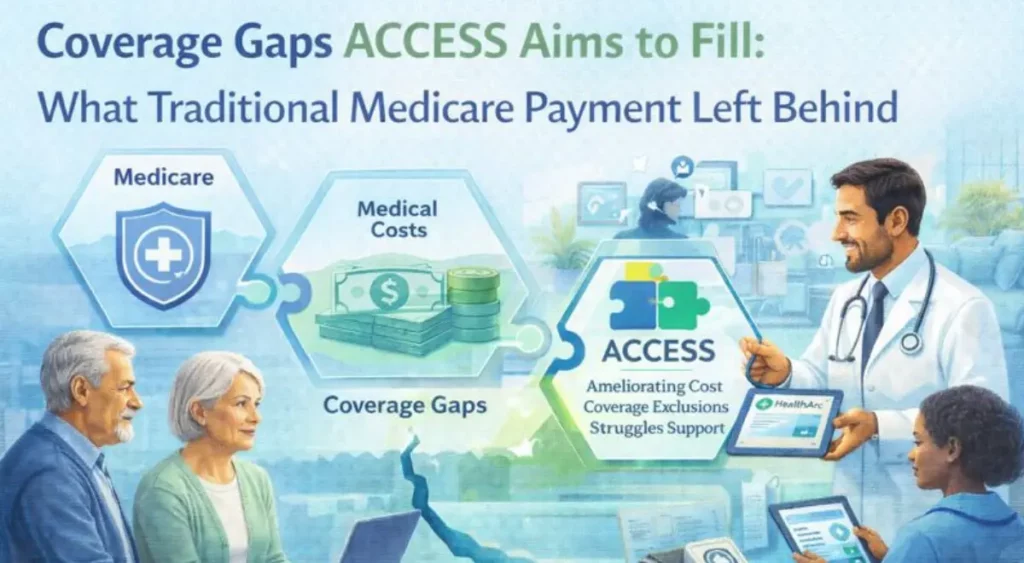
Medicare paid for visits but not for care.
For a long time, Medicare payments have been based on the idea that care happens during visits to the doctor. Payment, documentation, and care delivery all relied on evaluation and management codes, procedures, and encounters.
That structure worked quite well when the healthcare system was mostly about short-term interventions and acute episodes. But the world is very different now.
People with chronic diseases now make up the majority of Medicare recipients. Patients have many conditions that affect each other and change every day. These changes are influenced by factors such as medication adherence, mental health status, functional ability, social circumstances, and access to care between visits. But traditional Medicare payment has stayed tied to one-time visits.
The result is a bigger difference between “what Medicare pays for” and “how care really happens.”
The ACCESS Model—Advancing Chronic Care with Effective, Scalable Solutions—was created to fill those gaps. Instead of adding small fixes to a system based on visits, ACCESS changes what Medicare expects, supports, and rewards in the delivery of chronic care.
The Structural Limits of Traditional Medicare Payment
Traditional Medicare payment didn’t give enough money to or support some important parts of chronic care. These gaps weren’t random; they were the result of a system that was made for encounters, not results.
GAP 1: There is no payment for care between visits.
In the past, when Medicare paid for services, the majority of critical work in chronic care occurred off-clock.
Care teams called patients after their appointments, worked with specialists, looked over lab results, made sure medications were correct, and answered patient questions, all without getting paid. The payment system couldn’t see these activities, but they were important for keeping patients stable.
This made a paradox: The most beneficial care was free; The least helpful interactions were often paid for.
ACCESS directly fights this imbalance by saying that “care between visits is not ancillary—it is foundational.”
GAP 2: Not Enough Help for Keeping Patients Engaged
Traditional Medicare thought that patients would take care of themselves between appointments. During visits, education was given, but there wasn’t much infrastructure to help people keep up positive behavior over time.
There was no money to: Keep an eye on trends in adherence. Spot disengagement early.. Keep up motivation and self-management.
ACCESS fills this gap by tying payment to “ongoing engagement” instead of just one-time instructions. Outreach, monitoring, and follow-up are no longer “extra” parts of care; they are now expected parts.
GAP 3: A Fragmented approach to long-term conditions
In the past, Medicare payments treated conditions and the services that helped them as separate entities. Each visit dealt with a single issue, which was often not connected to the overall plan for care.
This fragmentation caused: Testing that isn’t needed Treatment plans that don’t agree Poor communication between primary and specialty care Missed chances to deal with the main problems
ACCESS sees chronic care as a “longitudinal responsibility,” which means that different conditions, providers, and treatments need to work together in a single framework.
GAP 4: There is no way to keep track of gradual deterioration.
It is uncommon for chronic decline to happen all at once. Most hospitalizations happen after weeks or months of small changes, like higher blood pressure, less mobility, more glucose variability, or more fatigue.
There was no way for traditional Medicare to pay for: Find these patterns early. Take action before things get worse. Show that things didn’t get worse.
ACCESS clearly says that “visibility between visits is needed for accountability.” Providers need to be able to see what is going on outside of the clinic if they are responsible for outcomes.
GAP 5: Little recognition of care provided by a team
Paying for services Medicare was built around visits to the doctor. Although doctors are still important, chronic care today relies on teams.
Nurses, care coordinators, pharmacists, therapists, and behavioral health professionals all play a role in outcomes, but traditional payment systems didn’t always show that.
ACCESS backs a care model in which: Teams work at the highest level of their licenses. Responsibilities are shared fairly. Doctors are responsible for care instead of doing everything themselves.
This change is necessary for growth and long-term success.
GAP 6: Behavioral health is treated as a separate type of medical care.
Behavioral health has long been one of the most poorly supported parts of Medicare’s chronic care program.
Depression, anxiety, cognitive decline, and social isolation have a direct impact on: Taking medication as prescribed Going to therapy Being reliable when self-monitoring Long-term results
But traditional payment systems saw behavioral health as separate, which made it challenging to track over time and often poorly integrated.
ACCESS sees behavioral health not as an extra, but as a “multiplier of outcomes.” Ignoring it reduces the effectiveness of all other care efforts.
GAP 7: Outcomes Were Not the Currency of Payment
The most basic difference is that traditional Medicare paid for “what was done” instead of “what changed.”
Documentation that was focused on: Services provided Time spent Codes sent
It didn’t often catch: Paths to improvement Stabilization over time Avoided use continued engagement
ACCESS makes it clear that outcomes are no longer optional; they are the basis for accountability.
How ACCESS Addresses These Coverage Gaps
There isn’t just one program called the ACCESS Model. It is a “reorientation of Medicare’s expectations” for long-term care.
From Encounters to Continuity
ACCESS changes episodic accountability into long-term responsibility. Providers are expected to record how well patients do over time, not just write down their visits.
From Action to Results
Payment is based on more than just volume; it also takes into account improvement, stability, and prevention.
From Gaps in Visibility to Ongoing Insight
Remote monitoring, engagement signals, and longitudinal analytics become necessary parts of the infrastructure rather than just nice-to-have tools.
From care that focuses on the doctor to care that is based on the team,
ACCESS makes the role of multidisciplinary team’s official by using technology and coordinating workflows.
ACCESS transforms multidisciplinary teams from fragmented to cohesive.
CCM, PCM, RPM, and APCM are no longer just separate projects. ACCESS tells them how to work together.
What This Means for Practices
While ACCESS sets a higher standard, it also creates opportunities.
Adaptable practices can:
- Cut down on unnecessary use.
- Make the patient experience better.
- Make revenue more stable with predictable care models.
- Get ready for risk-bearing arrangements.
Practices that only use visit-based workflows will have more and more problems with the relationship between effort, outcomes, and payment.
ACCESS Is Not Filling Gaps—It’s Redefining the Floor
The most important thing to remember is that ACCESS doesn’t just fix holes in Medicare payments. It changes the meaning of “adequate” chronic care.
Providers no longer ask, “Which codes can we bill?”
“Can we show that we are getting better over time?”
ACCESS makes it clear that “Medicare’s future is continuous, coordinated, and outcome-driven.”
Conclusion: Why the Gaps Can’t Be Ignored Anymore
Traditional Medicare payment left out the things that make chronic care work: engagement, coordination, monitoring, behavioral insight, and long-term accountability.
ACCESS came about because those gaps were too big to ignore.
ACCESS is a model for what modern chronic care should look like and what payment should support as Medicare moves toward value-based and outcome-aligned models.
Practices that proactively address these gaps will not only adhere to ACCESS.
They will set the standard for the next era of chronic care.
As Medicare moves toward continuous, outcome-based care, it will only work if the right operational foundation is in place. HealthArc is made to assist with this change by helping practices address the shortcomings of traditional payment models through continuous monitoring, organized communication, adaptable care plans, and processes focused on results. HealthArc helps practices follow the ACCESS Model by supporting long-term care across CCM, RPM, AWVs, behavioral health, and team-based coordination. This means that policy expectations become real-world care delivery that lasts.
FAQs
Q1. What does the ACCESS Model mean in Medicare?
The ACCESS Model is a Medicare framework that fills in the gaps left by visit-based payment systems to support continuous, coordinated, and outcome-based chronic care.
Q2. Why doesn’t traditional Medicare payment work well for long-term care?
Medicare mostly pays for office visits and procedures, not for ongoing care activities like monitoring, follow-ups, or coordination that are essential for managing chronic diseases.
Q3. What kinds of care does traditional Medicare payment not cover?
Some of the main gaps are unpaid care between visits, weak support for patient engagement, fragmented treatment of multiple conditions, a lack of early decline tracking, limited recognition of team-based care, and a lack of focus on outcomes.
Q4. Does Medicare cover care that happens between doctor visits?
In the past, Medicare didn’t pay much or at all for care that happened between visits, like reaching out to patients, reviewing medications, and coordinating care. ACCESS officially acknowledges that this work is important.
Q5. How does the ACCESS Model help patients become more involved?
ACCESS connects accountability to ongoing engagement, which includes outreach, monitoring, and follow-up. It doesn’t just rely on education given during office visits.
Q6. How does ACCESS help people who have more than one long-term illness?
ACCESS sees chronic care as a long-term responsibility and brings together conditions, providers, and treatments into one system of care.
Q7. Why is it important to find out about a slow decline in health early?
Most serious events happen slowly over time. ACCESS stresses keeping an eye on trends between visits so that problems can be found and fixed before they get worse and require hospitalization.
Q8. Does the ACCESS Model help with team-based care?
Yes. ACCESS officially backs multidisciplinary care teams, which lets doctors, nurses, coordinators, pharmacists, and behavioral health professionals all be responsible for the same results.
Q9. What does ACCESS do to help people with chronic illnesses who have mental health problems?
ACCESS incorporates behavioral health into chronic care, acknowledging that mental health directly influences adherence, engagement, and long-term outcomes.
Q10. What is different about payments under the ACCESS Model?
ACCESS changes the focus of payment from the services provided to the results achieved, such as improvement, stability, prevention, and ongoing patient engagement.
Q11. Is ACCESS just one Medicare program?
No. ACCESS is a change in Medicare’s expectations that affects how programs like CCM, RPM, APCM, and behavioral health work together.
Q12. What does ACCESS mean for doctors’ offices?
Practices that follow ACCESS can help patients get better, cut down on unnecessary care, keep revenue steady, and get ready for value-based care models.
Q13. Is ACCESS merely filling in the gaps or altering the rules for Medicare?
ACCESS changes the standard for chronic care by making continuous, outcome-driven care the norm instead of the exception.
Q14. How does technology help the ACCESS Model?
ACCESS uses tools that let people keep an eye on things all the time, communicate with each other, and get long-term insights to manage care outside of office visits.

Sudeep Bath
Sales & Tech Leader with 22+ years of experience Former SVP for $37B PE portfolio company Advisor and Board member in number of startups


Categories
Advanced Primary Care Management→AI & Care Coordination→Behavioral Health Integration→Care Management Programs→Chronic Care Management→Digital Health & Software Solutions→General Remote Care Topics→Medication Therapy Management→Pricing & Business Strategy→Principal Care Management→Remote Patient Monitoring→Remote Therapeutic Monitoring→Transitional Care Management→
Related Blog
- February 4, 2026 | Read Time: 16 mins
The Most Common Chronic Diseases and How to Manage Them Effectively
Chronic diseases are one of the biggest problems that healthcare systems around...
Learn More- December 22, 2025 | Read Time: 23 mins
CMS ACCESS is Advancing Chronic Care through Effective, and Scalable Solutions
Introduction: Why Chronic Care Needs a New Model Chronic disease management has...
Learn More- February 21, 2025 | Read Time: 6 mins
RPM’s Role in Identifying Early Symptoms of Chronic Conditions for Prevention
Remote patient monitoring (RPM) systems allow for the continuous tracking of essential...
Learn More