
dddddd
By Jack Whittaker
| February 13, 2026
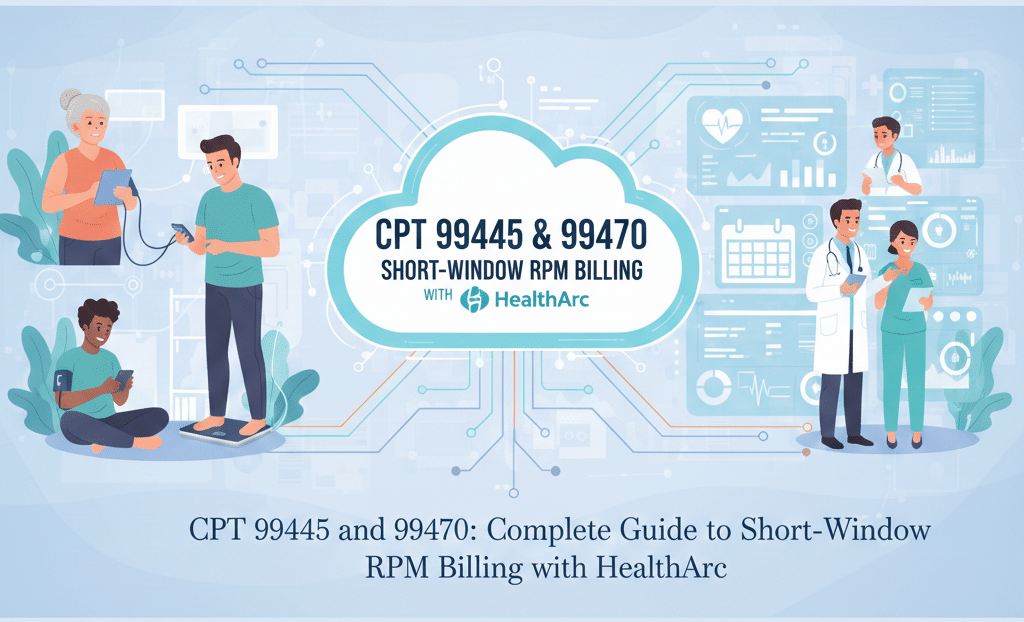
CPT 99445 and CPT 99470 are transforming how practices bill for Remote Patient Monitoring by finally recognizing shorter monitoring windows and lighter-touch management. This blog explains what each code means, how CPT 99445 applies to 2–15 days of physiologic data, and how CPT 99470 captures 10–19 minutes of RPM treatment and management time. You’ll learn eligibility rules, documentation requirements, and how these codes fit alongside existing RPM codes like 99454 and 99457. The article also highlights how HealthArc helps automate tracking, coding, and compliance so you can maximize revenue while expanding your virtual care programs.
Understanding CPT 99445 and CPT 99470 in 2026
CPT 99445 and CPT 99470 are two powerful additions to the 2026 Remote Patient Monitoring (RPM) landscape that give practices more flexibility in billing for shorter monitoring periods and lighter engagement patients. These codes are particularly relevant for practices that manage chronic conditions virtually and want to ensure reimbursement for meaningful work that previously went uncompensated. For digital care platforms like HealthArc, they expand your ability to capture revenue across a wider range of patient use cases while still supporting high-quality, compliant care.
Broadly, CPT 99445 addresses 2–15 days of physiologic data transmission within a 30‑day period, while CPT 99470 covers 10–19 minutes of RPM treatment and management time in a calendar month. Together, they bridge the gap between traditional RPM codes that required 16+ days of data and at least 20 minutes of management time and real-world scenarios where patients may not reach those thresholds but still benefit from regular monitoring and clinical oversight.
CPT 99445: Short-Window RPM Device Supply (2–15 Days)
What CPT 99445 is designed for
CPT 99445 is a device supply and data transmission code for shorter RPM windows. It allows you to bill for patients who transmit physiologic data on at least 2 days but fewer than 16 days in a 30-day period. This is critical for:
- Newly enrolled RPM patients who are still learning how to use the device
- Post-acute or post-procedure episodes where you only need 1–2 weeks of monitoring
- Patients with fluctuating engagement who do not consistently hit 16 days
Instead of losing revenue when patients fall short of the 16-day requirement for traditional device-supply codes, CPT 99445 lets you get reimbursed for the real work and monitoring infrastructure you provide over that shorter period.
Key clinical and technical requirements
To bill CPT 99445 compliantly, your workflow should meet several key conditions:
- The device must qualify as a medical device, typically under FDA rules.
- Data must be automatically collected and transmitted—not manually keyed in by the patient.
- You must receive a minimum of 2 days of valid physiologic data within the 30-day period, but fewer than 16.
- The code is billed once per 30-day period per patient, similar to other RPM device codes.
- Your documentation should clearly show:
- Device type
- Number of days with transmitted data
- Clinical rationale for monitoring
- How the data fit into the patient’s care plan
Practical workflow tips
From a practical perspective, you need your RPM platform to automatically count “reading days” and categorize each patient’s month-end status into either:
- 2–15 days → CPT 99445
- 16+ days → traditional RPM device code (e.g., 99454 or its latest equivalent)
A platform like HealthArc can automatically track these thresholds, surface billing suggestions, and ensure your billing team uses CPT 99445 whenever it is the appropriate code for short-duration RPM cycles.
CPT 99470: 10–19 Minutes of RPM Treatment and Management
Why CPT 99470 matters
Historically, RPM management codes required a minimum of 20 minutes per month, which meant that any work below that threshold went unpaid. CPT 99470 introduces a more granular tier for 10–19 minutes of RPM treatment management time in a calendar month. This code is ideal for:
- Stable chronic care patients who need shorter check-ins
- Months where the clinical team’s work never quite reaches 20 minutes
- Lower-acuity episodes or “maintenance” months in long-term RPM programs
Instead of artificially stretching encounters to meet 20 minutes or simply not billing at all, you can now capture legitimate clinical work under CPT 99470.
What counts toward CPT 99470 time
Time that may count toward CPT 99470 typically includes:
- Reviewing RPM data trends and alerts
- Communicating with the patient or caregiver via phone, video, or secure two-way messaging
- Adjusting medications or care plans based on RPM data
- Documenting clinical decisions and interventions related to RPM findings
To bill this code, you must:
- Reach at least 10 minutes but less than 20 minutes of cumulative time in the month
- Conduct at least one interactive communication with the patient or caregiver
- Ensure that the time is distinct from time reported under other codes (e.g., CCM, PCM) when required by payer rules
A robust solution like HealthArc can automatically aggregate staff time across interactions, flag when the 10-minute threshold is met, and help your billing team decide when CPT 99470 versus 99457/99458 should be used.
How CPT 99445 and 99470 Fit with Other RPM Codes
The new codes don’t replace the core RPM codes; they extend your options.
- For device supply and data:
- Shorter monitoring (2–15 days): CPT 99445
- Longer monitoring (16+ days): existing RPM device code (e.g., 99454 equivalent)
- For treatment and management time:
- 10–19 minutes: CPT 99470
- First ≥20 minutes: CPT 99457
- Each additional 20 minutes: CPT 99458
This tiered structure allows practices to align billing more closely with the real intensity of work performed in any given month rather than losing revenue on borderline or low-intensity scenarios.
Revenue and Strategy Considerations for Practices
From a revenue perspective, CPT 99445 and 99470 help you:
- Capture reimbursement for partial months or low-engagement months
- Improve ROI on RPM devices by reducing “non-billable” patient months
- Smooth your monthly cash flow by recognizing shorter, yet still meaningful, interactions
Strategically, these codes support a more nuanced RPM model where:
- High-risk patients still hit 16+ days and 20+ minutes, billed under traditional codes
- Moderate or stable patients often fall into the 2–15 day and 10–19 minute ranges, billed under CPT 99445 and 99470
- Practices can scale RPM to more patients without requiring every patient to conform to strict 16-day and 20-minute patterns
When combined with a platform like HealthArc, which automates counting, time tracking, and suggested coding, practices can reduce administrative burden while maximizing compliant revenue across their RPM population.
Why HealthArc Is an Ideal Partner for CPT 99445 and 99470
To get the most from these new codes, technology and workflow design matter. HealthArc helps you operationalize CPT 99445 and 99470 by:
- Tracking daily data transmission so you always know whether a patient meets 2–15 days or 16+ days in a period
- Logging and aggregating care management time across nurses, physicians, and care managers
- Triggering alerts when patients cross the 10-minute or 20-minute marks for RPM management
- Generating audit-ready records that align every billed unit with clear, defensible documentation
- Integrating RPM with other programs (CCM, PCM, TCM, APCM) so your team can coordinate care while respecting payer rules around double-counting time
This combination of automated tracking, coding intelligence, and documentation support allows practices to adopt CPT 99445 and 99470 confidently, improve revenue integrity, and expand virtual care offerings without overwhelming staff.
FAQs on CPT 99445 and CPT 99470
Q1. What is CPT 99445 used for?
CPT 99445 is used to bill remote patient monitoring device supply and data transmission when a patient transmits physiologic data on 2–15 days within a 30-day period. It is designed for patients who do not reach the 16-day threshold required by traditional RPM device codes but still receive meaningful monitoring and support. This is especially useful for short-term monitoring, new RPM enrollees, and patients with inconsistent engagement.
Q2. What is CPT 99470 used for?
CPT 99470 is an RPM treatment and management code that covers 10–19 minutes of cumulative clinical time in a calendar month, including at least one interactive communication with the patient or caregiver. It allows practices to bill for legitimate RPM work that falls short of the 20-minute requirement for codes like 99457, such as brief monthly check-ins, data review, and minor care plan adjustments.
Q3. How do CPT 99445 and 99470 differ from traditional RPM codes?
Traditional RPM codes generally require 16+ days of monitoring for device supply and 20 or more minutes of management time. CPT 99445 and 99470 introduce lower thresholds—2–15 days and 10–19 minutes—so providers can bill for shorter monitoring periods and lighter management services. They add flexibility rather than replacing existing RPM codes.
Q4. Can I bill CPT 99445 and 99454 in the same 30-day period?
No. In a given 30-day period, you typically choose either CPT 99445 for 2–15 days of transmitted data or CPT 99454 for 16 or more days of data—not both for the same patient in the same billing cycle. Your RPM platform should help track valid reading days to determine the correct code.
Q5. Can CPT 99470 be billed together with 99457 and 99458?
CPT 99470 applies when total RPM management time reaches 10–19 minutes in a calendar month. Once time exceeds 20 minutes, providers typically bill 99457 for the first 20 minutes and 99458 for each additional 20 minutes. You generally bill either 99470 or 99457/99458 for the same patient in the same month, depending on documented time.
Q6. What documentation is required for CPT 99445 and 99470?
For CPT 99445, documentation should include the device type, number of days with valid transmitted readings, and the clinical purpose of monitoring. For CPT 99470, documentation must include total management time (10–19 minutes), description of services provided, and at least one interactive communication with the patient or caregiver. Time-stamped notes and platform logs help support compliance.
Q7. How can a platform like HealthArc simplify CPT 99445 and 99470 billing?
HealthArc can simplify billing by automatically counting data transmission days, tracking cumulative clinical time, and flagging when patients meet thresholds for CPT 99445, 99470, 99457, and 99458. It also provides audit-ready documentation and reporting, reducing manual errors and helping practices capture appropriate reimbursement.
Q8. Are CPT 99445 and 99470 only for Medicare patients?
CPT codes are developed nationally, but coverage and reimbursement vary by payer. Medicare may establish baseline guidance, while commercial insurers and Medicaid plans may adopt or modify policies. Practices should verify payer-specific rules before billing.

Jack Whittaker
Sales leader and high level Operator with a demonstrated history of working in the hospital & health care industry.




Categories
Advanced Primary Care Management→AI & Care Coordination→Behavioral Health Integration→Care Management Programs→Chronic Care Management→Digital Health & Software Solutions→General Remote Care Topics→Medication Therapy Management→Pricing & Business Strategy→Principal Care Management→Remote Patient Monitoring→Remote Therapeutic Monitoring→Transitional Care Management→
Related Blog
- March 19, 2026 | Read Time: 17 mins
How Technology Enables Success in CMS Alternative Payment Models
The US healthcare reimbursement model is transitioning away from volume to value....
Learn More- March 16, 2026 | Read Time: 10 mins
How the CMS ACCESS Model Reshaped Provider Reimbursement
The CMS ACCESS Model (Advanced Coordinated Care through Enhanced Support Services) is...
Learn More- March 12, 2026 | Read Time: 17 mins
Common Conditions Monitored with Remote Patient Monitoring (RPM)
Just imagine an advanced healthcare system that tracks and analyze your health...
Learn More