
dddddd
By Jack Whittaker
| December 15, 2025
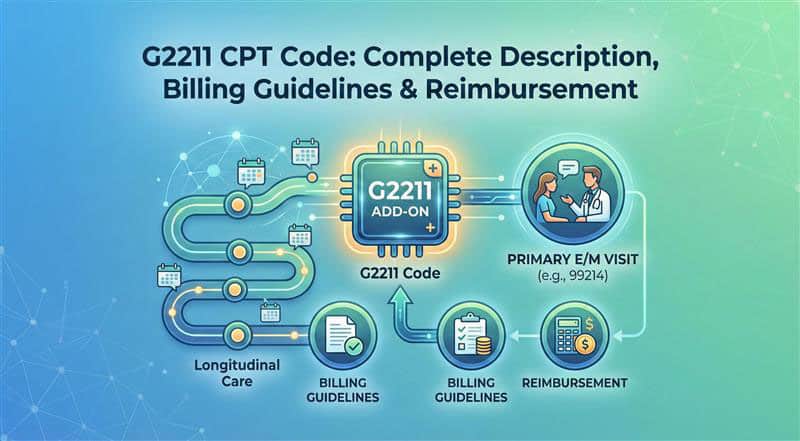
G2211 CPT code is an add-on HCPCS code that lets you capture the inherent complexity of office and outpatient E/M visits when you act as the patient’s ongoing focal point for care, especially for chronic or complex conditions. It is billed in addition to standard E/M codes (99202–99205, 99211–99215) and certain preventive services, and is payable by Medicare starting in 2024 with expanded use in 2025.
What is G2211 CPT code?
G2211 CPT code (technically HCPCS code G2211) describes the visit complexity that comes from managing a patient longitudinally, not just the time spent on a single visit. CMS created it so primary care and other longitudinal clinicians are paid more accurately when they serve as the continuing focal point for all or most of a patient’s health care needs. The code is intended for situations where you are coordinating ongoing care for multiple conditions or a single serious or complex condition over time.
The official G2211 CPT code description from CMS emphasizes that it is an add-on to office/outpatient E/M services rather than a standalone service. It recognizes care that goes beyond the immediate problem, such as reviewing cumulative history, coordinating with other clinicians, and updating long-term care plans.
G2211 CPT Code Description and 2025 Updates
In CMS language, the G2211 CPT code description focuses on “visit complexity inherent to evaluation and management associated with medical care services that serve as the continuing focal point for all needed health care services” or for ongoing care related to a single serious or complex condition. In practice, that means G2211 is meant for clinicians who truly manage the patient longitudinally, not for isolated, time-limited visits.
For 2025, CMS expanded its guidance so G2211 can be billed in more situations, including when the base E/M code is reported with modifier 25 for certain Part B preventive services and procedures. CMS also clarified that G2211 may be used by any specialty when the visit meets the longitudinal relationship criteria, not just family medicine or internal medicine.
When you should use G2211
You should consider the G2211 CPT code when:
- You are the ongoing focal point for most of the patient’s care, such as a primary care clinician or a specialist managing a complex chronic condition.
- The visit involves longitudinal management, like revisiting chronic problems, adjusting long-term treatment plans, or coordinating care, beyond addressing a simple, isolated complaint.
G2211 is not appropriate for discrete, time-limited visits where you are not taking responsibility for ongoing care (for example, one-time consults only addressing an acute concern without plans for continued management). It must always be billed in addition to an eligible office or outpatient E/M code on the same date of service.
G2211 CPT code billing guidelines
Core G2211 billing guidelines include:
- G2211 is an add-on code and must be appended to office/outpatient E/M codes 99202–99205 or 99211–99215; it cannot be billed alone.
- The documentation must support both the medical necessity of the E/M visit and the ongoing, longitudinal nature of your relationship or management.
G2211 only applies to office and outpatient settings (including telehealth when billed with eligible E/M codes), and clinicians must meet normal Medicare billing requirements. Commercial payers, Medicare Advantage plans, and Medicaid programs may have their own G2211 billing guidelines, so practices need to monitor payer-specific policies and fee schedules.
G2211 CPT code reimbursement and RVU value
Medicare publishes a national average payment and RVU for G2211 each year under the Physician Fee Schedule. For 2024, the national Medicare allowable is in the mid-teens (around 16 dollars) with an RVU just under 0.5, though exact values differ slightly by source and geographic adjustment. Early 2025 resources show a similar national average reimbursement in the mid-teens with slightly different work RVU figures, again subject to local variation.
This means that G2211 CPT code reimbursement can modestly increase total payment per eligible visit, especially when combined with Annual Wellness Visits or higher-level E/M codes. Because the g2211 cpt code rvu value and reimbursement rates are adjusted by locality, practices should check their Medicare Administrative Contractor and local fee schedules for precise amounts.
How to bill G2211 CPT code step-by-step
A practical approach to how to bill G2211 CPT code:
- Confirm that the visit is an eligible office or outpatient E/M service (99202–99205 or 99211–99215) and that you are managing the patient longitudinally.
- Ensure documentation shows ongoing responsibility for most of the patient’s health care needs or for a serious or complex condition over time, not just a single acute issue.
- Add G2211 on the same claim as the base E/M code for the same date of service, following payer-specific formatting rules.
- When applicable in 2025, confirm whether the base E/M code is billed with modifier 25 and that any additional Part B preventive service on the same day is on CMS’s allowed list for concurrent G2211 payment.
Good internal workflows, EHR prompts, and coder education help reduce denials and ensure consistent use of g2211 cpt code billing guidelines.
Modifier 25 and G2211 in 2025
Originally, CMS did not pay G2211 when the associated E/M code was billed with modifier 25 on the same date as another significant procedure or service. In the 2025 final rule, CMS revised this stance and now allows G2211 payment when the base E/M code includes modifier 25, but only when the other service is an allowed Part B preventive service or other specified codes.
This change means clinicians can capture both the preventive service and the inherent visit complexity, as long as documentation clearly supports a distinct E/M service and longitudinal management. Practices should review the CMS lists and payer bulletins to align internal billing edits with the updated g2211 cpt code cms guidelines.
G2211 and Medicare vs commercial insurance
G2211 is covered under traditional Medicare Part B when billed correctly with eligible E/M codes, subject to deductible and coinsurance. CMS also lists it on the Medicare telehealth list, allowing use when E/M services are provided via telehealth under applicable rules. So the g2211 cpt code description for Medicare emphasizes both longitudinal care and standard Part B cost-sharing.
However, g2211 cpt code commercial insurance policies vary widely: some commercial and Medicare Advantage plans cover it, some bundle it, and others do not recognize it at all. Medicaid adoption is state-specific, so practices must verify whether the g2211 cpt code is covered by Medicare Advantage, local Medicaid, and commercial plans before widespread use.
G2211 CPT code and care management programs (RPM, CCM, RTM, TCM, PCM, APCM)
G2211 is separate from care management codes like Chronic Care Management (CCM), Principal Care Management (PCM), Remote Patient Monitoring (RPM), Remote Therapeutic Monitoring (RTM), Transitional Care Management (TCM), and Advanced Primary Care Management (APCM). CMS notes that G2211 recognizes the professional work and inherent complexity during the E/M visit itself, while care management codes pay for structured work done between visits.
Practices that already provide CCM, PCM, RPM, or APCM can still use the G2211 CPT code description criteria to capture added complexity during qualifying office visits when they serve as the patient’s longitudinal care focal point. This allows a more complete revenue picture for both in-visit complexity (via G2211) and between-visit care management (via CCM, RPM, RTM, TCM, PCM, or APCM where appropriate).
Special populations and settings, including pediatrics
CMS does not impose a specific G2211 CPT code age limit; the code is not restricted to older adults or Medicare patients by definition. In practice, Medicare is currently the primary payer using G2211, but other payers may adopt it for pediatric or non-Medicare populations according to their own coverage rules. For example, g2211 cpt code pediatrics usage is possible when a pediatrician serves as the continuing focal point for a child with complex, chronic needs and the payer recognizes the code.
Federally Qualified Health Centers (FQHCs) and Rural Health Clinics (RHCs) do not typically receive separate G2211 reimbursement; instead, the value is bundled into their encounter-based payment systems. Other outpatient specialties can report G2211 if their visits meet the longitudinal complexity criteria, irrespective of specialty.
Documentation best practices for G2211
To support g2211 billing guidelines, documentation should clearly reflect:
- A longitudinal, continuous relationship, or ongoing management of a serious or complex condition.
- Work that goes beyond a simple problem-focused visit, such as coordinated care, medication management across multiple conditions, or integrating external records.
CMS has stated that it does not require unique, special documentation elements solely for G2211, but medical reviewers can use the record to verify that the visit was medically necessary and that the relationship criteria were met. Templates and prompts that remind clinicians to note longitudinal care elements during qualifying visits can improve compliance with g2211 cpt code guidelines.
FAQs about G2211 CPT code
Q1. What is G2211 CPT code used for?
The G2211 CPT code is used to capture the inherent complexity of office and outpatient E/M visits when a provider delivers longitudinal, relationship-based care or ongoing management of a serious or complex condition. It is billed as an add-on to eligible E/M codes and cannot be used as a standalone service.
Q2. How do you bill G2211 CPT code?
To bill G2211, append it to an eligible office or outpatient E/M code (99202–99205 or 99211–99215) on the same date of service when documentation supports ongoing, longitudinal care or complex condition management. The visit must be medically necessary, and the payer must recognize G2211 under its billing policies.
Q3. What is the G2211 CPT code reimbursement rate?
The national average Medicare reimbursement for G2211 is typically in the mid-teens (approximately $15–$16), though the exact payment and RVUs may vary by year and geographic location. Practices should consult their local Medicare fee schedule to confirm the current G2211 reimbursement rate.
Q4. Is G2211 covered by Medicare?
Yes. Traditional Medicare Part B covers G2211 when it is billed appropriately with an eligible E/M service. Standard Part B coinsurance and deductibles apply. Medicare also permits G2211 to be billed with certain preventive services and Annual Wellness Visits beginning in 2025, subject to CMS rules.
Q5. Can you bill G2211 with Annual Wellness Visits?
Yes. CMS has confirmed that G2211 may be billed with Medicare Annual Wellness Visits (G0438 and G0439) when documentation shows management of a serious or complex condition in addition to the preventive service. This allows practices to recognize the added longitudinal care provided during AWVs.
Q6. Can G2211 be billed with modifier 25?
Beginning January 1, 2025, CMS allows payment for G2211 even when the associated E/M code is billed with modifier -25, provided the additional service is an approved Part B preventive service or other specified code. Practices should review CMS guidance and payer policies to ensure compliance.
Q7. Is there an age limit for G2211 CPT code?
There is no explicit age limit for G2211. The code is not restricted by patient age, although it is most commonly used for Medicare beneficiaries. Non-Medicare patients may also qualify if payer rules allow and documentation supports longitudinal care.
Q8. Can you use G2211 for non-Medicare or commercial insurance patients?
G2211 may be submitted to commercial insurers and Medicaid plans, but coverage is payer-specific. Many commercial payers may deny or bundle the code, so practices should verify coverage policies before using G2211 for non-Medicare patients.
Q9. How does G2211 differ from RPM, CCM, or APCM?
G2211 is an add-on code that reflects the inherent complexity of an E/M visit itself, while programs such as RPM, CCM, PCM, RTM, TCM, and APCM reimburse for structured care management work performed outside of face-to-face visits. CMS states that G2211 is not duplicative of these care management services.
Q10. What are common billing mistakes with G2211 CPT code?
Common billing errors include using G2211 without an eligible E/M code, applying it to one-time or acute visits without longitudinal responsibility, or failing to confirm payer coverage. Inadequate documentation of the ongoing provider-patient relationship or complex condition management is another frequent cause of denials or audits.

Jack Whittaker
Sales leader and high level Operator with a demonstrated history of working in the hospital & health care industry.



Categories
Advanced Primary Care Management→AI & Care Coordination→Behavioral Health Integration→Care Management Programs→Chronic Care Management→Digital Health & Software Solutions→General Remote Care Topics→Medication Therapy Management→Pricing & Business Strategy→Principal Care Management→Remote Patient Monitoring→Remote Therapeutic Monitoring→Transitional Care Management→
Related Blog
- March 19, 2026 | Read Time: 17 mins
How Technology Enables Success in CMS Alternative Payment Models
The US healthcare reimbursement model is transitioning away from volume to value....
Learn More- March 16, 2026 | Read Time: 10 mins
How the CMS ACCESS Model Reshaped Provider Reimbursement
The CMS ACCESS Model (Advanced Coordinated Care through Enhanced Support Services) is...
Learn More- February 27, 2026 | Read Time: 11 mins
What Is the CMS Access Model? A Complete Guide for Healthcare Providers
The CMS Access Model represents a significant shift in how Medicare reimburses...
Learn More