
dddddd
By Prateek Haswani
| March 16, 2026
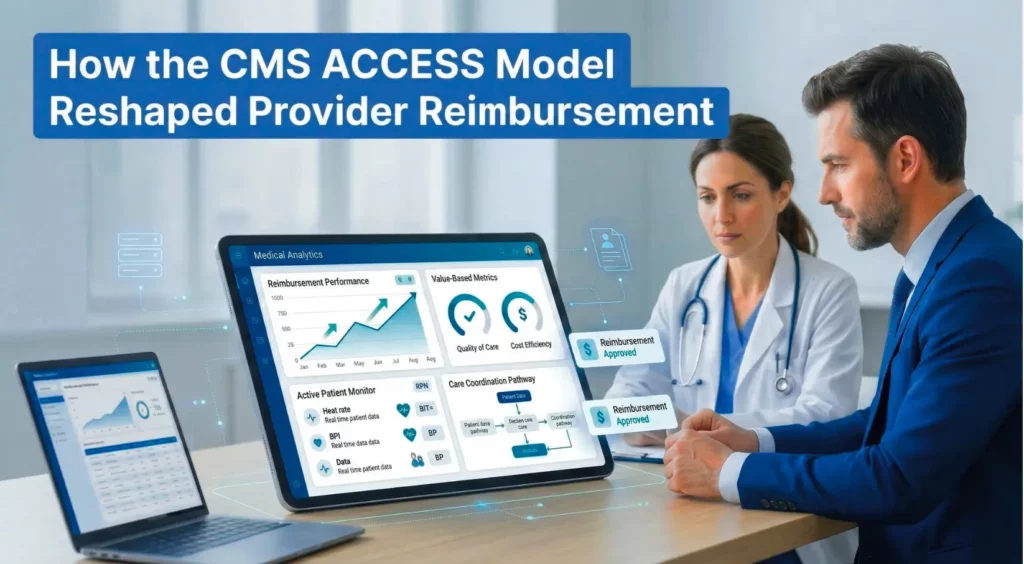
The CMS ACCESS Model (Advanced Coordinated Care through Enhanced Support Services) is more than just a change in how Medicare pays for things. For healthcare executives, physician leaders, and decision-makers in health systems, it means that the way providers make money will have to change. CMS is no longer making small changes to how it pays for services. Instead, it is changing how providers make money in a world where chronic disease burden, workforce shortages, and value-based accountability are becoming more important. Organizations capable of providing large-scale, continuous, coordinated, technology-enabled care receive payments differently under the ACCESS Model.
From Visit-Based Payments to Continuous Care
In the past, healthcare reimbursement has rewarded clinical encounters. The amount of money made depended on the number of visits, the number of procedures done, and how much the facility was used. This structure worked well in an acute-care setting, but it unintentionally separated financial incentives from long-term patient outcomes.
The ACCESS Model starts to make reimbursement more in line with how healthcare is actually delivered today. Chronic conditions now make up most of the patterns of use, but real clinical management happens outside of scheduled visits, through monitoring, engagement, and coordinated intervention. CMS is effectively acknowledging longitudinal care as a reimbursable service line. For provider organizations, this is a shift from making money on a per-episode basis to relationship-driven care economics, where financial performance is based on ongoing patient management instead of just one-time clinical interactions.
Predictable Revenue and Financial Stability
One of the most important effects of ACCESS is that it has made revenue more stable. Healthcare organizations have long had to deal with unstable financial situations caused by changes in appointments, staffing shortages, and changes in how often services are used. CMS supports continuous care models, which makes it possible for reimbursement structures to be linked to ongoing patient management. This makes it possible to have regular income streams that keep operating margins steady and make the business less reliant on daily clinical capacity.
From a leadership point of view, knowing that reimbursement will happen makes it easier to invest in things like expanding the workforce, building digital infrastructure, and improving the health of the population. Financial planning starts to move away from short-term productivity metrics and toward long-term strategies for keeping patients engaged.
Broadening What Counts as Billable Care
ACCESS fundamentally broadens the scope of clinical activities that Medicare acknowledges as reimbursable. Care delivery is no longer limited to the physical confines of hospitals or medical offices. Clinical oversight now increasingly encompasses remote monitoring, proactive outreach, care coordination, and treatment optimization within patients’ daily environments. This change shows that the industry as a whole is starting to understand that health outcomes are always changing, not just sometimes.
This is a chance for executive teams to grow their organization’s reach without having to spend more money. Medicare reimbursement frameworks help pay for care delivery that gets closer to the patient.
Care Management as a Revenue Generator
With ACCESS-aligned reimbursement, structured care management goes from being an extra service to being a key economic driver for provider organizations. To take care of complicated groups of patients, clinical disciplines, behavioral health services, and community resources must work together all the time. CMS reimbursement is becoming more and more favorable to organizations that can effectively manage this continuity. Because of this, the provider’s strategy changes from getting the most out of visits to getting the most out of managing the population. Health systems that build scalable care coordination skills set themselves up to get better clinical outcomes and better financial results.
Digital Infrastructure and Reimbursement
The most important effect of the ACCESS Model may be that digital health infrastructure goes from being just operational support to being a strategic necessity. To provide continuous care, you need to always be able to see how your patients are doing, have automated engagement workflows, and have real-time clinical intelligence. Without integrated platforms, it is not possible to provide ACCESS-aligned care in a way that works. Technology now has a direct impact on how much money you get back. Companies that can combine remote patient monitoring, care management workflows, and analytics-driven intervention see clear benefits in terms of both efficiency and revenue. Digital transformation is no longer just about modernization for healthcare leaders; it is now also about optimizing reimbursement.
The Rise of Team-Based Care Models
ACCESS also helps move toward care that involves more than one type of professional. Sustainable chronic care management cannot depend solely on physician availability. Reimbursement support for coordinated services lets healthcare organizations use nurses, care coordinators, and other professionals as important parts of long-term care delivery. Doctors are still the ones who make clinical decisions, and care teams keep patients involved all the time. This change makes the workforce more stable and lets businesses cover more patients without raising provider burnout or staffing costs by the same amount.
ACCESS and the Shift to Value-Based Healthcare
The ACCESS Model should be seen as part of CMS’s larger move toward value-based reimbursement. ACCESS gets provider organizations ready to be more involved in risk-based payment environments by encouraging prevention, early intervention, and coordinated management. Organizations that put continuous care into action today are better prepared for future shared savings programs, accountable care arrangements, and reimbursement models that focus on outcomes. ACCESS is both an immediate way to get paid back and a strategic step toward value-based healthcare maturity.
Strategic Implications for Health System Leaders
For leaders in the C-suite, the ACCESS Model brings up important strategic questions:
- Can our organization keep track of patient populations all the time instead of just sometimes?
- Do our workflows make it possible for proactive intervention?
- Is our technology infrastructure helping or hurting our ability to get paid?
- Are we set up for long-term care that is done by a team?
As Medicare reimbursement changes, the answers become more and more important for competitive positioning. Organizations that adapt early have better financial stability, better patient engagement, and more room to grow their operations.
How HealthArc Supports ACCESS-Aligned Care
The ACCESS Model supports a way of delivering care that is based on ongoing patient involvement and coordinated management. HealthArc helps provider organizations make this change happen by giving them a single platform that supports Remote Patient Monitoring, chronic care workflows, and integrated care coordination. Healthcare organizations can move from fragmented programs to scalable, ACCESS-ready care models by making sure that their clinical operations follow CMS reimbursement guidelines. In this setting, technology is not just a way to build things; it is also a way to speed up the change to sustainable reimbursement by enabling more efficient data collection, improving patient engagement, and facilitating better communication among care teams.
Conclusion
The CMS ACCESS Model is a major change in the economics of healthcare. Reimbursement is slowly moving away from visits that are based on volume and toward long-term relationships with patients that are supported by digital care delivery. For healthcare leaders, the message is clear: how well organizations manage patient health over time will matter more for their financial success in the future than how many patients come to the clinic. ACCESS is more than just a policy; it’s a plan for how providers will be paid in the future.
Frequently Asked Questions (FAQs)
What does the CMS ACCESS Model mean for healthcare?
The CMS ACCESS Model (Advanced Coordinated Care through Enhanced Support Services) is a way for the government to pay for healthcare that moves payments from services that are based on visits to ongoing, coordinated care for patients. It focuses on long-term patient care, preventive care, and reimbursement based on results instead of short-term treatment.
What effect does the ACCESS Model have on how providers are paid?
The ACCESS Model does away with payments based on volume and instead ties payments to ongoing patient engagement and care coordination. Providers are paid for things like remote monitoring, proactive outreach, and managing chronic conditions instead of just in-person visits.
What does the ACCESS Model mean for healthcare providers?
It makes revenue streams more predictable and stable, lowers the need for a lot of patient visits, and ties financial rewards to better patient outcomes. It also lets providers expand care delivery beyond traditional clinical settings.
What kinds of services can you get paid for under the ACCESS Model?
- Services that can be reimbursed now include:
- Monitoring Patients from Afar (RPM)
- Management of chronic care (CCM)
- Making sure that care is coordinated and followed up on
- Getting patients involved before they need to be
- Clinical interventions based on data
- These services help people get care outside of hospitals and clinics and into their everyday lives.
How does the ACCESS Model help care that is based on value?
The ACCESS Model fits with value-based healthcare because it rewards prevention, early intervention, and care that is well-coordinated. It helps providers move toward payment models based on risk, like shared savings and accountable care organizations (ACOs).
What part does digital health technology play in the ACCESS Model?
ACCESS-aligned care needs digital infrastructure to work. Real-time monitoring, automated workflows, and data-driven insights are all features of platforms that directly affect reimbursement by making care more consistent and operations more efficient.
How does ACCESS reimbursement include Remote Patient Monitoring (RPM)?
RPM lets you keep an eye on a patient’s vitals and health data outside of a doctor’s office. Under ACCESS, RPM becomes a key service that can be paid for that helps with proactive care, cuts down on hospital stays, and makes patients’ health better.
Does the ACCESS Model make people less likely to go to the doctor in person?
Yes. The model changes the focus from episodic, visit-based care to continuous, relationship-based care. Even though in-person visits are still important, a lot of the reimbursement is now based on ongoing patient management outside of traditional settings.
What effect does ACCESS have on models for the healthcare workforce?
It encourages team-based care by giving nurses, care coordinators, and support staff more responsibility for managing patients. This makes things easier for doctors and makes it easier to grow without raising staffing costs too much.
What are the monetary benefits of using ACCESS-aligned care models?
- Healthcare organizations gain from:
- Revenue that comes in on a regular basis
- Higher operating margins
- Less reliance on the number of visits
- Better planning for money in the long run
What can healthcare organizations do to get ready for the ACCESS Model?
- Companies should:
- Put money into digital health platforms.
- Set up workflows for coordinating care.
- Make remote monitoring programs bigger
- Set up care structures that are based on teams
- Make sure that operations follow CMS rules for reimbursement.
How does HealthArc help put the ACCESS Model into action?
HealthArc offers a single platform for managing chronic care, coordinating care, and monitoring patients from a distance. It lets healthcare providers give continuous, scalable care while meeting CMS reimbursement standards and improving financial results.

Prateek Haswani
MIT grad with 9+ years in Business Development and Marketing, aiding startups in Sales and Funding.


Categories
Advanced Primary Care Management→AI & Care Coordination→Behavioral Health Integration→Care Management Programs→Chronic Care Management→Digital Health & Software Solutions→General Remote Care Topics→Medication Therapy Management→Pricing & Business Strategy→Principal Care Management→Remote Patient Monitoring→Remote Therapeutic Monitoring→Transitional Care Management→
Related Blog
- March 19, 2026 | Read Time: 17 mins
How Technology Enables Success in CMS Alternative Payment Models
The US healthcare reimbursement model is transitioning away from volume to value....
Learn More- February 27, 2026 | Read Time: 11 mins
What Is the CMS Access Model? A Complete Guide for Healthcare Providers
The CMS Access Model represents a significant shift in how Medicare reimburses...
Learn More- February 13, 2026 | Read Time: 8 mins
CPT 99445 and 99470: Complete 2026 Guide to Short-Window RPM Billing with HealthArc
CPT 99445 and CPT 99470 are transforming how practices bill for Remote...
Learn More