
dddddd
By Sudeep Bath
| April 3, 2026
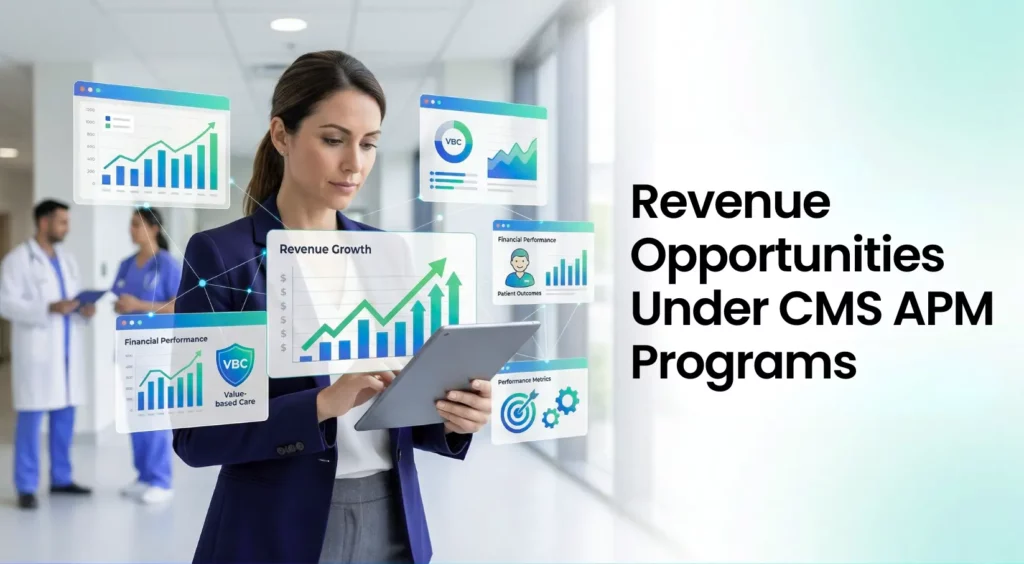
Today, healthcare organizations are dealing with a structural transformation that is changing the way revenue is earned, maintained, and grown. For decades, the fee-for-service model offered a predictable, volume-based financial system in which the rendering of more services equated to more revenue. Value-based care models are replacing that paradigm, linking financial performance to outcomes, efficiency, and the management of entire patient populations. Within that context, CMS (Centers for Medicare and Medicaid Services) Alternative Payment Models (APMs) represent more than changes in reimbursement—they signify a new operational model for the economics of healthcare.
APMs have fundamentally transformed the basis of provider revenue determination. Providers now have to account for the alignment of care delivery with specific performance metrics attributable to revenue. This presents both opportunities and challenges. On one hand, providers have a greater variety of income opportunities through the promotion of innovative, preventive, and coordinated care. On the other, the expansion of income opportunities requires the development of new systemic capabilities that most traditional systems have not been designed to support. The most successful organizations are those that view APMs not as a compliance burden but as an opportunity to develop a long-term revenue-sustaining strategy.
The Opportunity for Untapped Revenue Potential
Via the Medicare Shared Savings Program (MSSP), the ACO REACH Model, and the Bundled Payment for Care Improvement (BPCI Advanced), CMS has significantly expanded the scope of their value-based programs. These programs aim to shift the financial and qualitative responsibility to the providers while incentivizing them to improve their services. Participation in these models continues to grow, indicating alignment with CMS’s future vision for healthcare.
Merely participating does not mean that everyone is trying their hardest. Many providers launch APMs without adequate resources for care coordination, data integration, and performance tracking. As a result, they remain on the sidelines, capturing only a fraction of the available funds. Care management programs that are underutilized, insufficient risk adjustment, and sporadic performance at the quality level are all examples of missed opportunities. This sort of pattern significantly narrows the difference between the presumed financial upside of APMs and the actual experience of many companies. To address this, we must prioritize focused execution to better align technology and processes.
1. Rapid Growth in APM Participation
Provider participation in CMS Alternative Payment Models has grown a lot over the past few years, especially in programs like the Medicare Shared Savings Program (MSSP) and the ACO REACH Model. This growth is in line with a larger trend toward value-based care becoming the norm instead of the exception. To meet payer expectations and make sure their reimbursement strategies will still work in the future, health systems, physician groups, and even smaller practices are starting to use these models. But even though more people are joining, the level of skill needed to fully take advantage of these models has not grown as quickly.
2. Participation Does Not Equal Revenue Optimization
A lot of businesses think that just joining an APM will automatically make their finances better. In reality, participation gives you the chance to make money, but it doesn’t guarantee it. To get the most money out of APMs, you need to plan, carry out, and keep improving them. Providers that are compliant may meet the minimum requirements for a program, but they often don’t make enough money to be worth it. To really optimize revenue, you need to start designing workflows, care models, and financial processes that are specifically based on value-based incentives.
3. Underutilization of Care Management Programs
Chronic care management, remote patient monitoring, and behavioral health integration are all examples of care management programs that are very important for both improving clinical care and making money in APMs. Even though these programs are important, they are not used enough by all eligible patients. A lot of providers don’t have the systems and processes they need to find, enroll, and manage a lot of patients. Because of this, a large part of the steady, predictable revenue is still untapped. Companies that are able to put these programs into action can build a stable financial base that helps APM performance as a whole.
4. Gaps in Risk Adjustment
Risk adjustment is very important for figuring out how much to pay under APMs because it links payment to the complexity of the patient. But a lot of providers have trouble keeping accurate and complete records of their patients’ conditions. This causes undercoding, which leads to lower benchmarks and less money-making potential. The problem isn’t that the clinicians aren’t good at their jobs; it’s that there aren’t any structured processes or tools to get accurate data. One of the most important but underused opportunities in APMs is to improve risk adjustment practices, which can bring in a lot of money without increasing the number of patients.
5. Inconsistent Quality Performance
Quality performance is a major factor in how well APMs do financially, but many companies have trouble consistently meeting CMS standards. Preventive care measures, like yearly wellness visits and screenings, are often not done consistently because patients aren’t involved enough and care isn’t coordinated well enough. This inconsistency has a direct impact on who can get shared savings and lowers the amount of incentive payments that can be made. When quality is seen as a strategic priority instead of just a rule to follow, it can lead to better results and more money.
6. Data Fragmentation Limits Revenue Capture
One big issue with trying to max out APM revenue is all the patient data being scattered everywhere. Like, it’s in electronic health records or billing stuff and care management tools, but they don’t really connect. That makes it tough to really see what a patient’s risk level is or how they are doing overall.
Providers end up struggling a lot because of this. They have a hard time spotting who the high-risk patients are or keeping up with those quality metrics. And then taking steps before something goes wrong—yeah, that’s even harder when the data is not pulled together.
I think it not only slows down clinicians when they need to make decisions. The whole organization misses out on revenue chances too. It seems like without that full view, things just stay messy.
7. Operational Maturity is the Missing Link
First of all, there is a level of operational maturity that APMs require, and this is something that many healthcare organizations are currently working on. There is a workflow that was designed for fee-for-service, and this is not necessarily beneficial in a value-based system, where care is required to be ongoing. There is more work to be done, and there is less time to accomplish it when there is a lack of care coordination infrastructure and patient engagement strategies. There is a need to rethink how things are done, spend money on resources, and get people working together.
8. Digital Health Adoption is Still Underleveraged
Digital health solutions like telehealth and remote patient monitoring are becoming more popular, but many organizations still don’t use them in their APM strategies. These technologies make it possible to provide care outside of traditional settings, which allows for constant monitoring and early intervention. But if they aren’t put into place in a planned way, they won’t be able to fully reach their potential to improve both clinical and financial outcomes. Providers that do a good job of incorporating digital health into their care models can greatly improve scalability and open up new sources of income.
9. Revenue Requires Cross-Functional Alignment
Under APMs, making money is inherently cross-functional, so clinical, operational, and financial teams need to work together. When these functions aren’t working together, it can mean missed billing opportunities, slow workflows, and poor performance. For instance, care teams might provide great interventions, but if the documentation and billing processes aren’t right, the money that comes in might not be counted. Companies that make sure that all departments are on the same page and responsible for their work are better able to get the most out of their APM.
10. Significant Untapped Revenue Potential Exists
A lot of money is being lost by APM participants because they aren’t using all of their programs, their data is incomplete, and their operations aren’t running as smoothly as they could be. There are many ways for providers to make money, such as care management, risk adjustment, quality incentives, and shared savings. However, many providers only take advantage of a small part of their potential. This gap is a big chance for businesses that are willing to spend money on the tools they need to get the most out of APM frameworks.
11. Shift from Compliance to Strategy is required
There is a need to change the way they think in order to do well in APMs. Companies that view these programs as rules to follow only attempt to do the bare minimum, which results in them not making much money. On the other hand, companies that view these programs as opportunities for growth strategically plan these operations to ensure they get the most money out of them. This involves the use of data, workflow improvements, and constant improvements in models to match with the incentives.
12. Competitive Advantage is emerging
With the shift towards a value-based model of care, it is now apparent which organizations have mastered APM execution and which ones have not. Those organizations that were early adopters of optimized strategies are reaping better outcomes, better margins, and scalable models. This creates a wider gap that is likely to define how organizations compete over the next few years. Organizations that have invested in data-driven care, technology, and operational excellence are better positioned to lead in this new world.
Understanding the APM Revenue Model
One of the most common mistakes people make about APMs is that they think shared savings are the main way they make money. Shared savings is important, but it is only part of a larger and more complete financial system. In fact, APM actually makes money in a number of ways that are related to and work together when done well.
1. Core Payment Model
The core financial design of each CMS Alternative Payment Model is what determines how money is made, shared, and balanced. On the other hand, APMs employ a different form of payment mechanisms in comparison to the fee-for-service payment, in which the payment is usually linked to the services rendered. The Medicare Shared Savings Program (MSSP) and ACO REACH Model employ a shared savings and losses mechanism that is usually linked to the benchmark spending. Population-based payments and prospective funding are also used in the ACO REACH Model. Target pricing and retrospective reconciliation are used in the episode-based payments, including the bundled payments.
It is important to know that this main payment method is not a “layer” in a stack; it is the engine itself. All revenue opportunities in an APM are based on how well an organization does within this financial framework. Providers who don’t make sure that their care delivery and operational strategies fit with how the model works often have trouble getting good financial results, no matter how much they participate.
2. Performance Adjustment Layer
The core payment model explains how money is made, but performance adjustment factors have a big effect on the actual financial outcome. These are quality scores, attribution methods, benchmark calculations, and rules for reconciling that decide how much of the possible revenue is realized. In a lot of CMS models, quality isn’t a separate source of income; instead, it works as a multiplier or gatekeeper that directly affects who can share in savings, how much they get paid, or how much they get in the end.
This difference is important for the strategy of the business. Companies that see quality as a requirement for compliance often do worse financially, while those that make quality improvement a part of their business model can see big increases in revenue. Attribution logic, or how patients are assigned to providers, can also have a big impact on performance because it decides which population providers are responsible for. To turn theoretical revenue potential into real financial performance, you need to understand and make the most of these adjustment factors.
3. Additional Revenue from Care Management Services
Providers can make money through parallel Medicare billing streams that support value-based care strategies in addition to the main APM payment structure. Some of these are chronic care management, remote patient monitoring, behavioral health integration, transitional care management, and more recently, advanced primary care management constructs. These services aren’t always included in every APM’s payment model, but they are very important for increasing overall revenue and helping to meet care delivery goals.
These parallel streams give you a level of predictability that core APM payments may not always give you. They usually charge on a recurring or per-service basis, which means they bring in a steady stream of money that can help stabilize the company’s finances. At the same time, they fit well with APM goals because they get patients more involved; make care more proactive, and lower costs down the line. When done right, they help with both clinical and financial issues, which make value-based care more cost-effective overall.
4. Operational Drivers That Impact Financial Performance
The real keys to APM success are how well it is run, not how it is paid for or how it bills. Preventive care, care coordination, transitional management, and patient engagement are not distinct revenue streams; rather, they directly impact financial outcomes across all models. For instance, good preventive care can cut down on expensive events, which can help you do better against benchmarks. Strong transitional care processes can cut down on readmissions, which will improve both quality scores and cost-effectiveness.
Another important operational driver is how accurate risk adjustment is. It is important to fully and accurately document the complexity of each patient so that reimbursement reflects the true cost of care. Organizations may provide high-quality care but still not make enough money if they don’t have this alignment. These operational parts are where many providers either gain or lose value, which makes them a key part of any APM strategy.
5. Technology and Data Enable Revenue Growth
Providers need a strong enabling infrastructure that brings together data, workflows, and financial processes in order to work well across these layers. When this happens, it is hard to find opportunities, keep track of how things are progressing, and act before issues arise. As APM models get more complex, it is more and more crucial to have platforms that can work well together. HealthArc and similar platforms help organizations bridge this gap by integrating patient information, care management, and revenue collection into one system. These platforms make things easier for administrators by automating important tasks, such as identifying, tracking, and documenting patients. This improves outcomes for both clinical and financial success. Real-time analytics make things even better by allowing action to be taken on insights, rather than waiting for outcomes to occur.
6. The Integrated Model: From Fragmented Streams to Cohesive Economics
The APM revenue model is not just a bunch of separate parts that work together; each part affects the others. The core payment model sets the financial framework, performance adjustments shape the results, parallel revenue streams provide stability, operational drivers determine effectiveness, and enabling infrastructure supports execution. Companies that only look at these parts separately often have trouble getting the same results every time. On the other hand, companies that put them all together into a single strategy can find a lot of value in both their finances and their health.
This unified view also shows why APM can’t be successful with just small changes. It needs a coordinated change in many areas of the organization, including clinical workflows, financial management, and the use of new technology. Providers who take this all-encompassing approach are more likely to take advantage of all the revenue opportunities that CMS APM programs offer.
7. Strategic Takeaway: Designing Revenue in a Value-Based World
The move to APMs is more than just a change in how healthcare is paid for; it is a change in how revenue is planned and made in healthcare. To be successful in this environment, you need to go beyond simple models and accept the complexity of integrated financial and operational systems. Providers who know how APM economics really works can go from reacting to events to planning ahead, which will help them grow in a sustainable way.
In this case, revenue is no longer a byproduct of providing services; it is the result of careful planning, backed by data, technology, and incentives that are in line with the goals. Companies that understand and act on this will not only do well in APMs, but they will also be in charge of the next stage of healthcare change.
Operational Challenges
CMS Alternative Payment Models offer a great way for healthcare organizations to grow their revenue, but many of them have trouble turning this potential into steady financial performance. The problem is almost never that there aren’t enough opportunities. APMs offer many ways to make money, such as performance incentives, care management, and population health strategies. The problem is not in the idea, but in how it is carried out. Value-based care makes things more complicated for healthcare systems that weren’t built to handle it. These problems, which include broken data environments, workflows that don’t line up, and a lack of infrastructure for coordinating care, make it hard for providers to get all the money they can. It is very important to understand these operational limits because fixing them is often the best way to make money with APMs.
1. Fragmented Data Ecosystems Limit Visibility
One of the biggest problems with getting money through APMs is that there isn’t a single place for all the data. In a lot of healthcare organizations, patient data is spread out across billing systems, electronic health records, care management tools, and outside data sources that don’t work well together. This fragmentation makes it hard to get a full, up-to-date picture of patient groups, risk profiles, and performance metrics. Providers often can’t find high-risk patients, close care gaps in time, or keep track of quality measures correctly without this visibility. Because of this, chances to take advantage of shared savings, quality incentives, and care management programs are often missed. This is not because they are not available, but because they are not visible at the right time.
2. Legacy Workflows Designed for Fee-for-Service Models
Most healthcare organizations still operate in a workflow that was designed in a fee-for-service, volume-driven environment. This is inherently a reactive-based environment, with a focus on patient visits, procedures, and episodic fee billing. However, the new world of APMs requires a completely different workflow, with a focus on ongoing care, proactive outreach, and ongoing patient management. When the old ways are used in a value-based model, they make things less efficient and can also lead to execution issues. Care teams may not have the right processes in place to stay in touch with patients between visits, and administrative teams may struggle to ensure that billing and documentation are aligned with the requirements of a value-based model. The difference between the way the workflow is designed to work and the way the reimbursement model works can make it very difficult to access all the money available.
3. Inconsistent patient identification and enrolment processes
A significant contributor to the loss of money is the difficulty in finding patients eligible to be enrolled in care management services on a regular basis. Many service providers have difficulty determining eligibility for services like remote monitoring or care coordination. Many service providers have flawed methods to determine eligibility for services. This results in inconsistent enrolment, with a large number of eligible patients not receiving services. Once patients are identified, the enrolment process may not work smoothly or may not be the same for all patients. This can result in patients not receiving services. Organizations can’t benefit from recurring revenue opportunities in APM-aligned services if they do not have a way to identify patients eligible to be enrolled in these services.
4. Documentation and Coding Gaps Impact Financial Outcomes
Accurate documentation and coding are very important for making sure that revenue shows how complicated patient care really is. However, a lot of groups have trouble keeping up with consistent and thorough documentation practices. Clinicians might not record all pertinent conditions, or the documentation might not comply with coding standards, resulting in undercoding. This has a direct effect on risk adjustment, benchmark calculations, and levels of reimbursement. The problem is made worse by the fact that there aren’t any integrated tools or workflows that allow for real-time documentation and coding validation. As a result, even when care is given well, the financial results may not show that performance completely.
5. Limited Care Coordination Infrastructure
Care coordination is very important for APMs to work, but many organizations don’t have the resources to do it well on a large scale. In order to coordinate care among many people, you will require special resources, standardized processes, and communication tools. Without these, you may receive incomplete care, and this may cause you to miss appointments, receive duplicate care, or be hospitalized unnecessarily. These gaps may not only harm you, but they may also increase costs, and this may make it even more difficult for you to save money. They may also harm your quality score, and this may make it even more difficult for you to make money.
6. Underutilization of Billable Services and Programs
Providers often have trouble making full use of billing opportunities, even when they know about them. Care management, transitional care, and behavioral health integration are just a few examples of services that need to follow certain billing rules, workflows, and documentation. These services might not be put into place at all or might not be done consistently if the right infrastructure and training aren’t in place. This means that there are chances to make money that are missed, both on a regular basis and in small amounts. The challenge is not just knowing about these programs, but also being able to use them effectively in the current care delivery models.
7. Misalignment between Clinical, Operational, and Financial Teams
For APM to work, clinical, operational, and financial functions need to be closely aligned. However, many businesses work in silos. The care teams may care how well a patient is doing, but they may not care how much it costs; the financial teams may not understand how care is delivered. This can create a situation that causes lost billing opportunities, inefficient workflows, and poor performance in APM measures. Good intentions are only good business when implemented in a collaborative manner. To get these functions working together, all members of the entire organization need to have the same goals and understand who is responsible for what and have access to the same information.
8. Administrative Burden and Workforce Constraints
When care becomes value-based, there are more administrative tasks to do, such as documenting, reporting, and making sure rules are followed. These tasks are added to the already full plates of many organizations, putting a lot of stress on their employees. Shortages of workers make this problem even worse, making it harder to effectively manage care coordination, reach out to patients, and analyze data. A lot of administrative work not only makes things less efficient, but it also raises the chances of making mistakes and missing chances. Without automation and streamlined processes, businesses may not be able to keep up the level of effort needed to do well in APMs.
9. Lack of Real-Time Performance Monitoring and Feedback Loops
In a value-based environment, timely information is critical to improve performance. However, a significant number of providers rely on reports, which do not provide them with much leverage to make any changes to the results. It is not possible for the organization to identify gaps in the plans and make the necessary changes or even act in advance of problems arising if the necessary monitoring is not in place. A reactive approach is the end result of the absence of timely feedback in the performance management process. This means that opportunities are only recognized when they have been missed. It is necessary to have feedback loops in place in order to achieve clinical and financial performance.
10. Technology Gaps and Limited Integration Capabilities
Technology is a big part of what makes APM work, but many companies have problems with their current systems. Older platforms might not have the features needed to support patient engagement, care coordination, or advanced analytics. Integration problems can also stop data from moving smoothly between systems, which can lead to inefficiencies and missing information. These limitations on technology make it harder to grow the business and bring in money. Companies that buy modern, integrated solutions are better able to get past these problems and make the most of APMs.
11. Change Management and Cultural Resistance
However, in order to adopt a value-based care system, not just the process and technology need to be changed; the culture also has to be altered. There are many physicians who are accustomed to fee-for-service and may not want to change their process and their rewards and their performance measures. It can take a little longer for new ideas to catch on and be less ineffective if such work is not done. Organizations that are good at this recognize how critical change management is. They spend money on training and getting all levels of leadership to understand and agree on how change management will be implemented so that teams understand and support a new value-based care system.
12. Strategic Takeaway: Execution Determines Revenue Realization
In the end, the problems that keep APM from making money aren’t because of the models themselves but because people can’t use them correctly. There are a lot of ways to make money, but they all need to be done in a coordinated, data-driven, and tech-enabled way. Companies that deal with these operational problems can go from partial participation to full optimization, turning APMs into a real way to make more money. Those who don’t may keep seeing the gap between what they could do and what they actually do, which means they aren’t getting all the value out of it.
How Integrated Platforms Scale APM Revenue?
As healthcare organizations move further into CMS Alternative Payment Models, the focus has shifted from finding new ways to make money to making sure they can scale them up quickly and reliably. Even though APM frameworks offer many ways for businesses to make money, most of them find it hard to put these into action at the enterprise level. Providers’ ability to scale revenue depends on how well they can bring together data, workflows, care delivery, and financial processes into one system. Even the best-planned strategies won’t have much of an effect if they aren’t in line with each other.
1.Unified Data and Real-Time Visibility
To start making more money, you need to be able to see the whole picture. Providers can’t find high-risk patients, keep track of performance, or act in time when data environments are broken up. A unified data layer combines clinical, financial, and operational data into one view, which lets you see things in real time. With this level of visibility, organizations can go from reactive reporting to proactive intervention, making sure that they always take advantage of chances to improve quality, manage care, and cut costs.
2. Standardized Workflows for Consistent Execution
Execution consistency across different patient populations is a vital factor in the revenue generated by the APMs. It has become a challenge to scale processes such as patient identification, enrollment, coordination, and follow-up without the integration of the necessary tools. Integrated tools provide the ability to develop structured and consistent processes that ensure every eligible patient is engaged, every care need is met, and every service has the potential to become a revenue stream.
3. Automation to Drive Efficiency and Margin Expansion
One of the biggest problems with scaling value-based care programs is that they are too much work for administrators. Automation cuts down on the need for manual work in important areas like reaching out to patients, keeping records, and making reports. Companies can grow their programs without spending a lot more money on operations by making these processes more efficient. This gives you operating leverage, which means that revenue grows faster than costs, which directly improves margins in APM models.
4. Care Coordination and Patient Engagement at Scale
Good care coordination is important for both clinical outcomes and financial performance. To make this capability work on a larger scale, providers, care teams, and patients all need to be able to talk to each other without any problems. Integrated platforms make it possible to keep patients involved all the time by reaching out to them, monitoring them from afar, and coordinating interventions. This closes gaps in care, stops unnecessary use, and raises quality scores, all of which help APMs make more money.
5. Integrated Revenue Capture and Continuous Optimization
In APMs, making money isn’t just about providing care; it’s also about making sure that every service is properly documented, meets billing requirements, and is optimized for performance. Integrated systems make it easier to collect money by including it in clinical workflows. This cuts down on leakage and makes sure that reimbursements are correct. At the same time, real-time analytics let providers keep an eye on things and make changes to their strategies as needed to get the best financial results.
To achieve this scalability in revenue generation through the CMS APM program, we need to change from a series of efforts to a system-driven and integrated approach. Businesses that can achieve this integration of data, workflows, and care can change value-based care from a compliance obligation to a growth opportunity. HealthArc and other platforms like these are extremely important to this change process since they can provide businesses with everything they need to integrate all their efforts and continue to improve their performance. HealthArc is extremely important to revenue generation since it can help providers maximize their revenue through APMs and improve patient outcomes by making revenue generation a part of care delivery and making it scalable.
Conclusion
The shift to CMS Alternative Payment Models is not simply about changing the payment structure; it is about fundamentally changing the definition of how healthcare organizations think about the design, delivery, and scaling of revenue. As has been discussed throughout this conversation, the opportunity is enormous, but achieving the opportunity is about far more than participation.
If healthcare organizations continue to think about the Alternative Payment Models in the same way they think about compliance, they will continue to be sub-optimized, achieving only a fraction of the opportunity. If they are able to think about the opportunity in the way that the future of healthcare is designed—holistically, at the system level, integrating care management, risk adjustment, quality performance, and digital health—the future is bright in terms of achieving scalable revenue growth.
The future of healthcare economics is defined by those who are able to create cohesive, intelligent systems out of fragmented processes. This is a future where revenue is no longer simply the outcome of the system; it is designed, optimized, and directly related to patient outcomes and operational performance.
With HealthArc, healthcare providers are able to operationalize value-based care through unification, automation, and scaling care management programs. With solutions ranging from remote patient monitoring and chronic care management to real-time analytics and revenue optimization, HealthArc closes the gap between clinical performance and financial achievement.
Are you interested in moving beyond participation and really capitalizing on your APM revenue potential? Now is the time to take an integrated and technology-driven approach.
Explore how HealthArc can help you design, capture, and scale revenue in value-based care.

Sudeep Bath
Sales & Tech Leader with 22+ years of experience Former SVP for $37B PE portfolio company Advisor and Board member in number of startups


Categories
Advanced Primary Care Management→AI & Care Coordination→Behavioral Health Integration→Care Management Programs→Chronic Care Management→Digital Health & Software Solutions→General Remote Care Topics→Medication Therapy Management→Pricing & Business Strategy→Principal Care Management→Remote Patient Monitoring→Remote Therapeutic Monitoring→Transitional Care Management→
Related Blog
- January 22, 2026 | Read Time: 13 mins
What are Capitation Payments? What is the Difference Between Capitation and Fee-For-Service?
Capitation payments will be one of the most important ways to pay...
Learn More- July 8, 2025 | Read Time: 9 mins
Remote Patient Monitoring (RPM) Pricing Structure and Models for Healthcare Providers
Remote Patient Monitoring (RPM) has emerged as an important part of value-based...
Learn More- March 4, 2025 | Read Time: 10 mins
Infrastructure Frameworks for Effective Remote Patient Monitoring (RPM)
Did you know that 74% of healthcare providers struggle with RPM implementation...
Learn More