
dddddd
By Sudeep Bath
| December 17, 2025
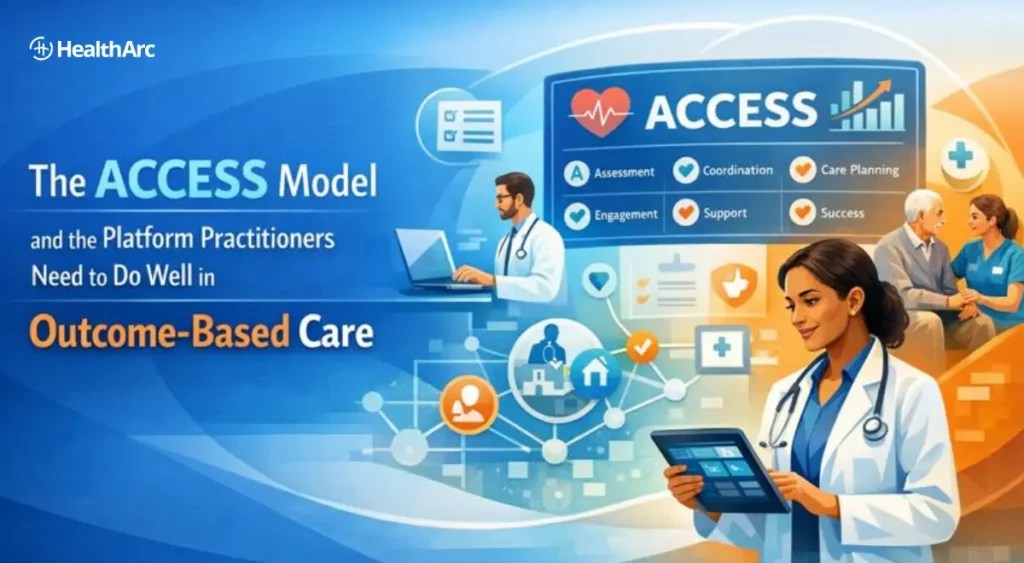
The change from volume-based healthcare to outcome-based care is no longer on the way; it is already happening. The federal government has made its long-term plan obvious with the launch of the CMS ACCESS Model (Advancing Chronic Care with Effective, Scalable Solutions). Chronic care will increasingly be paid for based on measurable patient improvement, long-term engagement, and real-world results. For doctors, especially those who treat complicated chronic and behavioral conditions, this change is both a big chance and a big change in how they do business. Under ACCESS, a practice’s success will not be based on the number of visits or procedures but on its ability to continuously manage, engage, measure, and improve patient outcomes over time.
What the ACCESS Model Changes About Chronic Care
The ACCESS Model makes structural changes to chronic care. In traditional fee-for-service systems, doctors are mostly paid for visits, procedures, and short-term services. ACCESS disrupts this norm by associating payment with long-term patient outcomes. The model doesn’t reward single instances of care; instead, it focuses on long-term improvements in chronic disease management, behavioral health, therapy-based recovery, and functional performance.
This change makes care delivery a continuous duty instead of a series of separate visits. Doctors are now responsible for more than just what happens during the exam. They are also responsible for how well patients follow treatment plans, whether remote monitoring shows improvement, how mental and behavioral conditions affect compliance, and whether progress is maintained over months instead of days. ACCESS basically sets the stage for a future where chronic care success is based on consistency, engagement, and measurable improvement instead of episodic intervention.
Why Outcome-Based Care Fundamentally Changes the Physician’s Role
Outcome-based reimbursement changes the doctor’s job from making decisions based on each visit to coordinating long-term care. With ACCESS, the risk of poor performance moves directly to the practice level. Patients who don’t follow through with therapy, don’t follow up, and have poorly coordinated care are no longer just a clinical risk; they are also a financial risk.
Most of the time, events outside of the clinic shape ACCESS outcomes. Most progress happens at home for patients, through remote monitoring, therapy, lifestyle changes, taking medications as prescribed, and maintaining behavioral health stability. This means that doctors need to be responsible for care ecosystems that go beyond the usual clinical settings. The practice needs to be a place where people can always interact, not just a place to go for appointments. This makes care more predictive and preventive than reactive and episodic.
The Need for Continuous Monitoring Beyond the Clinic
ACCESS makes it possible to see patients all the time. For outcome-based care to work, we need to know how patients are doing in between visits. This includes being able to see physiological metrics like blood pressure, glucose levels, and oxygen saturation, but it goes far beyond just vital signs. Therapy adherence, pain trajectories, mobility enhancement, endurance, respiratory recovery, and functional performance emerge as outcome determinants that necessitate longitudinal measurement.
Behavioral and mental health metrics are just as important. Patients often don’t follow their medical and therapy plans because of depression, anxiety, lack of motivation, and cognitive decline. Without constant access to both physical and behavioral signals, things become worse without anyone noticing. When this happens, help comes too late, performance drops, and it’s impossible to hold people accountable for results under value-based models like ACCESS.
Why Structured Patient Engagement Becomes a Core Performance Engine
Patient engagement is no longer a secondary priority under ACCESS; it is now one of the most important factors in determining outcomes and getting paid. Engagement needs to be planned, tailored, and ongoing. Casual outreach and manual follow-ups cannot help with outcome accountability on a large scale.
Modern outcome-based care needs automated engagement pathways that help patients with their daily and weekly interactions. These pathways include reminders for therapy, prompts for medication, educational reinforcement, behavioral health check-ins, feedback on progress, and escalation workflows for when patients stop engaging. Engagement is now a quantifiable part of running a business, not just talking. When engagement drops, results get worse. When engagement grows, progress speeds up. ACCESS connects this relationship directly to financial stability.
Outcomes-Based Documentation as a Strategic Asset
When you do outcome-based care, documentation goes from being a way to follow the rules to being a way to improve performance. Practices must show that patients are getting better over time with ACCESS. This means setting baseline condition states, keeping track of progress over time, recording interventions as they happen, and making sure that outcomes stay stable over time.
Longitudinal outcomes reporting is crucial, both at the individual patient level and across entire populations. Doctors need to know which groups of patients are getting better, which treatments lead to the most functional improvements, where engagement drops off, and which treatments lead to long-lasting results. Manual documentation processes cannot support this level of intelligence. Without automated outcome analytics, performance risk remains undetected until penalties for non-payment materialize.
Interdisciplinary Care Coordination as a Requirement for Success
Chronic care usually requires multiple clinical perspectives. Diabetes is related to behavioral health, pain management is related to physical therapy, respiratory disease is related to mental health, and emotional stability and social conditions have a direct effect on how well people stick to their medications. ACCESS makes it even more important for doctors, therapists, behavioral health providers, care managers, and support teams to work together smoothly across disciplines.
For outcome-based success, all disciplines need to be able to see the same patients, have the same care plans, keep the same records, and work together in real time. When systems remain fragmented, care execution deviates, accountability falters, and the quality of outcome measures deteriorates. ACCESS does not allow care delivery to be done in separate groups. It needs full synchronization for care orchestration.
Financial Sustainability under Outcome-Based Reimbursement
Outcome-based care changes the way doctors make money. Revenue is tied to engagement, clinical performance, documentation reliability, and consistent good results. This means that there are both chances for growth and changes in the economy. Practices need to be able to keep track of their care workload, figure out how much they will be paid based on performance-based risk, automate compliance documentation, and manage cost structures that are in line with long-term outcome accountability.
Even the best clinical teams can lose money if they don’t have a financial system that connects operational execution with outcome-based reimbursement. ACCESS requires practices to integrate clinical and financial data in a manner not possible with traditional billing systems.
Why Traditional EHRs and Disconnected Tools Fail Under ACCESS
Most EHR platforms were made to keep track of visits, bill for them, and handle workflows based on encounters. They weren’t made to keep patients engaged all the time, track therapy adherence, integrate behavioral health, or do real-time outcomes analytics. Disconnected RPM, CCM, behavioral health, and therapy tools further divide the care environment into silos, necessitating constant manual reconciliation.
This fragmentation creates gaps in data, problems with engagement, delays in interventions, team burnout, and unreliable performance reporting. With ACCESS, these kinds of disconnected environments become too expensive and difficult to run. For outcome-based care to work, workflows need to be integrated, not just pieced together.
The Platform Physicians Need to Succeed Under ACCESS
For doctors to do well under the ACCESS Model, they need a single outcome-based care platform that works as the operating system for modern chronic care. This platform needs to manage enrollment, monitoring, engagement, therapy execution, behavioral health integration, documentation, analytics, and reimbursement alignment all in one place.
The platform needs to automate patient engagement journeys, respond to risk signals in real time, customize care pathways based on the patient’s condition, and constantly link engagement activity to clinical improvement. Doctors need to be able to see how well they’re doing in real time for both individuals and groups so that care can be proactive instead of reactive. The platform must also support outcome-aligned revenue enablement through audit-ready documentation, reimbursement modeling, and financial optimization under value-based risk.
Behavioral health integration needs to be a basic part of this platform. Mental and emotional health have a direct effect on adherence, motivation, recovery, and engagement reliability. Without deep behavioral integration, physical health outcomes consistently decline over time. ACCESS clearly understands this fact.
ACCESS as the Catalyst for Platform-Led Physician Practices
The ACCESS Model is a driving force behind the next generation of medical practices. In the future, practices that use platforms and have continuous engagement, real-time intelligence, predictive intervention models, interdisciplinary orchestration, and financial structures that are aligned with outcomes will do better. Outcome-based reimbursement will put practices that continue to rely on manual workflows, disconnected tools, and visit-based economics at greater risk.
Practices that use platforms become more scalable, more consistent in their clinical work, better at keeping patients, more reliable in their performance, and more economically stable in the long run. ACCESS doesn’t just reward hard work; it also rewards how well a system is designed.
Why Physicians Must Prepare for ACCESS Now
Even though ACCESS participation officially starts in 2026, the changes that need to be made for success can’t be made on the fly. Choosing a platform, redesigning workflows, training staff, moving patients, setting baseline outcomes, deploying engagement infrastructure, and modeling finances all require a phased approach. Practices that delay implementing transformation within unstable timelines may experience early performance losses.
Early adopters get more operational runway, more mature data, a more prepared team, a unique place in the market, and stronger patient loyalty before the pressure to get results increases. With ACCESS, being ready gives you a competitive edge.
Conclusion: Outcome-Based Care Is an Infrastructure Challenge
The ACCESS Model makes one thing clear: outcome-based care works or doesn’t work at the infrastructure level. Physicians do not fail under outcome-based systems because they lack clinical skill. They fail because their operational systems can’t handle large-scale continuous engagement, real-time intelligence, interdisciplinary coordination, behavioral integration, and financial alignment.
Physician practices that are digitally orchestrated, platform-powered, behaviorally integrated, and economically optimized for outcomes will be the future of chronic care. ACCESS just speeds up this future.

Sudeep Bath
Sales & Tech Leader with 22+ years of experience Former SVP for $37B PE portfolio company Advisor and Board member in number of startups


Categories
Advanced Primary Care Management→AI & Care Coordination→Behavioral Health Integration→Care Management Programs→Chronic Care Management→Digital Health & Software Solutions→General Remote Care Topics→Medication Therapy Management→Pricing & Business Strategy→Principal Care Management→Remote Patient Monitoring→Remote Therapeutic Monitoring→Transitional Care Management→
Related Blog
- January 14, 2026 | Read Time: 12 mins
What Is a Care Manager? Roles and Responsibilities
A care manager is a dedicated healthcare professional who helps patients navigate...
Learn More- July 12, 2025 | Read Time: 11 mins
How Remote Monitoring & AI Are Tackling Burnouts in Small Practices?
Approximately half of U.S. physicians experience symptoms of burnout, including exhaustion, cynicism,...
Learn More- June 21, 2025 | Read Time: 8 mins
Chronic Care Management Trends 2025: CMS Updates, AI Tools & RPM Integration
While healthcare delivery has become more accessible, chronic conditions continue to impact...
Learn More