
By Jack Whittaker
| April 28, 2026
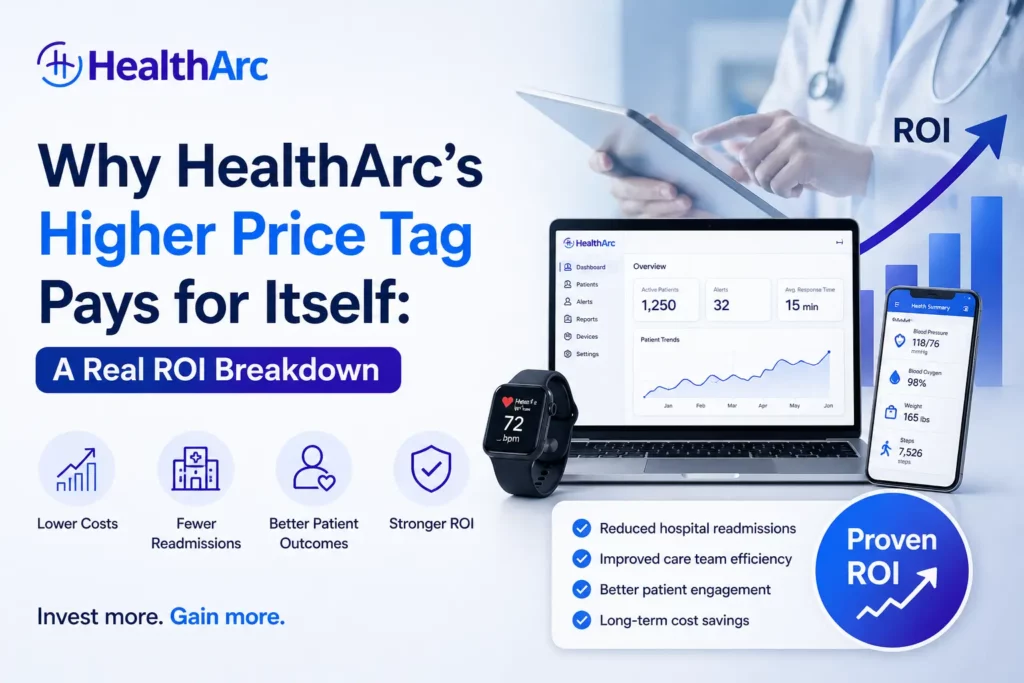
When a practice manager sits down to compare RPM and CCM platforms, the line item that jumps out first is the monthly per-patient fee. A cheaper tool at $15–$20 per patient looks attractive on a spreadsheet. HealthArc’s integrated platform costs more. That conversation ends there for a lot of buyers, and it is the wrong place to end it.
The real question is not what the platform costs. It is what the platform earns.
A point solution that handles only device data collection leaves billing automation, care coordination, and patient engagement to other tools, other staff, or nobody at all. Each gap is a revenue leak. When you add those leaks together across a patient panel of 100, 200, or 500 chronic patients, the “cheaper” option frequently generates less net revenue than a fully integrated platform, even after accounting for the higher monthly fee.
This article breaks down the math. It shows, using real Medicare reimbursement rates and published clinical data, why HealthArc’s pricing reflects a deliberate architecture designed to maximize billable time, close compliance gaps, and automate the administrative work that most practices leave on the table.
Key takeaway: RPM programs built on integrated platforms with cellular devices, automated billing, and built-in care coordination generate 3x–5x returns on technology investment. Programs built on software-only point solutions routinely underperform because engagement and billing compliance fall through the cracks.
The Revenue Stack Most Practices Are Not Capturing
The starting point for any honest ROI comparison is understanding how much revenue a well-run RPM and CCM program can generate per patient. The numbers are significant, and most practices are not capturing all of them.
Medicare reimbursement for a single patient enrolled in both RPM and CCM, managed with at least 20 minutes of care coordination per month, looks like this:
| CPT Code | Service | Monthly Reimbursement |
|---|---|---|
| 99454 | RPM device supply + data collection (16+ days) | ~$43 |
| 99457 | RPM clinical time, first 20 min | ~$48 |
| 99458 | RPM clinical time, additional 20 min | ~$38 |
| 99490 | CCM, first 20 min | ~$60 |
| 99439 | CCM, additional 20 min | ~$46 |
| 99453 | RPM setup (one-time) | ~$20 |
A patient enrolled in both RPM and CCM, with the provider billing the base codes (99454, 99457, 99490), generates approximately $150 per month in Medicare reimbursement. Over 12 months, that is $1,800 per patient. A practice managing 200 such patients is looking at $360,000 in annual revenue from this program alone, before factoring in the downstream evaluation and management visits that enrolled patients generate at a rate of 6–12 per year compared to 2–3 for unmanaged chronic patients.
The problem: capturing this revenue consistently requires meeting specific compliance thresholds every month. For RPM billing, the patient must transmit device data on at least 16 days. For CCM, at least 20 minutes of documented care coordination must occur. Miss either threshold and the month is unbillable.
Why Compliance Thresholds Kill Revenue on Point Solutions
Software-only platforms that rely on patients to manually pair Bluetooth devices or remember to take readings create an inherent compliance gap. Industry data shows that patient compliance in RPM programs averages around 55% when using non-cellular devices, according to research from NYU Langone Health’s Cardiology Division published in PMC. At 55% compliance, a meaningful portion of enrolled patients fail to hit the 16-day threshold, making their month unbillable.
Cellular devices change the equation. They transmit automatically without patient action. HealthArc’s platform ships cellular-enabled devices as part of its device-as-a-service model, which means readings go through regardless of whether the patient remembers to sync an app. That single architectural difference can move compliance from 55% toward 80–90%, which directly translates to a higher percentage of enrolled patients generating billable months.
The financial impact of that compliance gap is not trivial. For a 200-patient panel at $150/month, the difference between 55% and 85% compliance is $108,000 in annual revenue.
The True Cost Comparison: Integrated Platform vs. Point Solution
The “cheaper platform” argument collapses when you account for everything a point solution does not include. Here is what practices typically need to build a functional RPM program on top of a software-only tool:
- Cellular or Bluetooth devices (procured separately, often $50–$150 per device upfront, plus logistics)
- Device logistics and replacement management (shipping, returns, lost device tracking)
- Billing staff or a separate billing service to handle CPT code submission, claim scrubbing, and denial management
- Care coordinator time to manually document CCM minutes and ensure 16-day thresholds are met
- EHR integration work (often a custom project, not included in base pricing)
- Patient support for device setup, troubleshooting, and engagement
When those costs are assembled honestly, the total cost of ownership for a point solution frequently exceeds HealthArc’s all-in pricing. The difference is that HealthArc’s costs are transparent and predictable. The point solution’s costs are hidden, variable, and often discovered only after the program has launched and revenue is underperforming.
Side-by-Side: 100-Patient RPM Program Over 12 Months
| Cost/Revenue Factor | Point Solution (Software Only) | HealthArc (Integrated Platform) |
|---|---|---|
| Platform fee (per patient/month) | $15–$20 | Higher (all-in) |
| Device procurement | $50–$150/device (separate) | Included (DaaS model) |
| Device logistics | Staff time + shipping costs | Included |
| Billing automation | Manual or separate service | Included |
| EHR integration | Custom project cost | Included (FHIR/HL7) |
| Patient compliance rate | ~55% (Bluetooth/manual) | ~80–90% (cellular auto-transmit) |
| Billable months per patient/year | ~6.6 | ~9.6–10.8 |
| Annual revenue (100 patients @ $150/mo) | ~$99,000 | ~$144,000–$162,000 |
The revenue gap in the table above, $45,000–$63,000 annually for just 100 patients, more than covers the difference in platform pricing. At 200 patients, that gap doubles. At 500 patients, it becomes a seven-figure difference in net revenue per year.
This is why the question “what does HealthArc cost?” is the wrong frame. The right question is: “What does HealthArc generate, net of its fee?” For most practices, the answer is substantially more than a cheaper alternative, because the integrated architecture removes the compliance and billing friction that silently drains revenue from point-solution programs.
For a deeper look at how different RPM program models affect profitability, HealthArc’s guide on choosing the most profitable RPM program model breaks down the trade-offs across staffing, technology, and billing structures.
ROI in Practice: What Integrated Programs Actually Deliver
Abstract comparisons are useful. Real program outcomes are more persuasive. The following scenarios are drawn from published clinical and financial data on RPM and CCM programs operating at scale.
Case Study: Primary Care Practice, 200 Chronic Patients (Hypertension + Diabetes)
Consider a primary care group with 200 Medicare patients managing hypertension and diabetes. These patients qualify for both RPM (blood pressure monitors, glucose meters) and CCM. Under a point-solution model, the practice uses a Bluetooth-dependent app, bills manually, and achieves roughly 55% monthly compliance.
Year 1 outcomes under a point solution:
- Billable patient-months: 1,320 (200 patients x 55% compliance x 12 months)
- Revenue at $150/month: $198,000
- Less device costs ($100/device x 200): $20,000
- Less billing staff (0.5 FTE at $50k): $25,000
- Net revenue: ~$153,000
Year 1 outcomes under HealthArc’s integrated platform:
- Billable patient-months: 2,040 (200 patients x 85% compliance x 12 months)
- Revenue at $150/month: $306,000
- Platform fee included; no separate device or billing costs
- Net revenue: ~$240,000–$260,000 (after all-in platform fees)
The net revenue difference in year one exceeds $85,000. In year two, with no device procurement costs and an established patient base, the gap widens further because HealthArc’s AI-powered risk scoring and automated alerts help care coordinators manage more patients per FTE, reducing the labor cost per billable patient as the program scales.
Case Study: ACO Managing CHF Patients Post-Discharge
For health systems operating under value-based contracts, the ROI calculation shifts from reimbursement revenue to avoided costs. A single hospital readmission for congestive heart failure carries a net cost to the health system that can exceed $10,000 after accounting for CMS readmission penalties.
An ACO monitoring 500 CHF patients with an integrated RPM platform that includes transitional care management (TCM) workflows reported the following outcomes in published data:
- Readmission reduction: 48% fewer 30-day readmissions
- Avoided readmission costs: $1.2 million annually
- Additional reimbursement revenue (RPM + TCM codes): $750,000
- Combined annual ROI: over $2 million
The TCM component is critical here. CPT codes 99495 and 99496 reimburse providers $180–$250 per care transition, and effective TCM requires structured post-discharge workflows, automated outreach, and real-time vital sign monitoring in the 7–30 days after discharge. Those are capabilities baked into HealthArc’s platform. They are add-ons, workarounds, or simply absent in point solutions.
HealthArc’s complete guide to transitional care management covers the documentation and billing requirements in detail.
The Downstream Revenue Effect
One factor that rarely appears in platform comparison spreadsheets is the increase in evaluation and management (E&M) visits generated by enrolled patients. Chronic patients in active RPM and CCM programs are seen 6–12 times per year by their provider, compared to 2–3 times for unmanaged patients. Each additional E&M visit generates $60–$130 in reimbursement.
For a 200-patient panel, that represents an additional 600–1,800 E&M visits annually, worth $36,000–$234,000 in incremental revenue. This downstream effect is a direct result of higher patient engagement, which is driven by the quality of the monitoring experience. Cellular devices that work automatically, a mobile app that keeps patients connected, and automated alerts that prompt timely check-ins all contribute to the engagement rate. These are features of an integrated platform, not a software-only tool.
The compounding effect: In year one, HealthArc’s platform generates more revenue than a point solution. In year two and beyond, the combination of higher engagement, automated billing, and expanded program capacity (more patients per care coordinator) means the gap grows, not shrinks.
Where HealthArc’s Architecture Creates Value That Pricing Tables Miss
Revenue per patient and compliance rates are the most quantifiable advantages. But HealthArc’s platform includes several capabilities that create value in ways that do not show up in a simple cost-per-patient comparison.
AI-Powered Risk Scoring and Automated Workflows
HealthArc’s AI workflows automatically flag high-risk patients based on their transmitted vital data, generating risk scores that help care coordinators prioritize outreach. This matters financially because it allows a single care coordinator to manage a larger patient panel without missing the patients who are approaching a clinical threshold.
In a manual or semi-automated program, a coordinator reviewing 200 patients’ data each day must triage by memory or basic alerts. Missed interventions lead to missed billing opportunities (the patient deteriorates, misses readings, and falls below the 16-day threshold) and, more seriously, to avoidable hospitalizations that trigger CMS readmission penalties.
The staffing math: A practice with 200 RPM patients and a manual workflow typically needs 1–1.5 FTEs dedicated to the program. With HealthArc’s automated risk scoring and care coordination tools, the same panel can often be managed by 0.5–1 FTE, reducing labor costs by $25,000–$50,000 annually while maintaining or improving billing compliance.
Billing Automation and Denial Prevention
RPM and CCM billing is not simple. Claims require accurate documentation of time, device data transmission records, care plan documentation, and proper CPT code sequencing. Billing errors and denials are common in manually managed programs, and each denied claim costs the practice both the revenue and the administrative time to resubmit.
HealthArc’s platform automates the documentation workflow, tracking billable minutes in real time, confirming device transmission thresholds, and generating the records needed for clean claim submission. According to CMS data on RPM reimbursement, RPM claims volumes grew 29% from 2022 to 2023, meaning payer scrutiny of these claims is increasing alongside volume. A platform that produces clean, compliant documentation from the start is a compliance asset, not just a convenience.
EHR Integration: The Hidden Cost of Fragmentation
Most point solutions do not include native EHR integration. That means care coordinators must manually enter data into the practice’s EHR, or the RPM data lives in a silo disconnected from the patient’s clinical record. Both outcomes create problems: manual entry consumes staff time, and siloed data means clinicians making care decisions do not have the full picture.
HealthArc supports FHIR, HL7, and DICOM standards and integrates with major EHR systems including athenahealth, which it joined as a marketplace partner. That integration eliminates double documentation, reduces the risk of data entry errors, and ensures that RPM and CCM data is visible in the clinical workflow where it informs care decisions.
For practices already using athenahealth, the HealthArc-athenahealth integration removes one of the most common barriers to program adoption: the fear that a new platform will create more work, not less.
HIPAA Compliance and SOC 2 Certification
Compliance infrastructure is another cost that point solutions often leave to the practice. HealthArc is HIPAA-compliant and SOC 2 certified, meaning the platform has undergone independent verification of its security controls. For practices that have faced audits or operate in high-scrutiny environments, the cost of building and maintaining equivalent compliance documentation independently is substantial.
This is not a revenue-generating feature. It is a cost-avoidance feature. A single HIPAA breach investigation or CMS audit can cost a practice far more than years of platform fees.
The Right Way to Evaluate RPM Platform Pricing
The practices that build the most profitable RPM and CCM programs share a common approach to platform selection: they evaluate total program economics, not line-item fees. They ask what the platform will generate, not just what it will cost.
When that lens is applied, the math consistently favors integrated platforms over point solutions, because the revenue gaps created by compliance failures, billing errors, and fragmented workflows are larger than the price premium of a full-service platform. The break-even period for HealthArc’s platform, relative to a cheaper alternative, is typically measured in months, not years. The compounding revenue advantage after break-even is the real story.
For providers ready to run the numbers on their own patient panel, HealthArc’s team can build a custom ROI projection based on panel size, chronic condition mix, and current billing performance. The analysis takes the conversation from abstract pricing comparisons to a concrete picture of what a well-run integrated program would generate for your specific practice.
The question is not whether you can afford HealthArc. It is whether you can afford to leave the revenue gap on the table.
To learn more about how HealthArc’s integrated RPM and CCM platform works, or to get a custom ROI analysis for your practice, visit healtharc.io or speak with a specialist today.

Ready to connect care between visits?
See how HealthArc runs RPM, CCM and seven more CMS programs — the platform, the devices and the clinical team — on a single demo.