
By Sudeep Bath
| April 23, 2026
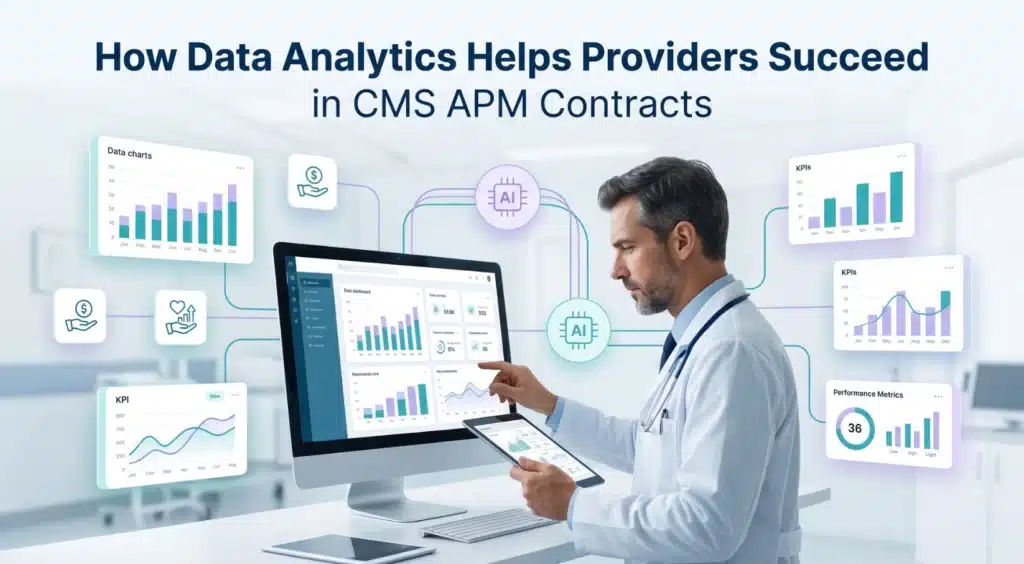
Today’s healthcare reimbursement model adopted by clinicians and providers have gone through a dramatic change, with being replaced by value-based reimbursement programs and Alternative Payment Models (APMs) compared to previous model of fee-for-service reimbursement. The newer model reimburses providers for quality outcomes, cost-effective care, and better patient experience.
The change from volume to value is not just a theory and is being accomplished in a number of ways. The Centers for Medicare and Medicaid Services (CMS) has set an ambitious target to have 100% of traditional Medicare beneficiaries linked with an Accountable Care Organization (ACO) by 2030.
For healthcare providers and organizations, this means that in order to achieve success in CMS Alternative Payment Model contracts, they must demonstrate their performance using population health management, cost containment, and improved outcomes. The ability to use data analytics and digital health technologies plays a critical role in achieving these goals.
Providers can utilize an advanced analytics platform to track their quality metrics, pinpoint high risk patients, enhance care collaboration, and forecast their financial results across contracts. Healthcare analytics are becoming increasingly important in managing cost-effectiveness while improving outcomes for patients and establishing a sustainable system of delivering value-based care.
This blog explains how data analytics impact success for providers under the CMS Alternative Payment Model Program, what analytics capabilities providers require, and how platforms such as HealthArc can help providers excel in today’s value-based health care environment.
What are Alternative Payment Models?
Alternative Payment Models or APMs are defined by CMS as reimbursement systems used to change the way healthcare is reimbursed, from volume to value based. APMs do not reimburse providers for every test or procedure; instead provides financial incentives to:
- Provide better outcomes for patients
- Decrease unnecessary costs
- Improve coordination of care
- Reduce hospitalizations
CMS created APM Models using the CMS Innovation Center to develop and test new ways to reimburse provider organizations for different segments of Medicare, Medicaid & other payer programs.
The Role of Data Analytics in Achieving APM Success
Providers must have access to detailed and accurate data before signing on to APM contracts, as the success of these contracts will be based on relevant performance measures, financial metrics, and the health of patients.
- Monitoring Quality and Performance
Performance can be evaluated by various quality metrics defined by CMS under APM programs:
-
- Compliance with preventive care
- Management of chronic illnesses
- Scoring of the patient experience
- Hospital readmission statistics
Analytics allows providers to continually monitor their quality performance against predetermined benchmarks and identify areas in need of improvement.
- Identifying High Risk Patients
Analytics has an additional and powerful ability to stratify risk among patient population. As such, analytics tools can use data derived from multiple sources, including:
-
- Electronic Health Records
- Remote Patient Monitoring devices
- Social Determinants of Health (SDoH)
By using this type of information, providers can identify those patients at highest risk of complications (i.e., readmission to the hospital or increased cost of care) to improve patient outcomes and ultimately lower overall costs, which are two important characteristics necessary for the success of APM contracts.
- Utilizing Predictive Analytics to Reduce Healthcare Costs
The financial performance of CMS Alternative Payment Model (APM) contracts primarily depends on the total cost of care for population-based or episode-based patients. Predictive analytics can assist organizations in:
-
- Forecasting patient utilization
- Predicting hospital readmissions
- Identifying unnecessary services
- Optimizing resource allocation
When providers utilize predictive insights, they can manage high-cost complications through early intervention and improve financial performance under at-risk sharing arrangements.
- Improving Care Coordination Among Multiple Care Providers
The primary driver of healthcare costs is the fragmented delivery of care. Analytics tools provide the ability to assess a patient’s response across the continuum of care, including:
-
- Primary care providers
- Specialty care providers
- Hospital facility
- Post-acute care providers
- Home healthcare providers
By identifying breaks in coordination of care, healthcare organizations can reduce unnecessary services, enhance patient outcomes, and improve seamless transition of care.
Remote Patient Monitoring’s Impact on APM Analytics
Remote Patient Monitoring (RPM) is one of the fastest growing healthcare services, assisting healthcare providers with the capability to monitor a patient’s physiological status in real-time (e.g., blood pressure, blood glucose, oxygen saturation, heart rate, and weight). The continuous flow of RPM data permits an understanding of a patient’s clinical condition at times when they are not under traditional supervision.
Through the integration of RPM data with analytics solutions, HealthArc helps providers recognize early signs of deterioration to avoid emergency hospitalizations, such as:
- High blood pressure readings can signal possible complications from hypertension
- Rapid weight gain in patients experiencing heart failure indicates fluid retention
- Decrease in oxygen levels can be a sign of respiratory distress
By identifying these signs early, care teams can proactively take action rather than responding reactively.
Benefits of Data Analytics in CMS APM Contracts
The benefits of data analytics for CMS APM Contracts are numerous; a few examples include:
- More accurate measurement of patient outcomes
- Lower rates of hospital readmissions
- Improved management of chronic conditions
- Better collaboration between different providers (care coordination)
- Greater opportunities for shared savings
Analytics systems are indispensable to the future of all modern day healthcare systems.
Key Data Analytics Strategies for APM Success
Healthcare organizations need to develop strategic analytical capabilities in order to meet the requirements of the Alternative Payment Model (APM) as set forth by the Centers for Medicare and Medicaid Services (CMS). Here are three of the most important strategies:
- Population Health Management
Population health analytics allows organizations to analyze large groups of patients and identify patterns within the data associated with those groups. These patterns include:
-
- Chronic disease prevalence
- Care utilization (how often patients use certain types of care)
- Factors that drive up healthcare costs
- Key metrics that reflect quality of care
With this, healthcare providers can implement targeted interventions for specific patient populations resulting in better quality of care and improved financial outcomes.
- Predictive Risk Modeling
Predictive modeling is the process of using both historical and real-time data to predict how patient’s condition will progress in the future. Some common uses of predictive analytics include:
-
- Predicting if a patient will be readmitted to the hospital
- Predicting how quickly a disease will progress from one stage to another
- Evaluating if a patient is compliant with taking prescribed medications
- Predicting how frequently a patient will need to seek medical services
By using predictive models to allocate healthcare resources more efficiently, healthcare providers can reduce the likelihood that their patients will experience adverse events due to lack of care.
- Contract Performance Analytics
APM contracts typically include complex financial benchmarks against which providers must demonstrate successful performance. Through the use of analytics dashboards, healthcare providers can monitor performance metrics, which include opportunities for:
-
- Shared savings
- Cost limits (thresholds)
- Performance metrics
- Risk exposure
Analytics that provide real-time visibility into a provider’s financial performance allows organizations to make necessary changes in their operation before actual performance declines.
- Clinical Decision Support
Clinicians can also receive analytics-based healthcare decision support via decision support tools. Clinical decision support systems (CDSS) provide evidence-based care advice at the time of patient care, helping clinicians:
-
- Follow clinical practice evidence and guidelines
- Safely decrease potentially unnecessary tests
- Improve patient treatment outcomes
By using analytics in conjunction with clinical decision support functions, healthcare organizations will be able to improve both clinical quality measurement scores and patient health outcomes.
Challenges Healthcare Organizations Usually Face Without Analytics
Despite the advantages available under value-based care, many healthcare providers are failing to meet their performance-based APM contract requirements and miss out on financial opportunities as they have limited data analysis capabilities. Some common challenges reported include:
- Multiple Data Sources
Healthcare industry uses fragmented data streams where patient health information is stored separately in electronic health record (EHR) systems, billing systems, and patient monitoring systems.
Without having an integrated view of all of their patient’s health information, healthcare providers cannot see any complete picture of their patient’s health.
- Limited Data Analysis
Although many healthcare organizations do collect data, they frequently do not possess the analytical tools or expertise to convert the collected data into useful and actionable guidance.
- Resource Limitations
Many small healthcare providers do not have access to sufficient infrastructure to provide adequate population health analytics and may need a single-source digital health platform with integrated functions.
How HealthArc Assists Providers in Data-Driven APM Success
CMS Alternatives Payment Models are a big change for how healthcare organizations will get paid. Therefore, healthcare organizations must leverage analytics to ensure success through:
- Monitoring quality measures
- Identifying high-risk patients
- Predicting healthcare expenditures
- Improving care coordination
- Improving contract performance
Digital health platforms provide the infrastructure necessary to convert raw healthcare data into actionable intelligence.
HealthArc’s digital health platform is created specifically to address provider challenges in programs utilizing value-based care. With an integrated set of capabilities (e.g., population health analytics, clinical decision support) that exist in a single ecosystem, we ensure data-driven APM success.
- Unified Data Platform
HealthArc provides an integrated solution for collecting data from various sources, like remote patient monitoring devices, EHR systems, patient engagement tools, and billing systems and aggregates it to help make the right choice.
The integrated nature of the data secures a complete view of patient health and utilization of services.
- Advanced Population Health Analytics
In order to help a provider achieve optimal performance, HealthArc platform assists providers with the capability to:
-
- Identify High Risk Patient Population Cohorts
- Monitor Chronic Disease Trends among the Cohorts
- Identify Gaps in Care in their Practice
- Measure Performance versus APM Benchmarks
The data provides assistance to providers in proactively managing their chronic patients.
- Real-time Clinical Alerts
HealthArc’s analytic engine monitors patient data in real-time for abnormal trends. When risk indicators appear, the care team receives an immediate alert, providing them with the opportunity to intervene on behalf of the patient in a timely manner.
As value-focused healthcare is continuously growing, data analytics will help organizations not only sustain significant financial stability but also foster a smarter and more patient-centered healthcare system.
Frequently Asked Questions (FAQs) About CMS Alternative Payment Models (APM)
Q1. What is a CMS APM contract?
Under a CMS Alternative Payment Model (APM) contractual arrangement, reimbursing healthcare providers for improving patient clinical outcomes and lowering the total cost of providing care is based on value rather than based on a fee-for-service basis by each service rendered.
Q2. Why is data analytics significant with APM programs?
Data analytics allows providers to assess the value of their services based on various quality metrics, accurately estimate what the costs of healthcare may be for their entire population of patients, identify those persons who may be at high risk, and facilitate improved care coordination among those providers who are working with those patients; all of which are essential for achieving satisfactory performance in performance benchmarks established by APM contracts.
Q3. How does remote patient monitoring help ensure APM success?
RPM delivers real-time and continuous data concerning the health status of patients; this data assists healthcare providers in identifying early indicators of patient deterioration, preventing hospital admissions, and managing their patients with chronic diseases; thereby supporting improved clinical quality and the use of the most appropriate clinical resources in the performance of their services; all of which constitute the foundation upon which the success of an APM program will derive.
Q4. What analytic capabilities do providers require in order to succeed with APM contracts?
- Healthcare organizations providing services under an APM contract should establish:
- Population health analytics
- Predictive risk models
- Quality performance dashboards
- Cost and utilization analytics
- Clinical decision support tools
- These capabilities assist providers in meeting their specific clinical and financial goals under these value-based models.
Q5. What benefits can providers expect from using HealthArc for value-based care?
Providers have access to a one-stop solution that offers a comprehensive range of digital healthcare tools, such as virtual patient monitoring, predictive analytics, and population health management, through HealthArc.
Key Takeaways
Healthcare providers participating in APM contracts with the CMS will have to pay more attention to certain analytics capabilities in order to thrive in value-based reimbursement programs. Some of the key takeaways include:
- Real-time access to quality and cost metrics is possible through the use of data analytics.
- Identifying patients with high-costs or high-risks quickly is possible through the risk stratification technique.
- Using predictive techniques to improve population health management strategies.
- Continuous patient data can be generated through virtual patient monitoring to proactively provide care.
- HealthArc’s mobile platform provides integrated platforms from which care teams can leverage their interactions with patients to achieve associated goals.
- Investing in data analytics infrastructure is vital to succeed in value-based reimbursement models.
To know more about our care delivery programs and services, schedule a demo today or give us a call right away.

Ready to connect care between visits?
See how HealthArc runs RPM, CCM and seven more CMS programs — the platform, the devices and the clinical team — on a single demo.