
By Sudeep Bath
| October 26, 2026
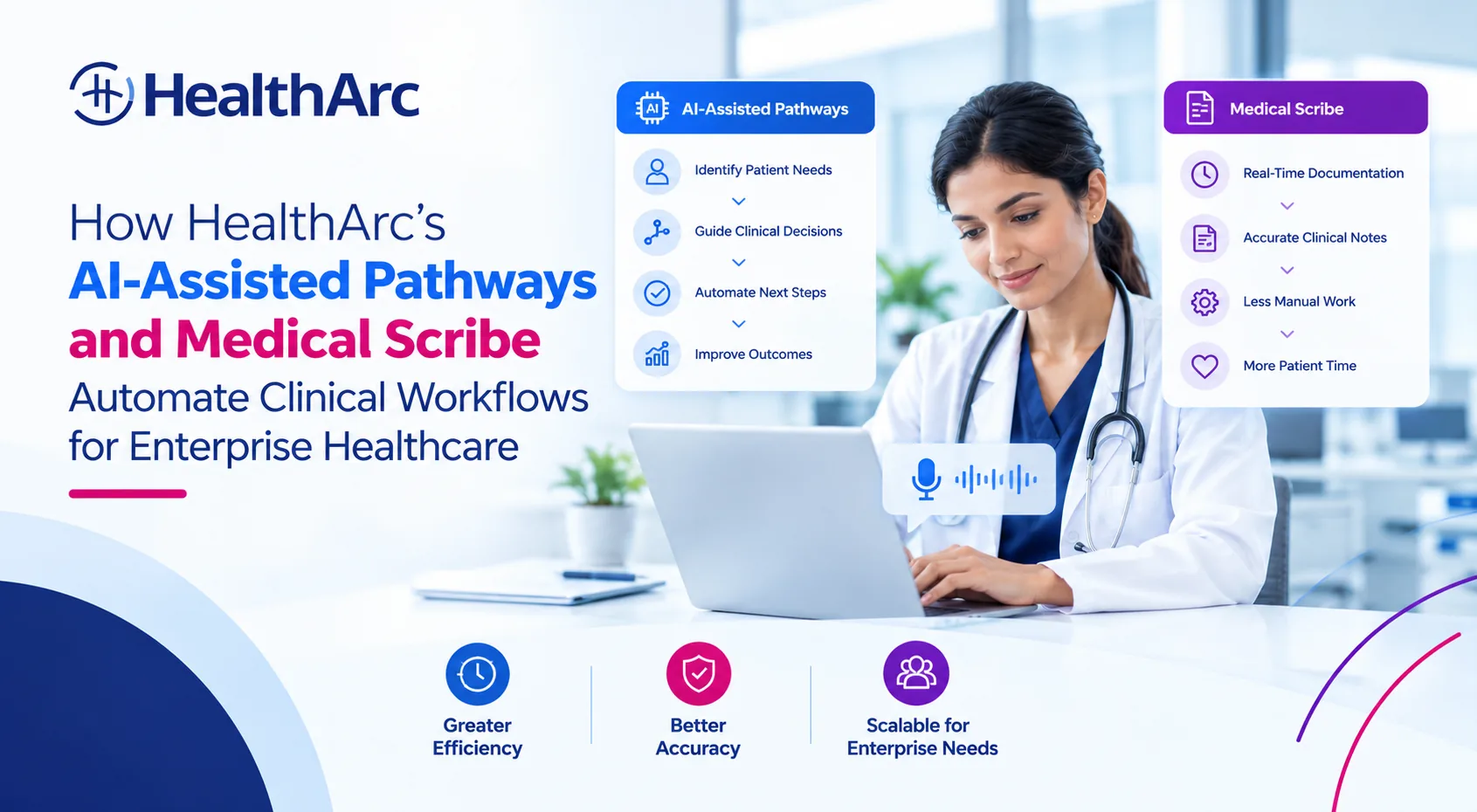
Quick answer: HealthArc’s AI-assisted care pathways read each patient’s device readings, diagnoses, program enrollment and billing calendar, then put the next clinical task in the care team’s queue with the reason attached. The medical scribe turns the work done on that task (readings reviewed, calls made, notes taken, minutes logged) into a program-specific draft note with suggested CPT or HCPCS codes, ready for a clinician to review and sign.
Both run on the same patient record across RPM, CCM, APCM, TCM and the other programs HealthArc supports, and both connect to the EHR so the chart stays the system of record.
Physicians in ambulatory practice spend nearly two hours on EHR and desk work for every hour they spend face to face with patients. That figure comes from a 2016 time-and-motion study in the Annals of Internal Medicine that observed 57 physicians across four specialties. Care management programs add their own layer on top: time logs, care plan updates and monthly notes for every enrolled patient.
Hiring more people doesn’t fix that. Across hundreds of providers and thousands of patients, the imbalance burns out staff, slows the revenue cycle and leaves compliance gaps a health system can’t afford.
Traditional EHR workflows were built to record care. They capture what happened after the fact. They don’t anticipate the next clinical action, surface the right protocol at the right moment, or write the documentation a care interaction just produced. Every gap between what the EHR does and what clinical teams need gets filled by human labor.
HealthArc’s AI-assisted pathways and medical scribe are built to close that gap at enterprise scale. The AI sits inside the clinical workflow itself. It drafts documentation as care happens, triggers condition-specific protocols, and surfaces alerts so care teams don’t have to hunt for them.
Below, we cover how each capability works, how it connects to your EHR, and what an enterprise rollout looks like across RPM, CCM and value-based care programs.
What Problem Does Clinical Workflow Automation Need to Solve?
“Clinical workflow automation” gets applied to everything from appointment reminders to fully agentic AI. So it’s worth being precise.
For a health system managing thousands of chronic care patients across several sites, the problem has three parts:
- Documentation volume. Care managers, nurses and physicians must produce compliant documentation for every patient interaction across RPM, CCM, TCM and APCM. Each program has its own time rules, note structure and billing triggers. Doing all of it by hand doesn’t scale.
- Care coordination latency. When a patient’s readings show a worsening trend, the time between the reading and a clinical response depends on how fast a person reviews it. At volume, review queues create dangerous delays.
- Protocol adherence at volume. Condition-specific pathways for hypertension, diabetes, COPD, heart failure and other conditions need to run the same way for every patient, every month. Manual tracking breaks down as panels grow.
Key insight: In Oliver Wyman’s 2026 Healthcare RCM Survey of more than 200 decision-makers at US provider organizations, ambient documentation, clinical documentation improvement (CDI) and coding automation rose to the top of the AI investments leaders called “no-regret.” The same article cites studies showing reductions of up to nearly 46% in coding time for complex cases.
That’s the context these features work in. They change how clinical work gets triggered, done and recorded. A productivity add-on bolted to the side of the old workflow would leave all three problems in place.
How Do AI-Assisted Care Pathways Work?
HealthArc’s AI-assisted care pathways act as a dynamic rules engine on top of the platform’s patient data. Care managers don’t get a static checklist. The system looks at each patient’s current readings, program enrollment, conditions and contact history to decide what the next clinical action should be, and when.
Condition-specific pathway logic
Each pathway is built around a condition’s clinical evidence base. Take a patient in a chronic care management (CCM) program whose primary diagnosis is type 2 diabetes. The pathway engine keeps checking:
- Blood glucose readings from connected cellular devices against patient-specific thresholds
- Medication adherence signals from patient-reported data
- Time since the last clinical touchpoint, measured against program requirements
- Upcoming billing deadlines, such as the 20-minute monthly minimum for CPT 99490
When any of these crosses a set threshold, the system creates a prioritized task in the care team’s queue. It isn’t a generic reminder. The task carries the clinical context that triggered it, the recommended intervention, and a documentation template already filled with the relevant patient data.
Patients with more than one condition
Enterprise panels rarely have single-condition patients. Someone enrolled in both RPM and CCM for hypertension and heart failure generates signals from two condition engines at once. HealthArc rolls these into one care team view. That prevents duplicate outreach and conflicting protocols, and nobody has to manage two separate program workflows for one person.
“To scale AI effectively, healthcare organizations must move beyond single-point applications and take a truly end-to-end, enterprise-wide approach that builds trust, safeguards patient outcomes, and embeds AI into core clinical and operational processes.”
KPMG, Intelligent healthcare report, 2026
Consolidation matters most for health systems running APCM, where patients are stratified by complexity and care intensity has to match the tier. The pathway engine reads each patient’s tier and adjusts how often, and how deeply, the team makes contact.
How alerts get escalated
Not every trigger needs the same response. HealthArc’s escalation logic separates four kinds of alert:
| Alert type | Trigger example | System response |
|---|---|---|
| Routine task | Monthly CCM time threshold approaching | Task queued for the care manager |
| Clinical alert | Blood pressure reading above the patient’s set threshold | Immediate notification to the supervising clinician |
| Escalation alert | Several consecutive out-of-range readings | Escalation pathway that requires physician review |
| Billing alert | Program time requirement unmet with 5 days left in the period | Priority task flagged in the billing workflow |
Clinical urgency decides what gets looked at first. Queue order doesn’t. When one care team covers hundreds of patients, that ordering is what separates early intervention from crisis management.
What Does HealthArc’s Medical Scribe Do?
The pathway engine tells care teams what to do next. The medical scribe records what was done and turns it into compliant clinical documentation, with no manual note entry.
How the scribe captures and structures an interaction
The scribe works from the inputs a care interaction produces: patient-reported data, device readings, care manager notes and structured answers to clinical questionnaires. It combines them into a structured note that fits the documentation rules of the relevant program.
For a remote patient monitoring interaction with a patient who has hypertension, the scribe assembles:
- Vital data summary: the blood pressure trend over the review period, flagged readings, and a comparison with the target range
- Patient communication log: a time-stamped record of outreach attempts and patient responses
- Clinical assessment: pre-filled with the care manager’s documented observations and any protocol-driven recommendations
- Time tracking: billable time added up automatically across every interaction type in the billing period
- CPT code suggestions: based on time logged and services delivered, surfaced for human review
The result is a complete, compliant record that’s ready for physician review. The care manager doesn’t spend 15–20 minutes building it by hand after each call.
Note templates by program type
Each program documents differently, so the scribe keeps a separate note structure for each one. That way the note always meets the requirements of the code being billed.
| Program | Main documentation requirements | Scribe output |
|---|---|---|
| RPM (99457, 99458, 99470) | Monthly treatment-management time (20 minutes for 99457, 10 minutes for 99470 from 2026), device data review, clinical response | Time-tracked interaction log, device data summary, clinical note |
| CCM (99490, 99439) | 20+ minutes of monthly care management, care plan documentation | Care plan update, interaction summary, time attestation |
| Complex CCM (99487) | 60+ minutes, moderate-to-high complexity, care plan revision | Full clinical note with complexity justification |
| APCM (G0556–G0558) | Billed by complexity tier with no time requirement; care plan and coordination records | Tier-appropriate note with a coordination record |
| TCM (99495, 99496) | Interactive contact within 2 business days of discharge, face-to-face visit, care plan, coordination | Discharge summary integration, contact log, care plan |
For the code-level rules behind each row, see the RPM, CCM and TCM CPT code references.
Does the scribe replace physician review?
No. It shortens it. Once a care manager finishes an interaction and the scribe drafts the note, the draft goes to the supervising physician’s review queue with a structured summary of the key findings. The physician reviews it, annotates if needed, and signs. That usually takes minutes, compared with the back-and-forth of reviewing hand-built notes.
Why it matters at enterprise scale: a physician supervising 200 chronic care patients can’t realistically review a hand-written note for every monthly interaction. With structured drafts, that review becomes workable without giving up compliance or clinical accuracy.
How Does It Integrate With Epic and Other EHRs?
A clinical AI platform is only useful if it works inside the infrastructure you already run. Enterprise health systems usually run Epic, Oracle Health (Cerner), athenahealth or MEDITECH, and a new platform has to connect without disrupting those workflows or creating a data silo.
HealthArc connects with 55+ EHRs through two-way data exchange. Patient data flows in from the EHR to inform pathway decisions. Completed documentation flows back out so the chart stays the single source of clinical truth. Each supported EHR has its own page and setup guide in the EHR integrations directory, including Epic and athenahealth.
How the two-way EHR sync works
- Patient data ingestion. Demographics, problem lists, active medications, care plan elements and encounter history are pulled from the EHR at enrollment and refreshed on a set schedule. Pathway logic always works from current clinical context.
- Real-time device data. Cellular RPM devices send readings straight to HealthArc, where they’re checked against patient-specific thresholds as they arrive. Readings that trigger an alert show up on the care team dashboard right away, with no EHR navigation.
- Documentation write-back. Once a note is completed and signed in HealthArc, it’s sent back to the EHR as a structured document, wherever that EHR’s API accepts write-back. The full encounter record stays in your primary system. That removes the double-documentation problem many point-solution integrations create.
Exactly which fields move each way depends on the EHR and its API. The setup guide for each EHR lists them.
HIPAA compliance and data security at scale
Enterprise deployments need more than a working integration. They need security that meets HIPAA and the health system’s own governance standards. HealthArc keeps data HIPAA compliant in transit, at rest and at the access layer (see our security and compliance page and the guide to SOC 2 and HIPAA for RPM). Role-based access controls mean care managers, physicians, billing staff and administrators see only the data their job requires.
For health systems in several states, this has real operational weight. A care manager at a New Jersey clinic shouldn’t see patient records from a Texas location unless their role requires it. HealthArc enforces those boundaries for each individual user, on top of the organization-level controls.
For IT leaders: KPMG’s 2026 report names interoperability as a core requirement for scaling clinical AI: “Design AI solutions that can seamlessly integrate with existing EHRs, imaging systems and clinical workflows. Focus on scalability and interoperability across departments.”
KPMG, Intelligent healthcare report, 2026
What Changes When AI Pathways and the Scribe Run at Scale?
Architecture matters. Enterprise buyers also need to know what changes day to day. The effects show up in three places: care team capacity, billing and compliance.
Care team capacity
Without pathways, a care manager’s day is mostly reactive. They review incoming device data, decide who needs outreach, make the calls, then document each one by hand. At a panel of 80 to 100 patients per care manager, that workflow is already full. More patients means more headcount.
With automated pathways and scribe-drafted notes, that changes:
- Pathway alerts replace manual data review, so nobody spends the morning scanning dashboards for problems
- Pre-filled note templates cut post-interaction documentation from 15–20 minutes to 3–5 minutes of review and sign-off
- Billing triggers appear on their own, which ends the end-of-month scramble to find patients short of their program time
In practice, care managers can carry larger panels without a matching jump in admin work. For an enterprise health system, programs grow without costs growing in step.
Billing accuracy and revenue capture
Documentation quality decides reimbursement accuracy. Incomplete notes, missing time attestations and the wrong CPT code are the main causes of denials in RPM and CCM programs. Adoption is already broad: an HFMA poll cited by Oliver Wyman found that 63% of healthcare organizations have built AI-powered automation into their revenue cycle workflows.
The scribe tackles documentation quality directly. Notes are structured to meet payer requirements before they reach the billing queue. The code suggestion engine cross-checks time logged, services delivered and patient complexity to surface the most accurate code for each encounter. That reduces under-coding, which leaks revenue, and over-coding, which creates compliance risk.
For a health system billing RPM, CCM and APCM at the same time, consistent accuracy across thousands of monthly claims is a meaningful financial gain over manual billing. You can model the program revenue for your own panel with the revenue calculator.
Compliance and audit readiness
CMS audit risk is a standing worry for health systems running large remote care programs. The rules for RPM and CCM are specific. Time must be tracked. Care plans must be current. Patient consent must be documented. Notes must reflect the services billed.
Scribe-drafted documentation leaves an audit trail that’s complete by design. Because notes are built from structured inputs instead of free text, they’re consistent, time-stamped and traceable to the interactions behind them. For compliance officers and legal teams, that’s a very different risk profile from hand-written notes that vary in completeness from one care manager to the next.
The same structure supports care gap closure and broader clinical workflow improvement across virtual care management programs.
How Long Does an Enterprise Rollout Take?
A single-site program usually goes live in about 30 days. A multi-site health system needs more structure: onboarding, clinical configuration and change management, run in three phases. Here’s what each one involves.
Phase 1: Program configuration and EHR integration (weeks 1–6)
- EHR integration setup. HealthArc’s implementation team configures the two-way data exchange with your EHR, mapping demographics, problem lists and care plan data to HealthArc’s data model.
- Enrollment criteria. Clinical and operational leaders define the patient population for each program (RPM, CCM, APCM, TCM), including eligibility, device assignment and consent workflows.
- Pathway configuration. Condition-specific rules are set to match your clinical protocols. Alert thresholds, escalation logic and care team routing are all decided here.
- User roles. Care managers, supervising physicians, billing staff and administrators get role-appropriate access.
Phase 2: Pilot and scribe calibration (weeks 7–12)
A controlled pilot with a defined patient group tests the pathway logic and the scribe’s output before full rollout:
- Care managers use the platform with part of their panel and give feedback on alert relevance and note accuracy
- Scribe-drafted notes are compared with hand-written ones for completeness and compliance
- The billing team checks CPT suggestions against the services actually delivered, to calibrate the suggestion engine
- Thresholds and templates are adjusted before full deployment
Phase 3: Full rollout and ongoing tuning (month 4 onward)
Deployment across the whole patient population, with ongoing tracking of:
- Alert volume and clinical response rates, to catch pathways that fire too often or too rarely
- Note completion rates and time to signature
- Billing accuracy and denial rates by program
- Care manager panel size and throughput
The deciding factor at this stage is clinical governance. The technology is the easy part. Health systems that name a dedicated clinical operations lead to own pathway configuration, review alert patterns and drive improvement get better results than those that treat the platform as set-and-forget. This is the part we push hardest on during enterprise onboarding.
Why Build Clinical Operations on an AI-First Platform?
Healthcare AI has moved past scattered pilots. Oliver Wyman reports that 80% of health systems are now exploring, piloting or implementing generative AI tools for revenue cycle work, up 38 percentage points in under two years. Organizations that wait aren’t holding steady. They’re falling behind peers who already have AI in their workflows.
So the real question for an enterprise health system is which platform to adopt. It needs clinical depth, EHR connectivity and the ability to scale. A point solution that automates one workflow in isolation adds another integration and another data silo. What you need is one system where pathway management, the medical scribe, device data, billing automation and EHR connectivity work together.
That’s how HealthArc is built. The pathways and the scribe are core to how the platform runs care across every program it supports, from RPM and CCM to APCM and transitional care management. See how that plays out for hospitals and health systems, or compare HealthArc with your current vendor on our platform comparisons.
The organizations best placed to do well under value-based care are the ones whose clinical operations can scale, adapt and keep improving. AI-assisted pathways and a medical scribe are where that starts.
Want to see the pathways and scribe running in your own clinical environment? Book an enterprise demo and we’ll walk through deployment options for your program mix and patient population.
Frequently Asked Questions
What is an AI medical scribe?
An AI medical scribe is software that turns the information from a patient interaction into a structured clinical note, so clinicians don’t write it from scratch. HealthArc’s scribe uses device readings, care manager notes, questionnaire answers and the outreach log, and drafts a note that matches the documentation rules of the program being billed.
What are AI-assisted care pathways?
They’re condition-specific protocols that a rules engine runs automatically. HealthArc’s pathways check each patient’s readings, diagnoses, program enrollment and billing deadlines, then create a prioritized task for the care team with the trigger, the recommended action and a pre-filled note template.
Does an AI scribe replace physician review?
No. Every scribe-drafted note goes to the supervising physician’s queue with a summary of the key findings. The physician reviews, edits if needed and signs. The scribe cuts the time that review takes. It doesn’t remove the review.
Can an AI scribe suggest CPT codes for RPM and CCM?
Yes. HealthArc’s scribe totals billable time across the period and suggests codes such as 99457, 99458, 99470, 99490, 99439 or 99487 based on time logged, services delivered and patient complexity. A person on your team confirms each code before the claim goes out.
Does HealthArc integrate with Epic?
HealthArc connects with 55+ EHRs, including Epic and athenahealth, and each live integration has a setup guide in the EHR directory. Patient data flows in to drive pathways, and signed notes flow back to the chart wherever the EHR’s API supports write-back. The exact fields are confirmed during scoping.
Is AI-generated clinical documentation HIPAA compliant?
The documentation is covered by HIPAA like any other protected health information. What matters is how the platform handles it. HealthArc signs a BAA before any data moves, encrypts data in transit and at rest, and limits access by role, down to the individual user.
How long does it take to deploy AI pathways and the scribe?
A single-site program usually goes live in about 30 days. A multi-site enterprise rollout typically runs six weeks of configuration and EHR integration, a six-week pilot, then full deployment from month four.
Sources
- Sinsky C, Colligan L, Li L, et al. Allocation of physician time in ambulatory practice: a time and motion study in 4 specialties. Ann Intern Med. 2016;165(11):753–760.
- Oliver Wyman, AI’s impact on the healthcare revenue cycle (2026 Healthcare RCM Survey), May 2026.
- KPMG International, Intelligent healthcare: A blueprint for creating value through AI-driven transformation, June 2026.
This article describes HealthArc product capabilities for healthcare professionals and IT leaders. It isn’t billing, legal or clinical advice. Billing codes, time requirements and payment rules change; confirm current requirements with CMS and your Medicare Administrative Contractor. Time savings vary by program mix, configuration and staffing.


Ready to connect care between visits?
See how HealthArc runs RPM, CCM and seven more CMS programs — the platform, the devices and the clinical team — on a single demo.